
For millions of girls, puberty is a natural milestone that signals growth into adolescence. But for some, the first signs of breast development become the beginning of unimaginable pain.
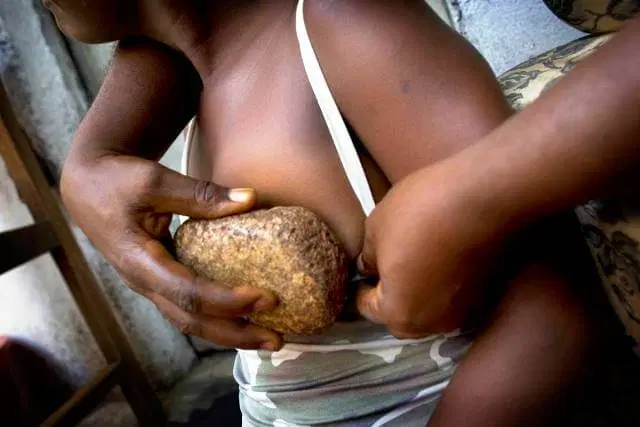
In parts of Africa, including Nigeria, a harmful traditional practice known as breast ironing or breast flattening continues to be carried out in secret. Under the guise of protecting girls from sexual harassment, early pregnancy, rape or child marriage, heated stones, pestles, wooden rollers, coconuts or metal objects are used to repeatedly pound, massage or flatten the breasts of young girls.
Medical experts, scientists and child rights advocates say the practice amounts to child abuse, causes severe physical and psychological harm and has no scientific basis.
Although awareness is gradually increasing, many cases remain hidden because the abuse is often perpetrated by mothers, grandmothers or female relatives who genuinely believe they are protecting their daughters.
The Tradition Behind the Practice
Breast ironing is usually performed on girls between the ages of eight and fifteen, immediately after breast buds begin to appear.
Families who practice it believe delaying breast development will make girls appear younger, discourage male attention and reduce the likelihood of sexual assault or early pregnancy.
However, experts argue that breast development is controlled by hormones and cannot be permanently stopped by external force.
Instead, they warn that the practice only inflicts pain while failing to address the real causes of sexual violence and child exploitation.
Survivors Speak of Lifelong Trauma
Many survivors describe breast ironing as one of the most traumatic experiences of their childhood.
An investigation by PUNCH revealed that victims continue to suffer years after the abuse, with many reporting chronic pain, body image issues, emotional distress and fear.
One survivor, Lysra Akon, recounted being subjected to breast ironing at the age of nine.
She recalled enduring unbearable pain without understanding why she was being punished.
Years later, she says the emotional scars remain as painful as the physical injuries.
Many survivors say they never discussed the abuse because they believed it was a normal cultural practice.
Others continue to experience shame, anxiety and difficulty forming intimate relationships.
What Science Says
Scientists have consistently rejected the belief that breast ironing protects girls.
According to researchers, breast development is regulated by hormones produced during puberty.
Professor Kathryn Yusoff, a developmental health researcher, explains that external pressure or heat cannot stop hormonal changes responsible for breast growth.
Medical literature published in the peer-reviewed journal Frontiers in Global Women’s Health describes breast ironing as a harmful traditional practice with no medical benefits.
Researchers state that while temporary swelling may reduce due to tissue damage, breast development eventually continues because hormones remain active.
Instead of delaying puberty, the practice destroys healthy tissue and increases the risk of permanent injuries.
A comprehensive review by researcher Fikrejesus Amahazion published in the National Library of Medicine describes breast ironing as a severe form of gender-based violence and a violation of children’s rights.
The review calls for stronger legislation, public education and support services for survivors.
Doctors Warn of Serious Health Consequences
Medical professionals say breast ironing exposes girls to numerous immediate and long-term health complications.
Clinical oncologist and Chief Clinical Coordinator of the NSIA-LUTH Cancer Centre, Dr. Habeebu Muhammad, says there is currently no scientific evidence proving that breast ironing directly causes breast cancer.
However, he warns that repeated trauma damages breast tissue, causes burns, infections, abscesses and permanent deformities.
According to him, severe injuries may complicate future breast examinations and delay diagnosis of other breast diseases.
Plastic surgeons also warn that extensive tissue damage may require reconstructive surgery in severe cases.
Other documented medical complications include:
- Severe burns
- Permanent scarring
- Chronic breast pain
- Tissue necrosis
- Breast deformity
- Cysts and abscesses
- Skin infections
- Difficulty breastfeeding
- Emotional trauma
The World Health Organization identifies harmful traditional practices such as breast ironing as preventable forms of violence against women and girls.
Psychological Damage Lasting Into Adulthood
Mental health professionals say emotional wounds often outlive physical injuries.
Clinical psychologist Adelowo Adesina explains that many survivors develop depression, anxiety disorders, low self-esteem and body dysmorphia.
He notes that girls often begin to associate their changing bodies with fear and punishment.
“This experience alters a child’s perception of safety and body image,” he explains.
“It can affect confidence, relationships and emotional wellbeing for decades.”
Psychiatrist Dr. Lizzy Etuk believes awareness campaigns should target both parents and community leaders.
According to her, comprehensive sexuality education and parental guidance remain far more effective than harmful cultural practices.
She argues that communities should teach boys to respect girls instead of forcing girls to alter their bodies.
Human Rights Perspective
Child rights organisations classify breast ironing as gender-based violence.
Legal practitioner and women’s rights advocate Josephine Effah-Chukwuma says the practice violates children’s rights to dignity, health and protection from violence.
She argues that society continues to punish girls for crimes committed by men.
“If the concern is sexual abuse, then the focus should be on preventing abuse and prosecuting offenders—not harming children,” she says.
Development expert Sumbo Oladipo also describes breast ironing as discrimination disguised as protection.
According to her, investing in girls’ education provides far greater protection than harmful cultural practices.
The Scale of the Problem
Reliable statistics remain difficult because the practice is usually hidden.
UNICEF estimates that thousands of girls across Central and West Africa have experienced breast ironing.
Cameroon remains the country where the practice has been most extensively documented, but studies indicate that it also occurs in Nigeria, Benin, Chad, Guinea, Togo and several other African countries.
Researchers believe the actual number of victims is significantly higher because many survivors never report the abuse.
Does Breast Ironing Prevent Pregnancy?
Experts unanimously say no.
Pregnancy results from sexual intercourse—not breast development.
Doctors explain that flattening the breasts neither delays puberty nor prevents ovulation.
Instead, comprehensive sexuality education, parental communication, safe school environments and strict enforcement of laws against rape and child marriage remain the most effective protective measures.
The Legal Framework
Nigeria’s Violence Against Persons (Prohibition) Act criminalises harmful traditional practices that cause bodily harm.
Several states have also domesticated child protection laws prohibiting violence against children.
Internationally, breast ironing violates provisions of:
- The United Nations Convention on the Rights of the Child.
- The Convention on the Elimination of All Forms of Discrimination Against Women (CEDAW).
- The African Charter on the Rights and Welfare of the Child.
- The Maputo Protocol on the Rights of Women in Africa.
These instruments recognise every child’s right to protection from harmful traditional practices.
Experts Recommend a Way Forward
Health professionals and researchers recommend replacing harmful traditions with evidence-based interventions.
These include:
- Community awareness campaigns.
- Comprehensive sexuality education.
- Stronger enforcement of child protection laws.
- Support services for survivors.
- Greater access to mental health care.
- Improved prosecution of sexual offenders.
- Keeping girls in school.
- Engaging religious and traditional leaders to challenge harmful cultural beliefs.
Researchers also urge governments to strengthen data collection to better understand the prevalence of breast ironing and design targeted interventions.
Conclusion
Breast ironing persists because of fear—fear of sexual violence, unwanted pregnancy and social stigma. Yet experts agree that the practice does not eliminate these risks. Instead, it inflicts physical pain, emotional trauma and lifelong scars on girls whose only “offence” is entering puberty.
As scientific evidence continues to mount, medical professionals, psychologists and child rights advocates insist that protecting girls should never involve harming their bodies. The real solution, they argue, lies in education, stronger laws, community engagement and ensuring that those who prey on children—not the children themselves—are held accountable.