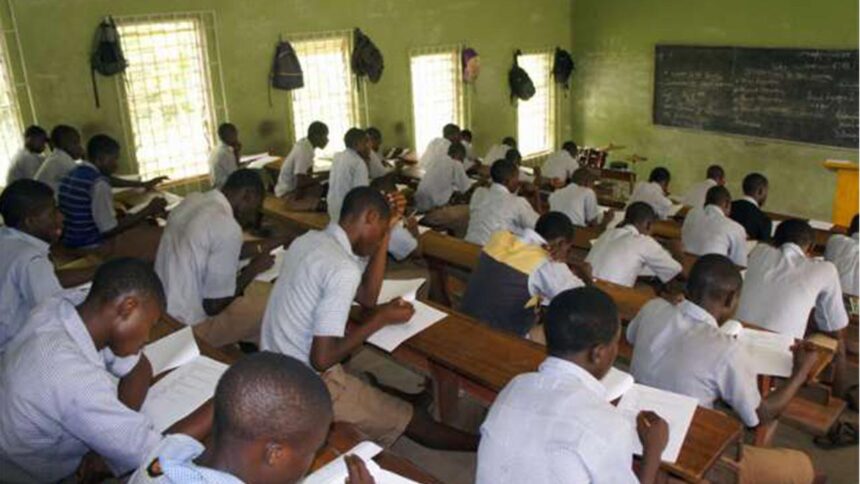
The Federal Government’s approval of a new N50,000 registration fee for the West African Examinations Council (WAEC) and the National Examinations Council (NECO) Senior School Certificate Examinations (SSCE) has triggered widespread concern among education stakeholders, who warn that the policy could force more Nigerian students out of school.
The new fee, approved by the Federal Ministry of Education, will take effect from the 2027 NECO Senior School Certificate Examination (Internal) and represents an 82 per cent increase from the current registration fee of N27,500.
The approval was contained in a letter dated June 18, 2026, signed by the Director of Senior Secondary Education, Adeniji Ibrahim, following a request by WAEC for an upward review of examination fees.
According to the ministry, the decision followed a meeting held on March 31, 2026, between the Minister of Education and examination bodies, where both WAEC and NECO were directed to adopt a uniform examination fee for the Senior School Certificate Examination.
The ministry said the increase was necessary to address the rising cost of conducting public examinations, including logistics, security, printing of examination materials, technology deployment, supervision and administration.
The Director of Press and Public Relations at the Federal Ministry of Education, Folasade Boriowo, confirmed that the approval had been granted.
While the government maintains that the review is essential to sustain the quality and integrity of public examinations, education experts and stakeholders argue that the increase could deepen Nigeria’s education crisis.
The National Mobilisation Officer of the Education Rights Campaign (ERC), Adaramoye Michael Lenin, described the policy as counterproductive, saying it contradicts government efforts to reduce the country’s out-of-school children population.
“This increase will not solve the out-of-school crisis; rather, it will worsen it. Many struggling parents may withdraw their children from school because they simply cannot afford the examination fees,” he said.
Lenin urged the government to reverse the decision, arguing that education should remain affordable and accessible to all Nigerians.
Similarly, the President of the National Association of Proprietors of Private Schools (NAPPS), FCT Chapter, Dorothy Okwuenu, warned that the increase could undermine efforts to improve school enrolment and retention.
She noted that many parents are already burdened by rising costs of tuition, transportation, uniforms and learning materials, adding that the new examination fee would further strain household finances.
According to her, states that currently sponsor WAEC and NECO candidates may also face significant budgetary pressure in sustaining such interventions.
Dr. Mary Chinwuba, Executive Director of Chalcedony Prime School, Abuja, expressed concern that students from low-income families could be denied the opportunity to complete their secondary education.
She said the sharp increase would widen educational inequality by making certification more accessible to wealthy families while excluding economically disadvantaged students.
The Proprietress of The Winners Joy International Academy, Kubwa, Rosemary Onyenagubo, echoed similar concerns, saying quality education is gradually becoming unaffordable for ordinary Nigerians.
“Many families are already struggling to survive. This increase may force students to abandon their education because their parents cannot afford the fees,” she said.
The policy has also drawn criticism from the African Democratic Congress (ADC) presidential candidate, Atiku Abubakar, who described the fee increase as “economically insensitive.”
In a statement issued by his media aide, Phrank Shaibu, Atiku argued that imposing higher education costs at a time of soaring inflation, unemployment and declining household incomes would deny many Nigerian children access to education.
He said education remains one of the most effective pathways out of poverty and warned that additional financial burdens on parents could worsen social inequality.
Adding another dimension to the debate, an old video of President Bola Ahmed Tinubu during his tenure as Governor of Lagos State resurfaced online.
In the 2001 video, Tinubu explained that his administration decided to pay WAEC examination fees for Lagos students after discovering that many parents could not afford the charges, which ranged between N1,000 and N2,000 at the time.
He recalled meeting schoolchildren hawking goods after school and concluded that government intervention was necessary to prevent poverty from denying children access to education.
Education stakeholders are now urging the Federal Government to introduce financial support measures, scholarships or targeted subsidies for vulnerable students if the new examination fee is to be implemented.
They warn that without adequate intervention, the increase could reverse gains made in improving school enrolment and further expand Nigeria’s already large population of out-of-school children.