Unemployment remains one of the most pressing challenges facing Nigeria today as thousands of graduates leave universities, other higher institutions, NYSC with hopes of securing stable jobs and building successful careers.
Unfortunately, many of them are met with disappointment as job opportunities remain limited and competition in Labor market continues to increase.
The question is “Are Nigerians themselves responsible for the high rate of unemployment, or should the government be blamed?”
While many citizens point fingers at poor performance for the lack of economic opportunities, others argue that some job seekers possess certificates but lack the practical skills required in modern workplaces. The reality is that both factors contribute significantly to the unemployment crisis.
One of the major problems lies within the educational system. In many institutions, students are exposed more to theoretical knowledge than practical experience yet struggle to apply their knowledge in real situations.
As a graduate of History and Diplomatic Studies, I had such experience. When it comes to the theoretical knowledge, I was good but, I had little to no political experience, this is because my lecturers prioritized the theoretical form more than the practical aspect. Therefore, I didn’t know my strengths and weakness until I got a job that opened my eyes and now, I am relearning a lot of things.
During interviews, employers often discover that some candidates lack communication skills, confidence, problem-solving ability and digital competence despite having impressive qualifications.
A major cause of this issue is the disconnect between education and industry needs, students often graduate without internships, practical exposure, or relevant skill development.
At the same time, some young people rely only on white collar job expectations and ignore vocational or digital skill opportunities.
What are Skills?
Skills are abilities, knowledge, and experience a person develops to perform tasks effectively. They help people do things well in their school, work, business, communication, sports and everyday life.
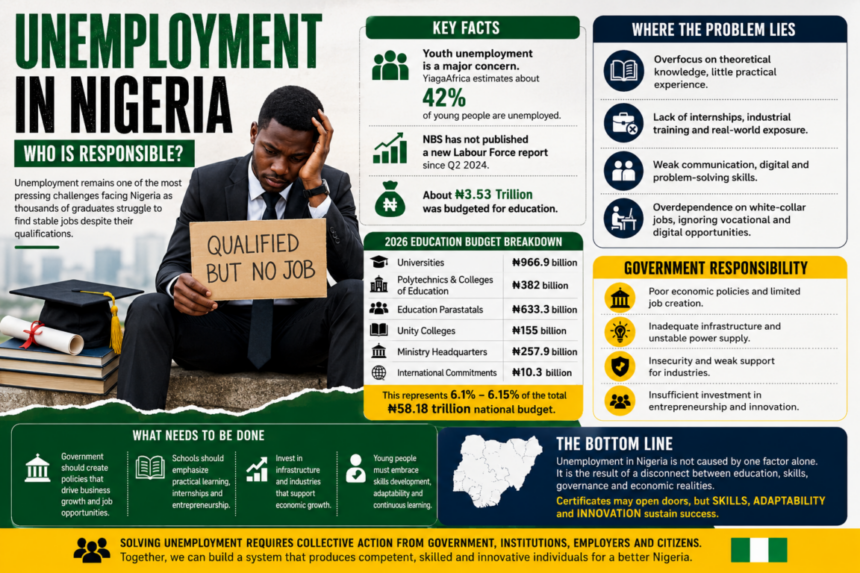
According to the National Bureau Statistics (NBS) has not published a new Labor Force report since the second quarter (Q2) of 2024.
This means that the most recent data remains the 4.3% figure for over a year and a half ago. YiagaAfrica, says about 42% people are unemployed in the young workforce.
According to the development Research and Project Center, it says about 3.53 trillion was budgeted for education. Below is the breakdown:
- Universities: 966.9 billion naira
- Polytechnics and Colleges of Education: 382 billion naira
- Education Parastatals: 633.3 billion naira
- Unity Colleges: 155 billion naira
- Ministry Headquarters: 257.9 billion naira
- International Commitments: 10.3 billion naira
- This represents 6.1% to 6.15% of the total 58.18 naira trillion of national budget.
The growing gap between qualifications and practical skills has become a major concern in Nigeria Labor Market. Employers today are not only searching for certificates; they are looking for individuals who can think it critically, adapt quickly, communicate effectively, and contribute meaningfully to organizational growth.
However, the government also carries a significant portion of the responsibility. Poor economic policies, inadequate support for industries, unstable power supply and limited investments in entrepreneurship have reduced job creation opportunities across the country. Even skilled individuals often struggle to find employment because the economy cannot absorb the large number of job seekers entering the work force yearly.
Addressing unemployment in Nigeria therefore, requires collective effort. The government must prioritize educational reforms, create policies that encourages business growth, and invest in infrastructure that supports employment opportunities. Schools should emphasize practical learning, internships and entrepreneurship alongside academic studies.
Unemployment in Nigeria is not simply a result of laziness among citizens or failure by the government alone. It is the outcome of a disconnect between education, skills, governance and economic realities. Certificates may open doors, but practical skills, adaptability and continuous learning are what sustain success in the modern workforce.
For Nigeria to truly overcome unemployment, both the government and the people must work together to build a system where education produces not just graduates, but competent and innovative individuals ready to contribute to national development.
Now the question is who is really responsible, the Citizens, the Government or the Educational system?