
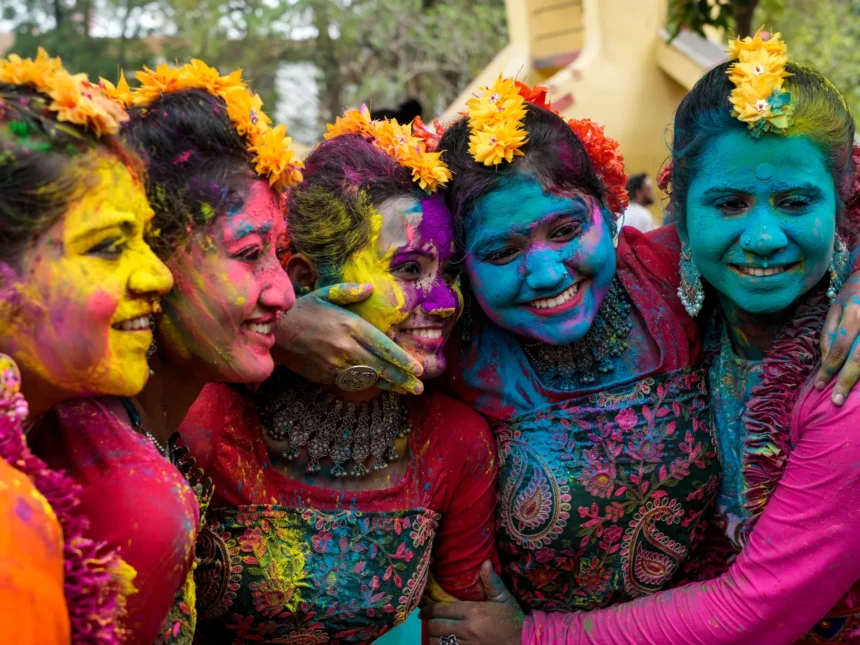
The Holi Festival in India is one of the most vibrant cultural celebrations in the world, and it marks the arrival of spring with color, joy, and unity.
Across the country, the Holi Festival in India brings people together through music, food, traditions, and the symbolic victory of good over evil.
Importantly, Holi celebrates joy, unity, and the arrival of spring. It also symbolizes the victory of good over evil and the renewal of life. Because of this, millions of people see it as more than a festival. Instead, they see it as a shared experience of happiness.
On the eve of Holi, communities gather for Holika Dahan. First, they light large bonfires in open spaces. Then, families sing, pray, and share stories around the flames. This ritual remembers the story of Holika and represents the victory of good over evil.
As the fire burns, people reflect on the past year. At the same time, they let go of negativity and prepare for a fresh start. Therefore, the night feels both spiritual and hopeful.
The next morning, everything changes life becomes color.
People step outside wearing white clothes. Almost immediately, they become covered in bright powders called gulal. Red, yellow, green, pink, and blue fill the air. Friends chase each other, and strangers laugh together in the streets.
As a result, normal social boundaries disappear. Age, status, and background no longer matter. Instead, people connect through joy and shared celebration.
Each color carries meaning. For example, red represents love and fertility. In addition, green stands for renewal and rebirth. Meanwhile, blue is linked to Lord Krishna.
Together, these colors show the beauty of spring. More importantly, they reflect life’s constant cycle of change and renewal.
No festival in India feels complete without food. During Holi, families prepare special dishes. For instance, they make gujiya, a sweet pastry filled with nuts and dried fruits. They also serve thandai, a chilled milk drink flavored with spices.
Furthermore, people share food with neighbors and guests. Because of this, homes feel warm, welcoming, and full of connection.
Although Holi happens across India, some places make it unforgettable.
In Mathura and Vrindavan, celebrations feel deeply spiritual. These cities connect closely with the life of Krishna. As a result, festivals here last for days and fill temples with music, devotion, and color.
Meanwhile, in Jaipur and Udaipur, Holi becomes more royal. Palaces host cultural shows, folk music, and traditional events. Therefore, the festival feels both grand and historic.
In eastern India, Shantiniketan offers a calmer version called Basanta Utsav. Inspired by Rabindranath Tagore, it focuses on music, poetry, and dance. In addition, people wear yellow to welcome spring.
Ultimately, Holi is not only about color. Instead, it is about connection. It brings people together, even if they are strangers. It also encourages forgiveness and joy.
Because of this, the festival feels powerful and deeply human.
As the sun sets, the colors slowly fade. However, the memories remain. Clothes may stay stained, but hearts feel lighter.
In the end, Holi leaves something behind that cannot be washed away easily—shared joy, new bonds, and a sense of renewal.
For anyone who wants to understand India, Holi is a doorway. It is colorful, loud, emotional, and deeply meaningful. Most importantly, it shows how celebration can unite an entire country in one powerful moment.