
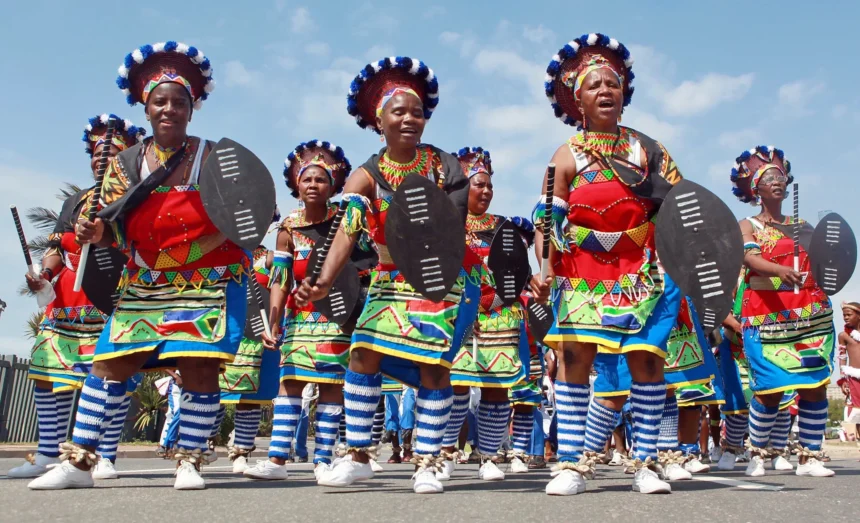
In South Africa, a nation of many vibrant cultures, one powerful rhythm echoes through the green hills of KwaZulu-Natal, specifically, it is the heartbeat of the Zulu people, the amaZulu,whose name translates to “heaven”.
Today, the Zulu form South Africa’s largest ethnic group. To step into their world is to see a beautiful balance between a fierce warrior history and a lively modern culture.
Initially, the Zulu nation began as a small, minor clan during the ancient Bantu migrations. Around 1816, however, a brilliant leader named King Shaka changed everything. He united scattered chiefdoms into a massive, imposing empire. Furthermore, Shaka created a permanent army and invented new battle tactics, such as the famous encirclement strategy. As a result of this expansion, the map of Southern Africa was altered forever.
Consequently, the days of vast imperial conquest are now over, but the proud warrior spirit still remains. For example, you can see this legacy clearly within traditional households. Young boys still learn their warrior heritage early through the fast-paced sport of stick-fighting. Moreover, the culture highly values honor in times of conflict. Therefore, people sometimes settle deep social disputes through physical duels, which end immediately as soon as the first blood is drawn.
In addition to their warrior traits, the Zulu people possess a delicate and clever visual language: the art of beadwork. In a Zulu community, a necklace is never just a decoration. Instead, it acts as a written letter, a relationship status update, and an emotional message. Overall, the craft uses seven distinct colors to express feelings, status, and spirituality.
Most importantly, shapes tell the story of the heart:
-
The Triangle: The direction of the tip shows whether a person is married or single.
-
The Diamond: Married women wear two triangles joined base-to-base, which subsequently symbolizes fertility.
-
The Hourglass: In contrast, married men wear two triangles joined tip-to-tip.
Meanwhile, colors also speak loudly to the community. Single women wear white beads to represent purity, while men wear green beads to show total contentment. Because of these strict meanings, local market shoppers must be careful! Buying the wrong pattern might accidentally tell locals that you are looking for a spouse.
Similarly, music and movement bring Zulu celebrations to life. The deep boom of the ingungu drum accompanies almost every major milestone, from a girl’s transition into womanhood to weddings. Naturally, every special event has its own unique dance:
-
The Hunting Dance: First, warriors carry spears to find courage before a hunt.
-
The Royal Dance: Next, men carry small shields to show military unity for the king.
-
The Indlamu: During weddings, two dancers stomp the earth wildly to loud drumbeats.
-
The Reed Dance (Umhlanga): Finally, once a year, thousands of unmarried young women dance while holding long reeds high above their heads to show pride in their nation.
Likewise, traditional Zulu clothing is minimalist and sustainable. The outfits openly reflect a person’s age and social standing. For instance, young, available girls keep their hair short and wear short skirts made of grass and beads. Once engaged, however, women grow out their hair and cover their bodies to show respect to their future in-laws. Eventually, married women wear heavy, knee-length cowhide skirts and traditional hats.
Meanwhile, men use animal skins and feathers to show their military status. Regular men wear simple hide coverings on their upper and lower bodies. In contrast, only tribal chiefs and the royal family may wear the majestic skin of the leopard.
Even at dinner, the Zulu people maintain a simple life. Despite living near abundant wildlife, their daily diet is mostly vegetarian. They treat the ox with immense respect and only sacrifice it during major life events to honor their ancestors. Instead, women tend the hearth to make daily staples like fermented milk and pap (a warm maize porridge). Furthermore, they brew the community’s traditional beer. When meat is served during celebrations, older men of high social status receive the largest portions.
Ultimately, by blending an ancient respect for ancestors with modern life, the amaZulu prove that true strength comes from wearing your heritage with pride.