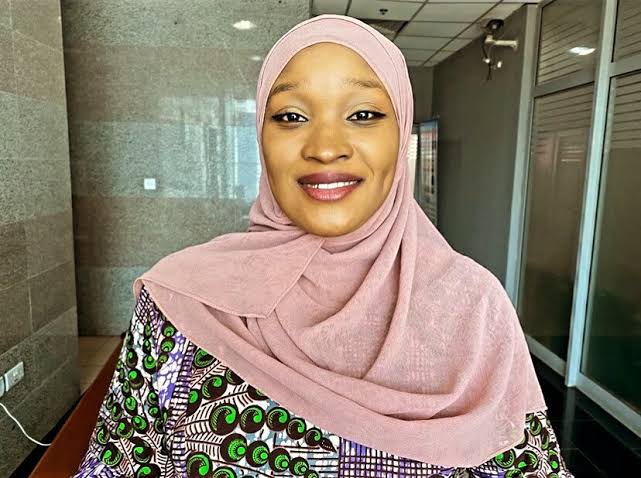
Award-winning Nigerian broadcast journalist, Zainab Bala Modibbo has recounted her experience navigating the media industry as a Muslim woman who chose to wear the hijab.
Based in Abuja, Zainab is known for people-centred journalism and storytelling focused on underrepresented communities across Africa. Through her work, she has sought to give visibility to people and communities whose experiences often receive limited attention in mainstream media.
In a recent podcast appearance on the HSM Tribe Cast, Zainab spoke about her journey as a hijabi journalist and the barriers she encountered while pursuing opportunities in the broadcast industry.
According to her account, her Muslim identity and decision to wear the hijab became a challenge at certain stages of her career, particularly in an industry where television presenters are often expected to conform to particular standards of appearance.
One of the experiences she highlighted occurred in 2023, when she secured an opportunity with BBC Africa through a partnership with Channels Television.
Zainab said she attended the interview wearing her hijab and was asked whether, if selected, she would be comfortable presenting the programme while keeping her head covered.
She said she made her position clear that she would continue wearing her hijab.
After securing the opportunity, however, she said the situation became more complicated.
According to her account, she was informed by her editor to prepare for her first episode of the programme. But after preparing for the assignment, the programme was not aired for about three weeks.
Concerned about the delay, she said she reached out to find out whether there was a problem. She recalled receiving indirect responses while also hearing rumours about the reason her appearance had not been broadcast.
Zainab said the matter eventually became clearer when the BBC West Africa editor contacted her.
According to her account, she was told that Channels Television had concerns about having a hijab-wearing woman appear on its screen, citing what she was told was the station’s policy.
The experience, she said, was emotionally difficult and became a major battle for her.
For a journalist who had worked hard to reach a major international platform, the situation represented more than a professional setback. It also raised questions about religious identity, representation and the extent to which media organisations accommodate diversity in their newsrooms and on-screen programming.
Zainab said the experience affected her emotionally and contributed to a period of depression.
However, rather than removing her hijab to preserve the opportunity, she maintained that her religious convictions were more important to her.
She made it clear that she would not compromise her faith or remove her hijab simply to meet a professional expectation.
For Zainab, the issue went beyond clothing. Her hijab was part of her religious identity, and she believed that succeeding professionally should not require her to abandon an important part of who she is.
Her experience has also placed renewed attention on the representation of Muslim women in the media.
For many women who wear the hijab, entering professions where appearance and public presentation are significant can sometimes involve navigating assumptions about competence, professionalism and identity.
Zainab’s story illustrates the tension that can emerge when professional expectations intersect with religious expression.
At the same time, her career demonstrates the contribution that journalists from diverse backgrounds can make when given opportunities to tell stories from different perspectives.
Her focus on underrepresented communities has made her work particularly relevant to conversations around inclusion, human rights and representation.
Beyond her own experience, Zainab’s story raises a broader question for the media industry: can newsrooms and broadcast platforms create environments where professional standards coexist with religious and cultural diversity?
The debate is particularly important in a multicultural country such as Nigeria, where people from different ethnic, religious and cultural backgrounds participate in public life.
Representation on television is not only about who tells the story. It is also about who is allowed to be visible while remaining authentic to their identity.
For Zainab, the decision appears to have been clear.
She chose to remain committed to her faith, even when doing so came with professional consequences.
Her story is therefore not simply about a journalist who faced a career challenge. It is also a story about identity, resilience, representation and the determination to pursue a professional career without compromising deeply held convictions.
As conversations around diversity and inclusion continue across Nigeria’s media industry, stories such as Zainab’s provide an opportunity to examine whether institutions are sufficiently representative of the society they serve.
For the journalist, however, the principle remains firm: professional ambition should not necessarily come at the expense of personal identity and religious conviction.
Zainab Bala Modibbo’s journey demonstrates the difficult choices some professionals face when their identity intersects with institutional expectations—and the determination required to remain true to one’s convictions when those choices become difficult.