
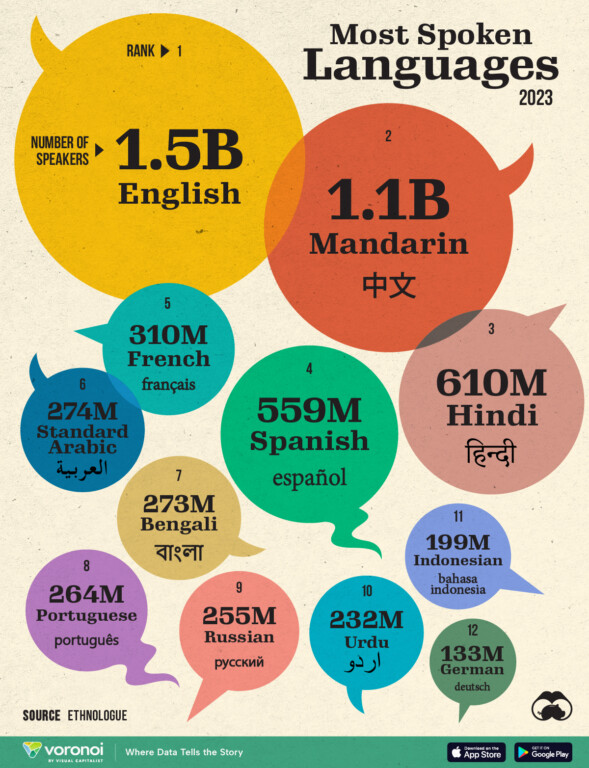
The world’s most spoken languages connect billions of people across continents as English, Mandarin, Chinese, Hindi, Spanish and Standard Arabic have enormous speaker populations, but their global reach comes from different histories, populations, cultures and regions.
But why do these languages have so many speakers? And where are they most widely spoken?
1. English: About 1.5 Billion Speakers
English has around 1.5 billion total speakers, making it one of the world’s most widely used languages.
Its strength comes partly from history. British colonial expansion carried English to different parts of Africa, Asia, the Caribbean and Oceania. Later, the economic and cultural influence of the United States helped push English even further around the world.
Today, English serves as a major international language in business, aviation, science, technology, education and diplomacy.
Major Regions
English is widely spoken in:
- North America — United States and Canada
- Europe — United Kingdom and Ireland
- Africa — Nigeria, Ghana, Kenya, South Africa and several other countries
- Asia — India, the Philippines, Singapore and other areas
- Oceania — Australia and New Zealand
- The Caribbean — Jamaica and several other English-speaking territories
English also has millions of second-language speakers who use it alongside their native languages.
2. Mandarin Chinese: About 1.1 Billion Speakers
Mandarin Chinese has roughly 1.1 billion total speakers and is the world’s most widely spoken native language.
Its huge population is closely connected to China’s enormous population. Mandarin serves as the official standard language of China and also has a major presence in Taiwan and Singapore.
The language developed from varieties of Chinese spoken across northern and southwestern parts of China. The spread of Standard Mandarin through education, government and mass media has helped make it a common means of communication among China’s diverse linguistic communities.
Major Regions
Mandarin is primarily spoken in:
- East Asia — Mainland China
- Taiwan
- Singapore
- Chinese communities around the world
Although Mandarin dominates the Chinese-speaking world, China itself contains many other languages and regional varieties.
3. Hindi: More Than 600 Million Speakers
Hindi has more than 600 million total speakers and is one of the most important languages in South Asia.
Its enormous speaker population is closely connected to India’s population and the widespread use of Hindi across northern and central parts of the country.
Hindi also has a strong presence in India’s entertainment industry. Bollywood films, television, music and digital media have helped carry Hindi beyond the regions where it is traditionally spoken.
Major Regions
Hindi is widely spoken in:
- Northern India
- Central India
- Parts of western and eastern India
- Nepal
- Indian diaspora communities around the world
Hindi exists within India’s remarkably diverse linguistic landscape. India has many major regional languages, including Bengali, Telugu, Marathi, Tamil and Gujarati.
4. Spanish: About 560 Million Speakers
Spanish has around 560 million total speakers, giving it an enormous geographical footprint.
Its global reach largely reflects Spain’s historical expansion into the Americas. Spanish became deeply established across Latin America and eventually developed into numerous regional varieties.
Today, Spanish is not confined to one continent. It connects people across Europe, North America, Central America, South America and parts of the Caribbean.
Major Regions
Spanish is widely spoken in:
- Europe — Spain
- North America — Mexico and the United States
- Central America — Guatemala, Honduras, El Salvador, Nicaragua, Costa Rica and Panama
- South America — Colombia, Venezuela, Ecuador, Peru, Bolivia, Chile, Argentina, Paraguay and Uruguay
- Caribbean — Cuba, Dominican Republic and Puerto Rico
The United States also has one of the world’s largest Spanish-speaking populations, making Spanish increasingly influential in North American culture and business.
5. Standard Arabic: About 330 Million Speakers
Standard Arabic has around 330 million total speakers and occupies a unique position among the world’s major languages.
Arabic stretches across a vast geographical area, from North Africa through the Middle East.
Modern Standard Arabic is widely used in formal settings, including government, education, news media and official communication. Everyday conversations, however, often take place in regional Arabic varieties that can differ significantly from one another.
Major Regions
Arabic is widely used across:
- North Africa — Egypt, Libya, Tunisia, Algeria, Morocco and Sudan
- The Middle East — Saudi Arabia, Iraq, Jordan, Lebanon, Syria, Palestine and other countries
- The Arabian Peninsula — Yemen, Oman, the United Arab Emirates, Qatar, Bahrain and Kuwait
Arabic also has an important cultural and religious influence far beyond native Arabic-speaking countries.
Why These Languages Have So Many Speakers
Population is one major factor.
Mandarin and Hindi benefit from the enormous populations of China and India. Spanish gained a vast international population through centuries of expansion across the Americas. Arabic connects dozens of countries across North Africa and the Middle East.
English followed a different path.
Its global dominance grew through British colonial history and later through the enormous international influence of the United States. Today, people learn English not only because they live in an English-speaking country but because it can provide access to education, employment, technology and international communication.
Geography also matters.
A language spoken across several countries can accumulate speakers much faster than one concentrated in a single small region.
Culture matters too.
Movies, music, television, literature and social media allow languages to cross borders. Spanish-language music, Hindi cinema, Arabic media and English-language entertainment all contribute to the global reach of their languages.
A World Connected by Language
The five languages represent more than numbers.
English connects people across continents. Mandarin reflects the scale and influence of the Chinese-speaking world. Hindi reflects India’s enormous population and cultural reach. Spanish links much of the Americas with Spain. Arabic connects a vast region stretching across North Africa and the Middle East.
Yet the numbers also tell only part of the story.
A language can have hundreds of millions of speakers while remaining deeply connected to local identity. At the same time, a language with fewer speakers can carry enormous cultural, historical and political importance.
Ultimately, the world’s most spoken languages show how population, history, migration, geography, culture and economic influence can shape the way humanity communicates.
And as migration, technology and globalisation continue to bring communities closer together, the map of the world’s languages will continue to evolve.