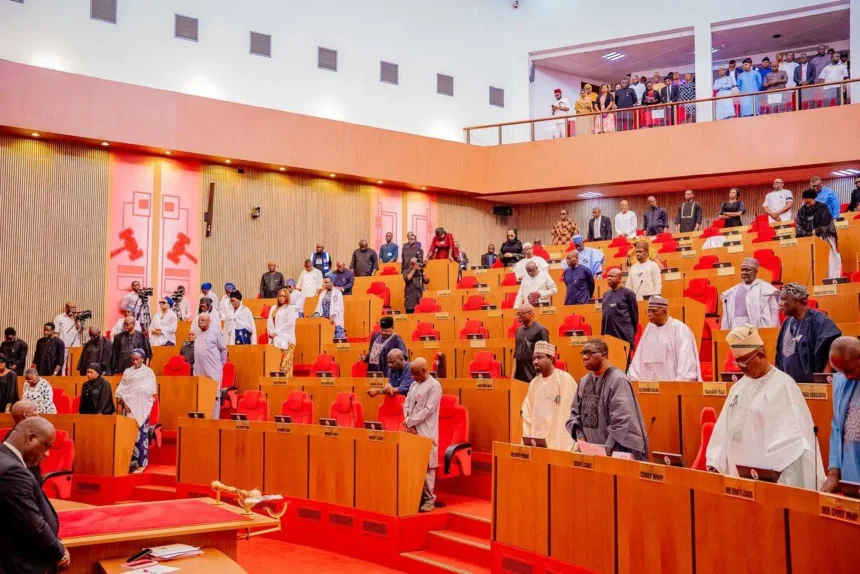
The debate over the establishment of State Police in Nigeria has intensified following the passage of a constitutional amendment bill by the Senate, with supporters describing it as a landmark step toward tackling the country’s worsening security crisis.
However, governance and security expert Suleiman Usman Yusuf believes the reform, while well-intentioned, could create more problems than it solves if implemented under the current political structure.
In an opinion article titled “State Police: Wrong Hands, Right Idea,” Yusuf argues that the country desperately needs a decentralised policing system but warns against placing control of armed police forces in the hands of state governors without first addressing longstanding issues of accountability, transparency and abuse of power.
According to him, Nigeria’s centralised policing model has repeatedly failed to respond effectively to insecurity across the country, particularly in the North-East, North-West, Middle Belt and other conflict-prone regions.
Communities have endured years of attacks by insurgents, bandits, kidnappers and criminal gangs while waiting for security responses that often arrived too late or failed to come at all.
Despite acknowledging these shortcomings, Yusuf insists that replacing one centralised system with another at the state level is not genuine decentralisation.
Instead, he argues that the proposed arrangement merely transfers excessive authority from the Federal Government to state governors, who already wield significant political influence within their states.
The security expert points to the management of security votes as one of the strongest reasons for caution. He notes that governors receive billions of naira annually in discretionary security funds that are largely exempt from public scrutiny and legislative oversight.
Over the years, allegations of diversion, misuse and poor accountability surrounding these funds have repeatedly surfaced, while insecurity has continued to worsen in many parts of the country.
Yusuf also raises concerns about the operation of existing state-backed security outfits, arguing that several have faced allegations of human rights abuses, political intimidation and excessive use of force.
He contends that giving governors direct control over state police commands without stronger institutional safeguards could expose security agencies to further political interference, particularly during elections.
The article further highlights Nigeria’s history of electoral violence, where security agencies have often been accused of intimidation, selective enforcement of the law and suppression of political opponents.
Yusuf warns that state-controlled police forces could become powerful tools for incumbent governors seeking to consolidate political control rather than protect citizens.
Rather than endorsing the State Police proposal in its current form, Yusuf advocates what he describes as a grassroots approach to security reform.
Central to his recommendations is the full implementation of the Supreme Court’s July 2024 judgment granting financial autonomy to local governments. He argues that stronger and financially independent local councils would be better positioned to coordinate community-based security initiatives and address conflicts before they escalate.
He also proposes reviving Local Government Peace and Security Committees, a framework previously used to facilitate community participation in conflict prevention and intelligence gathering.
According to him, these committees would allow traditional rulers, religious leaders, civil society organisations and community representatives to work closely with formal security agencies while remaining directly accountable to local communities.
Beyond local governance reforms, Yusuf calls for a comprehensive overhaul of the Nigeria Police Force. His recommendations include recruiting officers from their home states, deploying them within familiar communities, improving welfare, increasing operational funding and establishing stronger independent oversight mechanisms to rebuild public trust in policing.
The governance expert also advocates abolishing or reforming the current security vote system, proposing that security spending at all levels of government should be subjected to transparent budgeting, public auditing and legislative scrutiny.
In his view, meaningful accountability must precede any expansion of policing powers.
While acknowledging that State Police remains an attractive solution for many Nigerians frustrated by rising insecurity, Yusuf argues that institutional reforms should come first.
He maintains that governors should demonstrate a consistent record of respecting local government autonomy, conducting credible local elections and managing public resources transparently before being entrusted with their own police services.
He concludes that Nigeria’s security challenges are fundamentally local and require equally local solutions built on accountable governance rather than political centralisation at the state level.
According to Yusuf, the country must prioritise rebuilding local institutions, strengthening community policing and reforming existing security structures before introducing State Police, warning that decentralising power without adequate safeguards could ultimately decentralise abuse instead of improving security.