As the race to the 2027 general elections gather momentum, concerns over the spread of misinformation, disinformation and hate speech across Nigeria’s digital space have intensified, with stakeholders warning of their potential impact on national security and social cohesion.
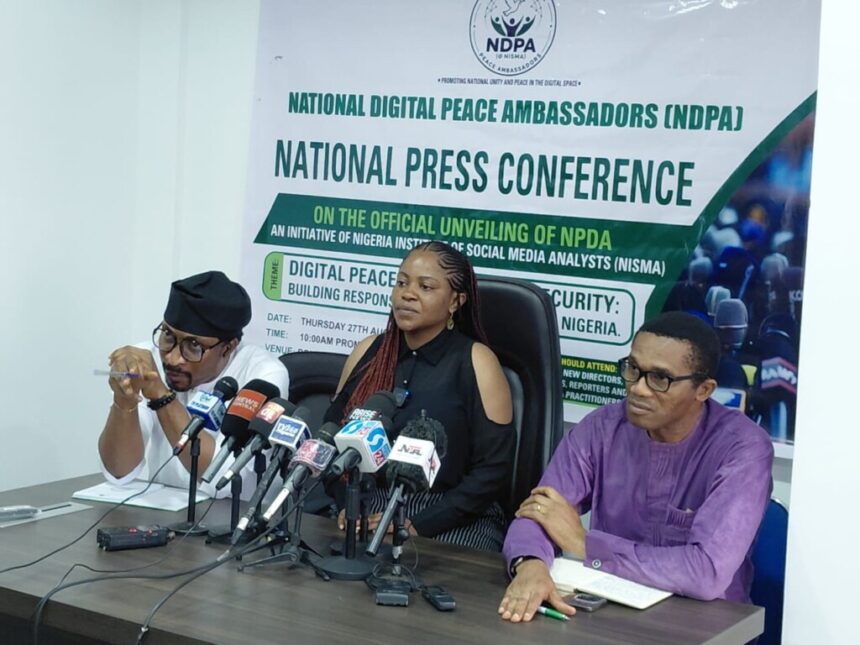
Against this backdrop, the National Digital Peace Ambassadors, NDPA, has been unveiled with a call for Nigerians to promote responsible communication and counter harmful narratives online.
The initiative, launched by the Nigeria Institute of Social Media Analysts, NISMA, is themed “Digital Peace and National Security: Building Responsible Voices for a United Nigeria.”
Speaking at a press conference on Thursday in Abuja, the National Secretary of NDPA, Erikan Obong, said the growing influence of social media had made digital communication an emerging national security concern.
According to her, false allegations, manipulated videos, fabricated election results and unverified information could spread rapidly online, potentially creating panic, deepening ethnic and religious divisions and escalating conflicts.
“The next national crisis may not announce itself with the sound of violence first. It may begin with a notification. A post, a video, a fabricated result, a false accusation or a manipulated recording.”
Obong said Nigeria’s expanding digital population had increased both the opportunities and risks associated with online communication, stressing that irresponsible content could reach millions before credible information had time to counter it.
“A single message can travel from one community to another in seconds. A false allegation can reach millions before the truth has even found its voice.”
She warned that the approaching 2027 elections could provide fertile ground for the exploitation of political, ethnic and religious sentiments through misinformation and increasingly sophisticated artificial intelligence-generated content.
According to her, the challenge was not disagreement itself, but the use of digital platforms to deliberately inflame tensions and promote falsehood.
“A strong nation is not a nation where everybody thinks alike. A strong nation is a nation where people with different opinions can disagree without destroying one another.”
The NDPA said it would promote responsible digital engagement, information verification, peaceful responses to harmful narratives, national unity advocacy and digital peace education.
The organisation also called on government institutions, security agencies, technology companies, media organisations, political actors and content creators to strengthen efforts to protect information integrity and prevent digital platforms from being used to fuel conflict.
Obong stressed that the initiative was not aimed at suppressing freedom of expression or criticism of government.
“A peaceful digital space must not mean a silent digital space. Nigeria needs responsible freedom, not fearful silence.”
She urged Nigerians to pause and verify information before sharing, particularly content capable of generating fear, hatred or communal tension.
The organisation also appealed to social media influencers and content creators to recognise the responsibility that comes with their reach and desist from exploiting sensitive national issues for online engagement.
“Influence is not just a privilege. Influence is responsibility.”
Obong warned influencers against monetising hatred or turning ethnic, religious and security-related issues into content simply to generate views.
“Do not sell Nigeria’s peace for views. Do not monetise hatred. Do not manufacture controversy simply because controversy pays.”
The NDPA said its approach to misinformation and harmful narratives would be peaceful and fact-based.
“We will not fight hatred with hatred. We will fight falsehood with facts. We will answer division with dialogue.”
The organisation said membership of the National Digital Peace Ambassadors would remain free and open to Nigerians from different political, ethnic, religious and professional backgrounds.
It urged citizens to embrace the message, “Different opinions, One Nigeria,” while using their digital platforms to promote peace, unity and national development.
Obong said ordinary citizens also had an important role to play in protecting Nigeria’s information environment, noting that responsible digital citizenship could sometimes mean simply refusing to share unverified information.
“Sometimes, the greatest contribution you can make to national peace is a message you refused to forward.”
The NDPA maintained that Nigeria’s digital space should become an avenue for constructive engagement and national development, rather than a platform for division and conflict, particularly as political activities intensify ahead of the 2027 elections.