
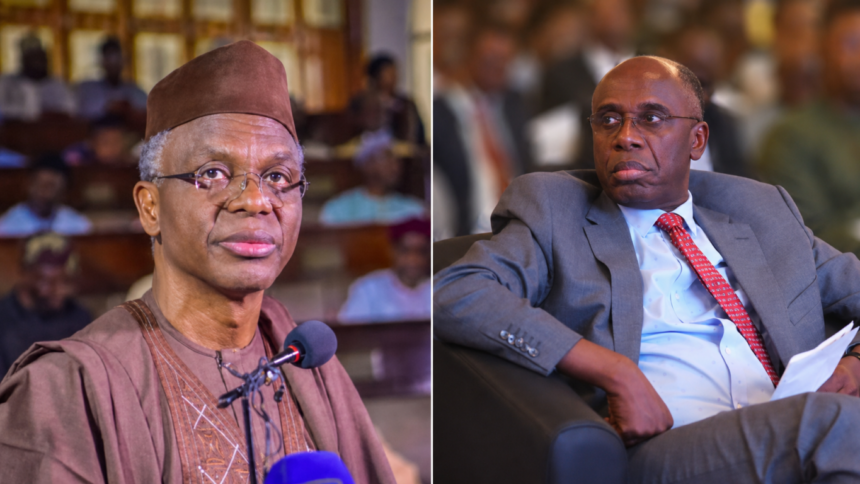
Former Rivers State Governor and former Minister of Transportation, Rotimi Amaechi, has raised concerns over the bail conditions attached to the case involving former Kaduna State Governor, Nasir El-Rufai, arguing that bail should not become a form of detention by another name.
Amaechi’s position centres on the broader principle of the right to liberty and the presumption of innocence, rather than on El-Rufai’s political identity.
According to the argument, while El-Rufai is not above the law and should face investigation and prosecution if allegations have been made against him, the conditions attached to his release should be reasonable and practically attainable.
The intervention comes amid concerns that excessively difficult bail requirements could effectively keep an accused person in detention despite a court having technically granted bail.
Amaechi argued that bail is primarily intended to ensure that an accused person appears for trial and should not be used as an indirect mechanism for prolonged detention.
He maintained that where allegations exist, law enforcement agencies should investigate them, prosecutors should present available evidence, witnesses should testify, and the accused should be given the opportunity to respond through legal representation.
Ultimately, he argued, the determination of guilt or innocence should rest with an independent court.
The former minister also stressed the importance of the presumption of innocence, noting that punishment should ordinarily follow conviction rather than precede it.
The issue, according to the argument, goes beyond El-Rufai himself and raises broader questions about the protection of fundamental rights in Nigeria’s justice system.
Amaechi’s intervention suggests that the precedent established in cases involving prominent political figures could eventually affect opposition politicians, activists, journalists and ordinary citizens who may not have the national visibility to attract widespread attention.
The argument further holds that political disagreements with El-Rufai should not determine whether Nigerians defend his constitutional rights.
The central question, therefore, is whether bail has genuine meaning if the conditions imposed are so difficult that an accused person cannot realistically satisfy them.
Amaechi’s position is that bail conditions should strike a balance between guaranteeing the accused’s appearance in court and protecting the individual’s right to liberty.
The case has consequently renewed discussion about the need for fairness, due process and judicial independence in politically sensitive cases.
The broader message is that Nigeria’s democratic institutions must protect fundamental rights consistently, regardless of whether the person involved is politically popular or unpopular.
As the legal proceedings continue, the argument is that the evidence should determine the outcome of the case, while the courts should be allowed to perform their constitutional role without political considerations influencing the administration of justice.
The call for reasonable bail conditions has also generated the social media campaign #FreeElRufai, with supporters arguing that granting bail should translate into meaningful liberty rather than continued detention through unattainable conditions.