


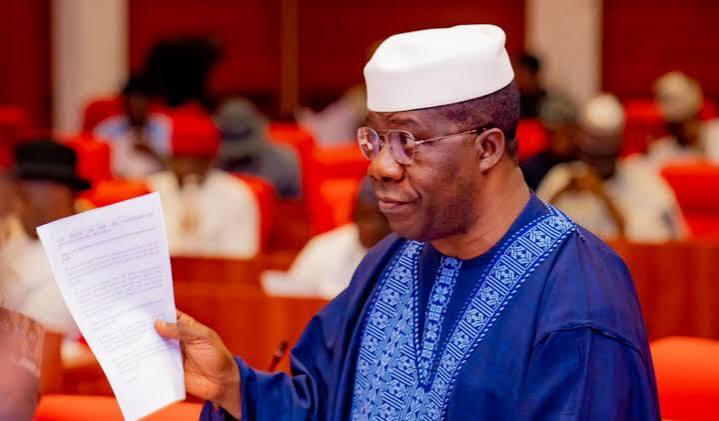
Senate Leader, Opeyemi Bamidele, has said the proposed State Police constitutional amendment will be ready for presidential assent on or before December 2026, following approvals by at least 30 State Houses of Assembly.
Bamidele disclosed this on Thursday while delivering a paper at the National Institute for Policy and Strategic Studies (NIPSS), Kuru, Plateau State, during the Senior Executive Course 48, with the theme, “Improving the Efficiency and Effectiveness of Governance through Proactive Lawmaking.”
He said the approval by 30 state assemblies had satisfied the constitutional requirement under Section 9(2) of the 1999 Constitution, which requires the support of at least two-thirds of State Houses of Assembly for constitutional alterations.
According to the Senate Leader, who is also Vice Chairman of the Senate Committee on the Review of the 1999 Constitution, the development represents a major step towards establishing a decentralised policing system in Nigeria.
“We are pleased to inform our constituents across the federation that State Police have moved from rhetoric to reality,” Bamidele said.
He explained that the next stage would involve the National Assembly collating reports from the state assemblies, adopting the required resolution through a simple majority in both chambers and transmitting the bill to the President for assent.
Bamidele expressed confidence that the remaining legislative processes would be completed on or before December 2026.
Addressing concerns over the possible misuse of state police by governors and other political authorities, he said the proposed reform was not intended to establish state armies but to strengthen community-based security within constitutional safeguards.
“It is not about creating state armies, but about creating state-led, community-anchored policing within clear constitutional safeguards, operational standards, oversight mechanisms, and human rights protections,” he said.
He added that decentralised policing would enable security agencies to better understand local communities, terrain and languages, potentially improving intelligence gathering and responses to security threats.
The proposed establishment of state police has remained a major subject of debate in Nigeria, particularly amid growing concerns over insecurity and calls for reforms to the country’s centralised policing structure.