

Democracy promises citizens the freedom to choose their leaders, but that freedom can be weakened when political competition becomes a contest of financial strength.
In such an environment, campaign spending, cash inducements, gifts and other material benefits can shift attention away from policies, competence and public service towards what candidates can offer voters before election day.
Money has a legitimate place in democratic politics. Campaigns require resources to organise rallies, communicate policies, recruit staff, reach voters and mobilise supporters. The problem begins when financial influence moves beyond persuading voters and becomes a means of purchasing their support, manipulating their choices or creating unfair advantages in the electoral process.
In Nigeria, where economic hardship and widespread financial vulnerability can shape political interactions, the distinction between campaign support, legitimate voter engagement and outright vote buying deserves close examination. The issue is not simply whether money changes hands, but whether financial inducements undermine the freedom of citizens to make political decisions in their own interests.
The Economics of a Vote: Poverty, Political Spending and Voter Choice
Vote buying thrives where financial vulnerability meets intense political competition. For a voter struggling to afford food, transport, medicine or school fees, a cash offer on election day may provide immediate relief. The promise of a better road, a functioning hospital or improved employment opportunities, by contrast, can feel distant and uncertain.
This imbalance helps explain why vote buying cannot be understood only as an individual moral failure. It must also be examined within the wider economic and political conditions that shape voter behaviour.
A 2024 report by Nigeria’s National Bureau of Statistics, covering experiences during the 2023 general election, found that 22 per cent of Nigerians said they had personally been offered money in exchange for their vote, while nine per cent reported being offered another favour. Among those who received an offer of money or another favour, 40 per cent said the offer influenced their vote choice.
These figures reveal the scale of the challenge, but they also show why the issue requires careful treatment. Not every voter who accepts money necessarily votes for the person offering it. Some may take the money and still vote according to their preference. Others may feel pressured by party agents, community expectations or fear of losing access to future assistance.
The transaction may appear simple, but the motivations behind it are complex. Poverty can increase vulnerability to inducements, while weak trust in political promises can make immediate benefits seem more dependable than long-term commitments.
Yet economic hardship does not erase the agency of voters. Nor should voters experiencing poverty be portrayed as the sole cause of electoral malpractice. The responsibility also lies with those who finance, organise and execute schemes designed to influence electoral choices.
When Campaign Spending Becomes Political Investment
Money politics extends beyond cash handed to voters at polling units. It can include the use of financial resources to dominate party structures, secure political nominations, finance extensive mobilisation networks and influence access to political office.
Campaign expenditure is not inherently improper. Candidates need resources to communicate their programmes and engage citizens. The concern arises when the ability to spend enormous sums becomes a substitute for public credibility, policy substance or demonstrated leadership.
In such circumstances, political office can begin to resemble an investment. A candidate who spends heavily to secure an election may face pressure to recover that expenditure through access to public contracts, appointments, government resources or other benefits.
This is a risk, not an inevitable outcome of every expensive campaign. Nevertheless, it raises a fundamental question about the purpose of seeking public office: is the objective to serve the public, or to gain access to resources that can repay the cost of acquiring power?
Where campaign financing lacks effective transparency, citizens may struggle to determine who funded a candidate, what obligations accompany that support and whether private interests will influence decisions after the election.
The consequences can extend beyond the polling unit. If financial power determines who can compete effectively, qualified aspirants without access to wealthy sponsors may find it harder to participate. Political competition can then become less accessible, while accountability risks weakening when elected officials depend heavily on powerful financial backers.
Vote Buying and the Cost to Public Accountability
A vote is more than a mark on a ballot paper. It is a mechanism through which citizens choose representatives and influence the direction of government.
When a vote is exchanged for money or a material inducement, that relationship can be distorted. Instead of competing primarily on public programmes, candidates may focus on securing immediate support through private transactions.
The consequences can be significant. A politician who wins through financial inducements may have less incentive to prioritise public services if electoral success depends more on distributing benefits before an election than on delivering results while in office.
This does not mean every elected official who spends heavily will neglect public responsibilities. It means that a political system that rewards inducements over performance risks weakening the connection between electoral choice and public accountability.
The voter may receive a small payment once, but the decisions made by an elected government can affect that voter’s household for years. Budgets determine how much is spent on schools, hospitals, roads, security and social protection. Public procurement determines how infrastructure is built and maintained. Government policies influence employment, taxation and the cost of living.
The long-term consequences of political decisions can therefore far outweigh the immediate value of a cash inducement.
The Law Prohibits Vote Buying, but Enforcement Matters
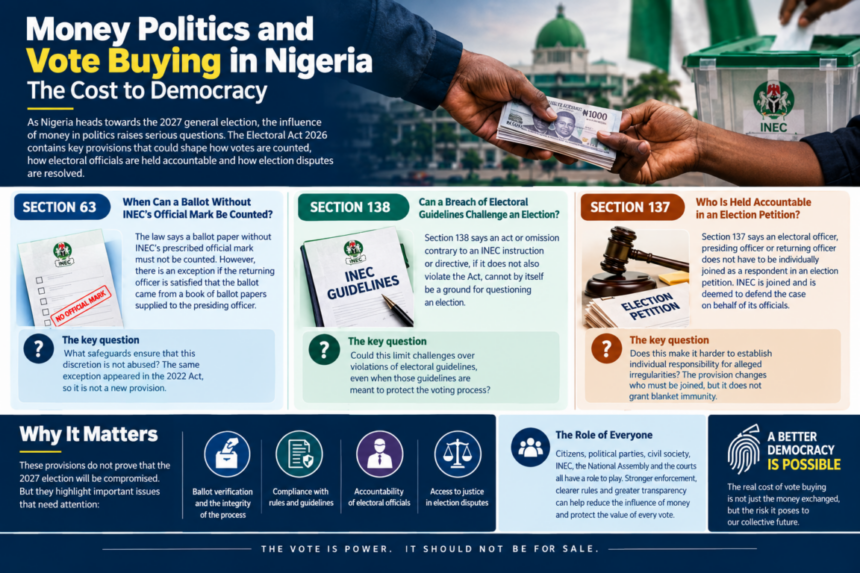
Nigeria’s electoral framework prohibits bribery and the corrupt use of money or other inducements to influence votes. The Electoral Act 2026 repealed and replaced the 2022 Act, introducing changes to the legal framework governing elections. The exact applicable provisions and penalties should be read from the current legislation rather than assumed to be unchanged from the previous law.
However, the existence of a prohibition does not automatically eliminate the practice. Effective enforcement requires credible intelligence, timely investigation, evidence collection, cooperation among electoral and security agencies, and appropriate legal consequences for proven offences.
Vote buying can also be difficult to detect. Payments may be distributed through intermediaries, community networks or digital transfers. Material inducements may be offered before election day, while attempts to verify voter compliance can threaten ballot secrecy.
In its final report on Nigeria’s 2023 general election, the European Union Election Observation Mission documented widespread allegations of vote buying and reported instances of cash and goods being distributed around election periods. It also noted concerns about enforcement and oversight.These findings underline the importance of prevention as well as prosecution. Authorities must be able to investigate credible allegations, while ensuring that enforcement is impartial and does not become a tool for intimidating political opponents or ordinary voters.
The protection of ballot secrecy is particularly important. Voters should not have to prove how they voted to receive money, keep a promise or avoid punishment. No political agent should be able to turn the secrecy of the ballot into a transaction that can be monitored or enforced.
Why Voter Education Alone Is Not Enough
Public campaigns often urge citizens to reject vote buying and defend their votes. Such messages are important, but education alone cannot resolve the economic and institutional conditions that sustain the practice.
A voter who distrusts political promises may reasonably ask why a long-term pledge should be valued over immediate assistance. Answering that question requires more than moral appeals. It requires political parties and elected officials to demonstrate that public commitments can be translated into measurable results.
Political parties must also strengthen internal accountability, disclose campaign financing as required by law and develop systems that reduce the influence of financial inducements in candidate selection and electoral mobilisation.
Civil society organisations and the media have a role in examining campaign spending, explaining electoral offences and tracking whether elected officials fulfil their promises. Electoral authorities and law enforcement agencies must investigate credible allegations consistently, regardless of the party or individual involved.
Governments, meanwhile, must address the material conditions that make voters vulnerable to short-term inducements. This includes improving access to essential services, creating economic opportunities and strengthening public confidence that government programmes will reach citizens fairly.
None of these measures alone will end vote buying. Together, however, they can help change the incentives that make it attractive to those who offer inducements and difficult to reject for those who receive them.
Beyond Election Day: Restoring the Value of the Vote
As Nigeria approaches the 2027 general election, the challenge is not simply to persuade voters to refuse cash. It is to build an electoral culture in which political competition is driven by ideas, credible programmes, public records and the willingness of candidates to be held accountable.
The government has already placed vote buying on the agenda of its nationwide voter mobilisation campaign. In October 2026, the Federal Ministry of Information and National Orientation, the National Orientation Agency and INEC participated in a campaign urging Nigerians to reject vote buying, voter apathy and electoral violence.
Such initiatives can help establish public expectations, but their impact will depend on sustained engagement and credible action against violations.
Citizens, too, have a role in protecting the democratic process. They can scrutinise candidates’ records, ask how campaign promises will be funded, examine policy proposals and demand explanations when elected officials fail to deliver. Political parties should be judged by their programmes and conduct, not merely by the scale of their campaign spending.
Ultimately, the real cost of vote buying cannot be measured only by the amount of money exchanged. It must also be measured by the quality of representation, the fairness of political competition and the strength of public accountability.
A vote may have an immediate financial value to a struggling household, but its democratic significance extends far beyond election day. It gives citizens a voice in deciding who exercises power, how public resources are used and what future their communities can expect.
The challenge for Nigeria is to build a democracy in which voters do not have to choose between immediate economic relief and the long-term power of their political voice.