


Justice is often described as a right that belongs to everyone, regardless of wealth, status or background. Yet for many Nigerians facing criminal charges, family disputes, land conflicts, unlawful treatment or other legal problems, the cost of securing a lawyer can become a major barrier to justice.
Legal consultations, professional fees, court filings, transportation and other litigation expenses can place legal representation beyond the reach of low-income households. For people already struggling to meet basic needs, paying for a lawyer may mean sacrificing money meant for food, rent, school fees or medical care.
In such circumstances, pro bono legal services can provide a critical alternative, offering legal assistance without professional fees to people who might otherwise have to navigate a complicated legal system alone.
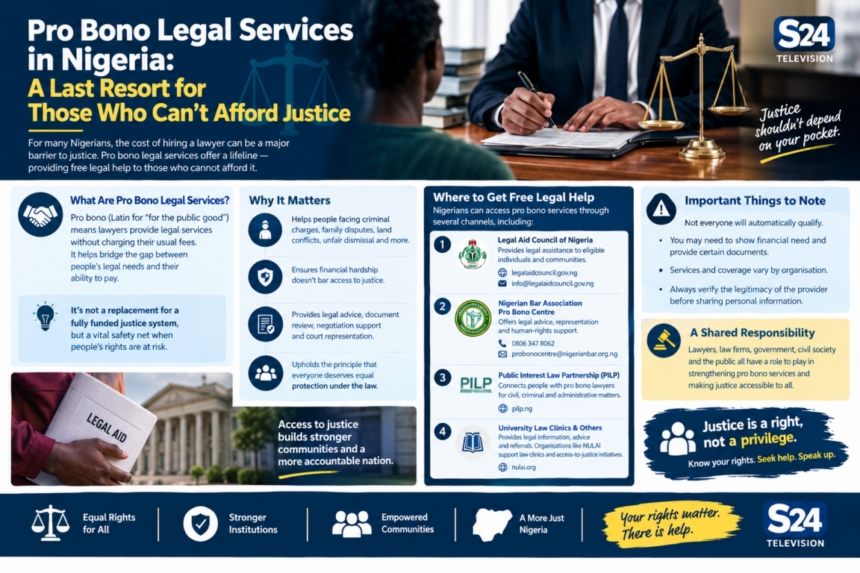
Derived from the Latin phrase pro bono publico, meaning “for the public good,” pro bono legal work involves lawyers providing legal services without charging their usual professional fees. It is an important part of efforts to improve access to justice, particularly for vulnerable people and communities that face financial or other barriers to legal representation.
However, pro bono assistance should not be understood as a replacement for a properly funded justice system or as a guarantee that every applicant will receive free representation. Rather, it can serve as a vital safety net when the cost of obtaining legal help threatens a person’s ability to defend their rights.
When private legal fees become a barrier
For a person who has been arrested, a worker who believes they have been unfairly dismissed, a tenant facing eviction or a parent caught in a custody dispute, the need for legal advice may be urgent. Yet the ability to obtain that advice often depends on financial circumstances.
The problem is not simply whether a person can afford to file a case in court. It is also whether they can obtain reliable guidance before making decisions that could affect their freedom, property, family or livelihood. Without legal advice, people may miss deadlines, sign documents they do not fully understand, accept unfair settlements or fail to recognise that their rights have been violated.
This is where pro bono lawyers can make a difference. Depending on the arrangement and the case, their assistance may include explaining a person’s legal position, reviewing documents, negotiating a settlement, helping prepare legal proceedings or representing a client in court.
The central principle is that a person’s financial limitations should not automatically prevent them from seeking protection under the law. Pro bono services can help bridge that gap, although the availability and scope of assistance depend on the lawyer or organisation accepting the case.
Pro bono is a safety net, not a guarantee
In Nigeria, free legal assistance comes through different channels, and it is important to distinguish between them. Pro bono services are generally provided by lawyers who volunteer their professional expertise without charging their usual legal fees. Government-supported legal aid, on the other hand, is delivered through established public institutions and programmes.
The Legal Aid Council of Nigeria is one of the key institutions responsible for providing legal assistance to eligible people who cannot afford private representation. Under the Legal Aid Act 2011, the Council provides a framework for legal assistance, including representation in qualifying cases. Eligibility and the type of assistance available depend on the applicable rules and circumstances.
The Nigerian Bar Association also operates a Pro Bono Centre that receives requests for assistance from people who lack the means to secure legal representation. In a notice published on 28 March 2026, the NBA Pro Bono Centre said it provides support that includes legal advice, court representation, human-rights protection and assistance with general legal issues.
These services can be especially important where a person has no realistic alternative to seeking help from a lawyer willing to take up the matter without professional fees. However, free legal representation is not automatically available to everyone who requests it. Applicants may need to provide details of their circumstances, demonstrate financial need and undergo an assessment before assistance is approved.
The availability of a lawyer may also depend on the nature of the dispute, its urgency, the resources of the organisation and whether a suitable legal practitioner is available. A person seeking assistance should therefore contact a recognised legal-aid provider as early as possible rather than assume that a lawyer will automatically be assigned.
The danger of waiting until every other option fails
Although pro bono legal services are often described as a last resort for people who cannot afford a lawyer of their choice, waiting until a situation becomes critical can make a legal problem harder to resolve.
A person who receives a court summons, faces a criminal allegation, is threatened with eviction or believes they are being unlawfully detained should seek qualified legal guidance promptly. Delaying action while trying to raise money for private representation may result in missed opportunities to protect their rights.
Early advice can also help determine whether a dispute needs to go to court at all. Some matters may be resolved through negotiation, mediation or other appropriate processes, potentially reducing the time and cost involved. Other cases, particularly those involving serious criminal allegations or urgent threats to personal safety, may require immediate legal intervention.
Pro bono assistance should therefore be viewed not merely as the final option after all personal resources have been exhausted, but as a legitimate route to explore when the cost of legal services becomes an obstacle. The earlier a person understands the options available, the better positioned they may be to make informed decisions.
The gap between legal rights and access to justice
Despite the importance of free legal assistance, its effectiveness depends on whether the institutions and professionals providing it have enough resources to meet demand.
In June 2024, the Director-General of the Legal Aid Council of Nigeria raised concerns about inadequate funding and a shortage of personnel, warning that the number of cases requiring assistance exceeded the capacity of the Council’s available lawyers. He also identified limited participation by experienced private legal practitioners in the legal-aid scheme as a challenge.
These concerns point to a wider problem: establishing a legal-aid institution is only the first step. People must know that the service exists, be able to reach it, understand how to apply and receive assistance within a reasonable time.
For someone facing an urgent legal problem, a referral that comes too late may offer little practical relief. Similarly, a free consultation may be helpful, but it may not meet the needs of a person who requires sustained representation throughout lengthy court proceedings.
Addressing these gaps requires more than encouraging lawyers to volunteer. Government must adequately support legal-aid institutions, while the legal profession, civil society organisations, universities and private-sector partners can help expand access to qualified practitioners.
The public also needs clearer information about where to seek assistance, the documents required and the circumstances under which services can be provided without charge.
Where can Nigerians seek free legal assistance?
People who cannot afford private legal representation do not necessarily have to abandon their legal concerns. Several established organisations and programmes provide routes to assistance, although the services offered and eligibility requirements vary.
Provides legal assistance to eligible people who cannot afford private representation. Applicants can contact the Council to enquire about eligibility, available services and the application process.
Website: legalaidcouncil.gov.ng
Email: info@legalaidcouncil.gov.ng
2. Nigerian Bar Association Pro Bono Centre
The Centre receives requests for free legal assistance, including legal advice, court representation and human-rights matters.
Address: NBA House, Plot 1101, Muhammadu Buhari Way, Central Business District, Abuja
Phone: 0806 347 8062
Email: probonocentre@nigerianbar.org.ng
3. Public Interest Law Partnership (PILP)
Connects eligible individuals, families, organisations and communities with pro bono legal practitioners for criminal, civil and administrative matters.
Website: pilp.ng
4. University law clinics and specialist organisations
Some university law clinics and civil society organisations provide legal information, advice, referrals and other forms of assistance. Organisations such as the Network of University Legal Aid Institutions Nigeria support the development of law clinics and access-to-justice initiatives.
Information: nulai.org
Before sharing sensitive documents or personal information, applicants should verify that they are dealing with a legitimate service provider. They should also confirm exactly what the service covers, whether any incidental expenses remain their responsibility and whether the organisation has formally accepted their case. Free legal assistance should not be assumed to guarantee representation or a particular outcome.
A shared responsibility to make justice accessible
Pro bono legal services reflect an important professional and social responsibility: legal expertise can be used not only to serve paying clients but also to protect people whose circumstances leave them unable to afford representation.
For lawyers, volunteering time and expertise can help close gaps in access to justice. For law firms, establishing structured pro bono programmes can make free assistance more consistent and accessible. For government, sustained funding, adequate staffing and public awareness are essential to ensuring that legal-aid institutions can fulfil their responsibilities.
For Nigerians facing legal difficulties, the first step is to seek information from a recognised provider instead of assuming that the cost of a private lawyer leaves them without options.
Ultimately, the value of pro bono services extends beyond the individual receiving assistance. When people can understand and defend their rights, the justice system becomes more accessible, and public confidence in the rule of law has a stronger foundation.
Justice should not depend solely on what a person can afford. Pro bono legal services cannot solve every weakness in Nigeria’s justice system, but they can offer a lifeline to people who might otherwise face legal challenges without professional support. The task ahead is to ensure that this lifeline is visible, adequately supported and available when it is needed most.