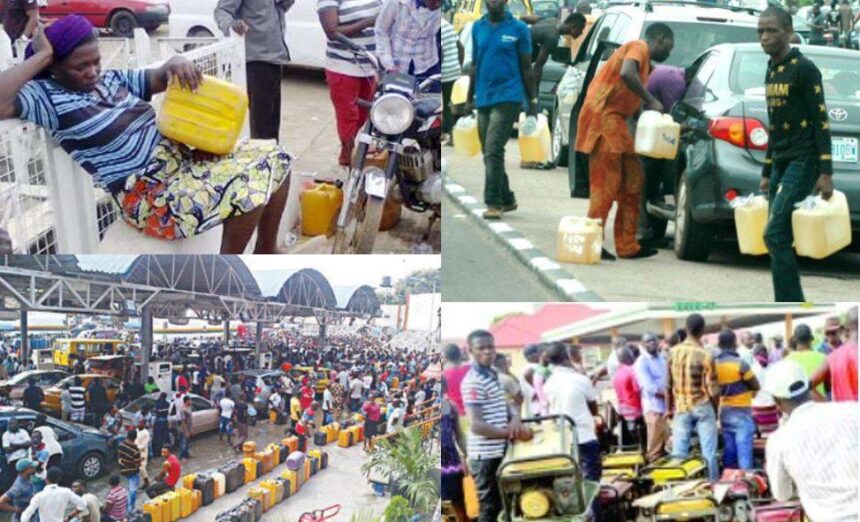
Nigerians across several states have expressed disappointment over the Federal Government’s 30-day petrol discount scheme, saying the intervention has yet to deliver meaningful relief as fuel prices remain high at filling stations.
Checks by Daily Trust across Abuja, Kaduna, Kano, Rivers, Bayelsa and Kwara states showed that petrol prices remained above N1,300 per litre at several Nigerian National Petroleum Company Limited (NNPC) retail outlets, while some independent marketers sold the product for as much as N1,900 per litre.
Motorists and commercial transport operators complained that the N66-per-litre discount announced by NNPC was difficult to access, with eligibility conditions, limited availability of self-service pumps and long queues discouraging potential beneficiaries.
The Federal Government introduced the temporary intervention to ease the economic hardship associated with high transportation costs and rising prices of goods and services.
Minister of Finance and Coordinating Minister of the Economy, Taiwo Oyedele, said the scheme would cover petrol supplied by NNPC, with public transport operators identified as priority beneficiaries.
However, consumers have called for a wider distribution system that would extend the price reduction to more filling stations and translate into lower transport fares and household expenses.
Abuja Motorists Question N66 Discount
In Abuja, several NNPC retail outlets were selling petrol at N1,405 per litre, although eligible customers using the company’s mobile application could access a N66 discount, reducing the price to N1,339 per litre.
Independent marketers sold petrol at between N1,400 and N1,410 per litre.
At the NNPC station in Mabushi, patronage appeared relatively low despite the discount, which was available to motorists using designated self-service dispensers and making payments through bank transfers.
A resident, Umar Hussaini, said the savings were too small to make a significant difference to household expenses.
He explained that purchasing 31 litres at N1,405 per litre cost him N43,555, compared with N41,509 at the discounted price of N1,339, representing a saving of N2,046.
“How many people buy 31 litres of fuel to benefit from the N2,000? Also, the N2,000 is little, so for me, we are not saving for anything using the NNPC retail stations,” he said.
Another resident, Jamiu Aliyu, said he was informed that customers needed to download the NNPC application, scan a barcode and provide personal details, including their Bank Verification Number (BVN), to open an account or wallet before accessing the discount.
He also complained that the offer was restricted to self-service pumps, which are not available at every NNPC station.
According to him, some stations have only one self-service dispenser among approximately 16 pumps, limiting access for motorists seeking to benefit from the reduced price.
Aliyu argued that the conditions disadvantaged customers without smartphones or mobile data, as well as those unwilling to complete the registration process.
Another Abuja resident, Hauwa Ibrahim, said she discovered that the discount was not universal only after arriving at a filling station.
She recounted an argument between a customer and a station attendant after the customer insisted on receiving the N66 reduction. The attendant reportedly explained that the discount applied only to customers using the designated application.
Ibrahim said the incident highlighted inadequate communication about the scheme’s eligibility requirements.
Kaduna Drivers Say Relief Remains Elusive
In Kaduna State, commercial drivers also reported that the announced discount had yet to translate into lower prices at several filling stations.
Zaiyad, a commercial driver in Rigachikun, said he visited an NNPC station on Sunday but found petrol selling at N1,370 per litre.
He also visited MRS and A.A. Rano stations, where the product was selling at N1,395 per litre, adding that he had yet to encounter the advertised discounted price at the outlets he visited.
Similarly, Hassan Kanti, a commercial driver at Kawo Garage in Kaduna, said he had not seen an NNPC station selling petrol at the government-announced discounted rate.
“For now, I bought petrol at N1,400 per litre, and things have not been easy for us as commercial drivers,” he said.
Petrol Prices Rise to N1,420 in Kano
In Kano State, while NNPC retail outlets at Hotoro Roundabout and Kano Line sold petrol at N1,385 per litre, several other stations increased their prices despite the N66 discount.
A.A. Rano on Kano-Maiduguri Road, Aliko on Zaria Road and Azman, also on Kano-Maiduguri Road, sold petrol at N1,420 per litre, up from N1,410.
AY Maikifi filling station sold the product at N1,418 per litre, an increase of N23 from its previous price of N1,395.
A commercial tricycle rider, Sani Bala, said the earnings from his business were largely consumed by fuel expenses.
He said the NNPC discount had not significantly improved the situation for commercial riders, noting that not all NNPC outlets sold petrol at N1,385 per litre, let alone offering the additional N66 reduction.
“The fuel situation in the country has made life difficult. Before now, customers did not negotiate fares because it was within reach, but because of the fuel price and exorbitant fares, they always negotiate fares before boarding,” he said.
Another rider, Tanimu Musa, who operates along the Hotoro-Zoo Road route, said he preferred buying petrol at the NNPC station in Hotoro because other outlets charged more than N1,400 per litre.
However, he said the arrangement became inconvenient whenever he exhausted his fuel outside Hotoro or far from Kofar Nasarawa, forcing him to purchase petrol at higher prices elsewhere.
Musa said the discount had not significantly eased the hardship faced by motorists and commuters, arguing that petrol would need to sell for between N500 and N550 per litre to make a substantial difference.
Ali Sheka, a motorcycle owner who also operates a tailoring business, said he bought petrol at AMMASCO for N1,410 on Saturday because travelling to an NNPC station to save N25 per litre would not make economic sense.
“My opinion is that the discount is too small and why will the discount last for only one month? It is really not needed if it is not intended to bring the price further down,” he said.
Rivers, Bayelsa Consumers Still Pay High Prices
The situation was similar in Rivers and Bayelsa states, where petrol prices remained high despite the Federal Government’s announcement.
In Port Harcourt, an NNPC filling station near Nkpolu Junction sold petrol at N1,405 per litre.
In Yenagoa, Bayelsa State, NNPC outlets near Tombia Junction and along Sani Abacha Expressway sold the product at N1,400 per litre.
Other outlets in Port Harcourt reportedly charged between N1,500 and N1,600 per litre, with some prices reaching N1,900.
In Yenagoa, independent marketers sold petrol at between N1,400 and N1,500, while black-market operators charged approximately N1,600 per litre.
A commercial driver at Ekeki Motor Park in Yenagoa, Adebajo Festus, said the discount had not produced noticeable benefits for transport operators.
He argued that restricting the scheme to NNPC outlets made it difficult for commercial drivers to access cheaper petrol without losing valuable working hours.
According to him, Yenagoa has too few NNPC stations to meet the needs of commercial motorists, leaving drivers with the choice of joining long queues or buying fuel elsewhere at prevailing market prices.
“If you tell us as drivers to buy at NNPC because government has reduced price, how many NNPC filling stations do we have here in Yenagoa, maybe two, how long will you be in the queue to buy the fuel before taking passengers to where they are going?” he asked.
Festus urged the government to extend the discount to independent marketers to improve access and encourage reductions in transport fares.
Offor Chuks, a commercial driver operating between Yenagoa and Port Harcourt, also warned that long queues would undermine the purpose of the intervention.
He called for the discount to be made available across retail outlets so drivers could purchase petrol conveniently and pass the savings on to passengers.
Kwara Transporters Demand Further Price Cuts
In Kwara State, checks at two NNPC retail outlets in Ilorin showed that petrol remained above N1,300 per litre.
The NNPC mega station along Asa Dam Road sold petrol at N1,375 per litre, while the station at Adewole dispensed the product at N1,405 per litre.
A commercial transporter, Malik Sulyman, said the prices remained too high to make a meaningful difference to his business.
“I still buy fuel at around N1,400 per litre, which means spending about N100,000 for roughly 70 litres. How much will one make after buying a full tank?” he asked.
Sulyman said the discount would make a significant difference only if petrol prices fell to N1,000 per litre or below.
He added that high spare-parts costs were compounding the challenges faced by transport operators.
“Where we can feel the impact is if the price comes down to N1,000 and below. Apart from fuel, the cost of spare parts is beyond reach. These are the things affecting our business,” he said.
Another transporter, Ishola Moses, said he had yet to notice any reduction in fuel prices and urged the government to take additional steps to ease the burden on motorists.
PETROAN Seeks 30% Allocation of Discounted Petrol
Despite the complaints, the Petroleum Products Retail Outlets Owners Association of Nigeria (PETROAN) said the intervention could provide meaningful economic relief if properly implemented.
The association urged the Federal Government to allocate 30 per cent of the total volume of discounted petrol to its members, arguing that their extensive retail network could help extend the benefits to communities without nearby NNPC stations.
PETROAN President, Billy Gillis-Harry, said cheaper petrol for public transport operators could translate into lower fares, reduced logistics costs and improved access to markets for farmers and traders.
Meanwhile, the Chief Executive Officer of the Centre for the Promotion of Private Enterprise, Dr. Muda Yusuf, supported the temporary discount, describing it as a reasonable intervention given the country’s economic difficulties.
Yusuf urged Nigerians to support the initiative, particularly after the government clarified that it was not a return to the previous petrol subsidy arrangement.
He also called on state and local governments to complement the Federal Government’s efforts by deploying their increased allocations to address economic hardship and improve public services.
Energy expert Rasheed Adeleke acknowledged that the discount was relatively small but stressed the need for transparent implementation.
He also urged the government to expand the compressed natural gas (CNG) programme, arguing that greater adoption of alternative fuels could provide more sustainable relief in the long term.
Oil Expert Explains Why Prices May Not Fall
Oil and gas industry analyst Otunba Tunji Oyebanji said some Nigerians had misunderstood the government’s announcement by assuming that the discount would automatically reduce petrol prices to below N1,000 per litre.
He explained that the N66 discount applied to eligible customers purchasing petrol at NNPC stations through the company’s mobile application, while the separate measure concerning the gantry price was intended to limit increases in the cost of supplying petrol.
According to Oyebanji, the government had not directly reduced the general pump price of petrol, and the discount should not be interpreted as a promise that prices would automatically fall.
He said the arrangement was intended to extend an existing NNPC discount and prevent increases in the relevant supply cost from being passed on through higher prices.
Oyebanji argued that consumers needed to distinguish between a discount offered by a retailer and a government-imposed reduction in the pump price.
He also rejected expectations that petrol should sell for N1,000 per litre or less simply because the government had introduced the temporary intervention.
The analyst maintained that someone would ultimately bear the cost of any price reduction, whether through lower earnings for operators or revenue forgone by the government.
His comments come amid renewed debate over whether the NNPC discount amounts to a form of subsidy.
In an opinion piece titled “Subsidy Na Subsidy, President Tinubu,” public policy scholar Abidemi Adebamiwa argued that reducing petrol prices through the national oil company still involves using public resources to ease the burden on citizens, regardless of the terminology used.
Citing Section 53(3) of the Petroleum Industry Act 2021, Adebamiwa noted that the Ministry of Finance Incorporated and the Ministry of Petroleum Incorporated hold shares in NNPC on behalf of the Federation.
He argued that any decision by the company to forgo part of its earnings to reduce petrol prices should be considered in the context of public ownership and the need to deliver value to Nigerians.
Adebamiwa maintained that the economic effect of an intervention mattered more than whether it was described as a discount, temporary margin waiver or price-smoothing measure.
The Federal Government, however, has maintained that the programme is a temporary relief measure intended to ease transportation costs without restoring the previous petrol subsidy framework.
For motorists and commercial transport operators, the central concern remains whether the intervention will translate into lower fuel prices, reduced fares and relief from rising operating costs.
With consumers continuing to report high prices and restricted access to discounted petrol, calls are growing for the government to improve communication, expand distribution and ensure that the announced intervention produces tangible savings for Nigerians.