
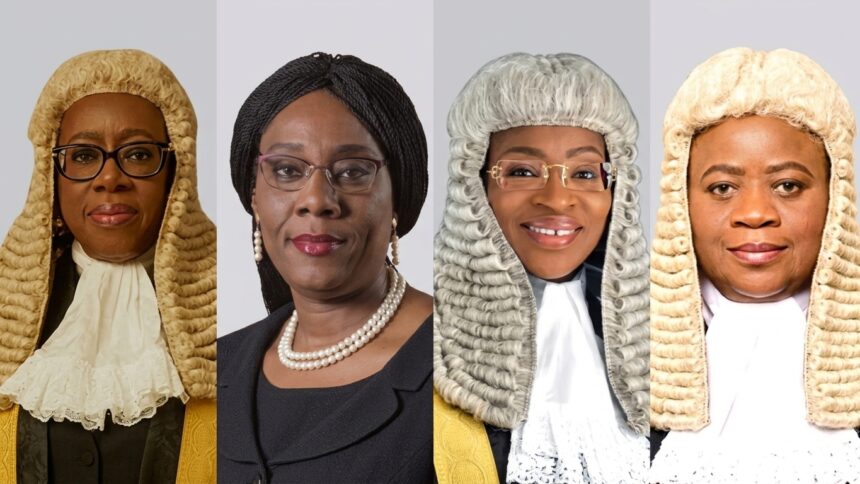
Women are occupying some of the most influential positions in Nigeria’s legal profession and judiciary, marking a significant shift in an institution historically dominated by men.
From the highest court in the country to the Court of Appeal, Nigerian Law School and the Nigerian Bar Association (NBA), women are increasingly taking up leadership roles that shape the administration of justice, legal education and the direction of the legal profession.
At the apex of the judiciary is Chief Justice of Nigeria, Justice Kudirat Motonmori Olatokunbo Kekere-Ekun, GCON, who heads the Supreme Court of Nigeria.
Kekere-Ekun was sworn in as Acting Chief Justice on August 23, 2024, before becoming the substantive Chief Justice on September 30, 2024. She is the second woman to become Chief Justice of Nigeria, following Justice Aloma Mukhtar, who served from 2012 to 2014. (Supreme Court of Nigeria)
Her rise to the country’s highest judicial office followed decades of experience across different levels of the judiciary. She was appointed a Lagos State High Court judge in 1996, elevated to the Court of Appeal in 2004 and appointed to the Supreme Court in 2013 as the fifth woman to serve on the apex court. (Supreme Court of Nigeria)
The Supreme Court’s current composition also includes several female justices, among them Justice Helen Moronkeji Ogunwumiju, Justice Jummai Hannatu Sankey and Justice Chioma Egondu Nwosu-Iheme. The court’s official list of justices confirms the continued presence of women at the highest level of judicial decision-making. (Supreme Court of Nigeria)
Beyond the Supreme Court, another woman occupies the leadership of the Court of Appeal.
Justice Monica Bolna’an Dongban-Mensem, CFR, is the President of the Court of Appeal, the country’s second-highest court in the judicial hierarchy.
Dongban-Mensem was sworn in as President of the Court of Appeal on June 19, 2020, after serving as a Justice of the Court of Appeal from 2003. Her career also includes service as a judge of the Plateau State High Court and the Federal Capital Territory Judiciary. (Federal Judicial Service Commission)
Her position places her at the head of an institution responsible for hearing appeals from the Federal and State High Courts, as well as other courts and tribunals as provided by law. The Court of Appeal currently operates 20 divisions across Nigeria’s six geopolitical zones. (Court of Appeal Nigeria)
Women Leading Legal Education
The transformation is also visible in Nigeria’s legal education system.
Dr. Olugbemisola Titilayomi Odusote is the Director-General of the Nigerian Law School and the institution’s first female Director-General.
She formally assumed office as the 10th Director-General of the Nigerian Law School. The institution is responsible for the vocational training of law graduates preparing to practise as barristers and solicitors in Nigeria.
Her position gives her significant responsibility over an institution that trains prospective members of the Nigerian Bar and plays a central role in determining the professional standards of future lawyers.
The Nigerian Law School currently has seven campuses and thousands of students undergoing professional legal education.
A New Chapter at the Nigerian Bar Association
The legal profession itself has also witnessed a historic development with the election of Oyinkansola Badejo-Okusanya, SAN, as President of the Nigerian Bar Association in July 2026.
Badejo-Okusanya became the 33rd President of the NBA after defeating two other Senior Advocates of Nigeria. She polled 12,317 votes, representing 47.18 per cent, to emerge winner of the election. (Punch Newspapers)
Her victory was particularly significant because she became the first woman to win the NBA presidency th rough a direct election and only the second woman to lead the association.
The first was Dame Priscilla Kuye, who served as NBA president from 1991 to 1992. (Channels Television)
Badejo-Okusanya was inaugurated as the 33rd NBA President in Port Harcourt on August 28, 2026, beginning a two-year tenure. (Punch Newspapers)
Her emergence means that women now occupy leadership positions across several major institutions at the heart of Nigeria’s legal system: the Supreme Court, Court of Appeal, Nigerian Law School and Nigerian Bar Association.
More Than Symbolic Representation
The growing presence of women in these positions goes beyond the symbolism of having women at the top.
The people occupying these offices have responsibility for judicial administration, legal education, professional regulation, access to justice and the interpretation and application of Nigerian law.
For example, as Chief Justice, Kekere-Ekun heads the country’s apex judicial institution and is responsible for providing leadership for the Supreme Court. The court describes itself as Nigeria’s final arbiter in legal disputes and a guardian of the Constitution and rule of law. (Supreme Court of Nigeria)
Similarly, Dongban-Mensem’s position at the Court of Appeal gives her responsibility for the leadership of one of the country’s most important appellate institutions. (Court of Appeal Nigeria)
At the professional level, Badejo-Okusanya now leads the NBA, an organisation representing legal practitioners across the country. Her election also signals a growing acceptance of women competing for and winning positions that were previously largely occupied by men.
Is This a Takeover?
Describing the development as women “taking over” Nigeria’s judicial system may be catchy, but the reality is more nuanced.
Women have not taken control of the entire Nigerian judiciary. Men continue to occupy many senior judicial and legal positions across the country.
However, the concentration of women in several strategic leadership positions is significant and represents a major development in the history of Nigeria’s legal profession.
The development also reflects the increasing participation of women in legal education and professional practice.
The Nigerian Law School’s leadership under Odusote, the Court of Appeal under Dongban-Mensem, the Supreme Court under Kekere-Ekun and the NBA under Badejo-Okusanya provide four particularly visible examples of women occupying influential positions across different arms of Nigeria’s legal architecture.
A Changing Legal Profession
The emergence of women at the top of Nigeria’s legal system has been gradual.
For decades, women faced structural and social barriers to entering and advancing within professions traditionally dominated by men. Yet successive generations of female lawyers and judges have continued to break into senior positions.
The careers of Kekere-Ekun, Dongban-Mensem, Odusote and Badejo-Okusanya illustrate different pathways to leadership: judicial progression, legal education, professional practice and elected leadership.
Their emergence also creates a stronger pipeline for younger women entering the legal profession.
For aspiring female lawyers, the visibility of women at the highest levels of the profession provides evidence that the traditional ceiling on women’s advancement in the legal sector is becoming less rigid.
What It Means for Nigeria
The increasing representation of women in legal leadership comes at a time when Nigeria’s judiciary is facing demands for greater efficiency, public confidence, judicial independence, faster case disposal and improved access to justice.
The Supreme Court, under Kekere-Ekun, has highlighted reforms aimed at improving case management, reducing delays, strengthening accountability and using technology to modernise court processes. (Supreme Court of Nigeria)
Meanwhile, Badejo-Okusanya has already indicated that her NBA administration intends to focus on strengthening the association and addressing the professional needs of lawyers. In her inaugural address, she described her mandate as a responsibility to make the Bar more responsive to its members and the wider legal profession. (Nigerian Bar Blog)
The real measure of this new era, therefore, will not simply be the number of women occupying senior offices.
It will be whether their leadership contributes to a more independent, efficient, accessible and credible justice system.
For now, however, one fact is difficult to ignore: women are increasingly moving from the corridors of Nigeria’s legal profession to its highest decision-making tables.
From the Supreme Court to the Court of Appeal, from the Nigerian Law School to the Nigerian Bar Association, a new generation of female legal leaders is reshaping the face of Nigeria’s justice system.