
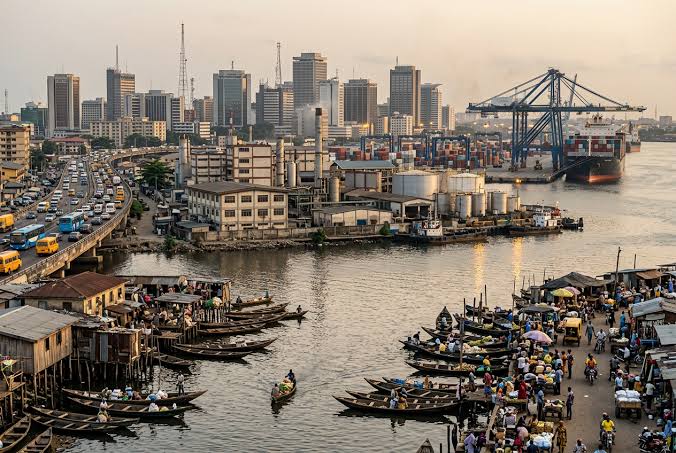
Lagos did not become Nigeria’s commercial capital by accident, long before skyscrapers, sprawling estates, and billion-dollar developments transformed its skyline, the city owed its success to one defining advantage,its geography.
Nestled along the Atlantic coast and surrounded by lagoons, creeks, and natural harbours, Lagos grew from a small fishing settlement into one of Africa’s largest and most influential cities. The same waterways that welcomed traders from across West Africa and Europe centuries ago helped shape the city into Nigeria’s financial powerhouse.
Ironically, those same geographical features that made Lagos prosperous are now contributing to one of its greatest environmental challenges. Rising sea levels, disappearing wetlands, unchecked urban expansion, and a sinking coastline are threatening the very foundation on which the city was built.
A City Born From Water
Before it became the bustling metropolis known today, Lagos was a collection of islands and fishing communities inhabited primarily by the Awori people, a Yoruba subgroup believed to have settled the area centuries ago.
The city’s original name, Èkó, reflected its indigenous heritage before Portuguese explorers arrived in the 15th century and named it Lagos, after the Portuguese port city.
Unlike many inland settlements, Lagos developed around water.
Barrier islands, lagoons, mangrove forests, creeks, and estuaries surrounded the settlement, creating natural waterways that connected the Atlantic Ocean to communities deep within present-day southwestern Nigeria.
These waterways became highways for trade long before roads were constructed.
Fishermen, merchants, and traders transported goods through the lagoon system, turning Lagos into one of the busiest commercial centres along the West African coast.
Why Geography Made Lagos Rich
Lagos occupies one of the most strategic coastal locations in West Africa.
Its deep natural harbour offered ships safe anchorage while its proximity to the Atlantic Ocean made it an ideal gateway for regional and international trade.
During the colonial era, the British expanded the city’s port infrastructure, transforming Lagos into Nigeria’s principal maritime trading centre.
Exports such as cocoa, palm oil, timber, rubber, and later crude oil passed through Lagos, cementing its economic importance.
After independence, industries, banks, manufacturing companies, multinational corporations, and government institutions concentrated around the city.
The ports at Apapa and Tin Can Island became among the busiest in Africa, handling millions of tonnes of cargo each year.
Businesses naturally followed.
Today, Lagos contributes a significant share of Nigeria’s economic activity despite occupying less than one percent of the country’s land area.
Its thriving financial sector, technology ecosystem, entertainment industry, manufacturing base, aviation links, and maritime economy continue to attract millions of residents and investors.
The geography that enabled centuries of trade remains the foundation of Lagos’ economic dominance.
A City Built on Water
Yet the same geography that created opportunity also created vulnerability.
Lagos is not built on solid inland terrain.
Instead, the city spreads across a network of islands, peninsulas, sandbars, and reclaimed wetlands surrounded by the Lagos Lagoon and the Atlantic Ocean.
More than 60% of metropolitan Lagos consists of lagoons, wetlands, creeks, and other water bodies.
Neighbourhoods such as Victoria Island, Lekki, Ikoyi, Ikate, Banana Island, and Ajah occupy areas that were once mangrove forests, marshes, or shallow coastal waters.
Over time, these wetlands were reclaimed through sand filling to create land for housing estates, commercial districts, and luxury developments.
While reclamation expanded Lagos’ capacity to accommodate rapid population growth, it also removed many of the natural systems that protected the city from flooding.
Nature’s Flood Defence Has Disappeared
Wetlands perform a vital environmental function.
They act like giant sponges, absorbing rainfall, slowing floodwaters, filtering pollutants, and protecting coastlines from storm surges.
Mangrove forests also reduce the force of ocean waves before they reach inland communities.
As Lagos expanded, many of these ecosystems disappeared beneath concrete.
Roads, shopping centres, housing estates, and business districts replaced natural floodplains.
Without these protective landscapes, rainwater has fewer places to collect, increasing the frequency and severity of urban flooding.
Climate Change Is Changing the Rules
Climate change has intensified these existing vulnerabilities.
Global temperatures continue to rise, causing glaciers and polar ice sheets to melt while warming oceans expand.
Together, these processes raise global sea levels.
Because much of Lagos sits only about one metre above sea level, even modest increases in ocean height can have significant consequences.
During heavy rainfall, high tides often prevent stormwater from flowing into the Atlantic Ocean.
Instead, seawater pushes inland while rainwater remains trapped across roads and neighbourhoods.
Residents have witnessed this repeatedly in Lekki, Victoria Island, Lagos Island, and other low-lying communities where streets quickly transform into rivers after storms.
The City Is Also Sinking
The threat does not come only from rising oceans.
The land itself is gradually sinking.
Large portions of Lagos rest on soft layers of clay, silt, and reclaimed swamp that naturally compress over time.
Rapid urbanisation has accelerated this process.
As high-rise buildings, highways, bridges, and commercial developments become heavier, the underlying soil continues to compact.
Environmental experts also point to excessive groundwater extraction as another contributing factor.
With limited access to reliable public water supplies, many households and businesses depend on private boreholes.
Removing large volumes of groundwater weakens underground soil structures, causing the land to settle even faster.
The combined effect of land subsidence and rising sea levels increases flood risk across the city.
Development Has Become a Double-Edged Sword
Lagos’ ambition has produced globally recognised developments.
Projects such as Eko Atlantic City, Banana Island, and several waterfront estates showcase engineering innovation and economic confidence.
However, creating new land often requires extensive dredging and sand filling.
These activities alter coastal currents, disturb marine ecosystems, and eliminate additional wetlands that once served as natural flood barriers.
Environmental experts argue that while development remains essential for economic growth, it must be balanced with stronger environmental planning.
Otherwise, today’s solutions may create tomorrow’s disasters.
Why Lagos Matters Beyond Nigeria
The future of Lagos carries implications far beyond its borders.
The city is home to more than 20 million people and serves as the headquarters of major banks, multinational companies, technology startups, media organisations, and manufacturing industries.
Its ports handle much of Nigeria’s international trade, making Lagos central to the country’s economy.
Any disruption caused by worsening floods, coastal erosion, or infrastructure damage would affect businesses, food supply chains, transportation, and investment across West Africa.
Protecting Lagos is therefore not simply a local environmental issue,it is an economic necessity.
Can Lagos Be Saved?
Experts believe the answer is yes, but only through coordinated action.
Protecting remaining wetlands, restoring mangrove forests, expanding drainage systems, reducing indiscriminate sand filling, regulating groundwater extraction, and enforcing strict environmental impact assessments are among the measures needed to reduce long-term risks.
Investment in coastal defences, flood management infrastructure, and climate-resilient urban planning will also become increasingly important.
Equally essential is improving waste management, as blocked drainage channels continue to worsen flooding during the rainy season.
The Irony of Lagos
Lagos demonstrates how geography can shape a city’s growth and prosperity. Its waterways, coastal location, and natural harbour helped transform it into Nigeria’s commercial and financial centre, attracting businesses, industries, and millions of residents.
Today, those same geographical features present new challenges as climate change, rapid urbanisation, and environmental degradation increase the risk of flooding and land subsidence. While these issues require careful planning and long-term investment, experts believe that sustainable development, stronger environmental policies, and better infrastructure can help improve the city’s resilience.
As Lagos continues to grow, balancing economic development with environmental protection will be essential to ensuring the city remains a vibrant place to live, work, and invest for generations to come.