There are places in the world where life is shaped by extreme heat, violent storms or dangerous wildlife, but in Longyearbyen, a remote settlement in Norway’s Svalbard archipelago, the environment creates an unusual problem: even death has to be carefully planned.
Longyearbyen is often described as “the place where nobody is allowed to die.” The phrase sounds like an urban legend, but it comes from a real practice. People can certainly die there, but traditional burial of bodies is generally avoided because the Arctic permafrost can preserve human remains for an exceptionally long time.

A Town at the Top of the World
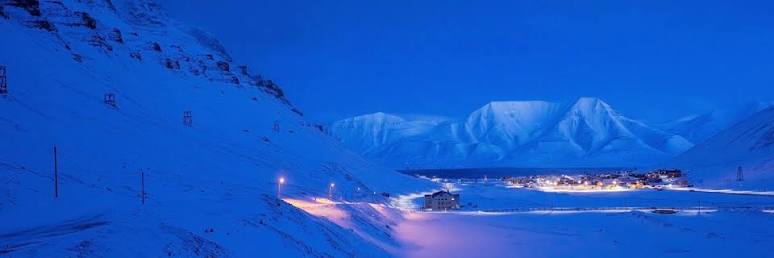
Longyearbyen is located on Spitsbergen, the largest island in the Svalbard archipelago, far north of mainland Norway.
It is one of the world’s northernmost permanent settlements, situated roughly halfway between mainland Norway and the North Pole. The town is surrounded by dramatic Arctic scenery mountains, glaciers, snow-covered valleys and the icy waters of the Arctic Ocean.
Life here is very different from life in most populated parts of the world.
During part of the winter, the sun does not rise above the horizon for weeks. This phenomenon is known as the polar night. During summer, the opposite happens: the sun remains visible around the clock for an extended period, creating the famous midnight sun.
The population is relatively small, but Longyearbyen has many of the basic services associated with a modern community, including shops, restaurants, schools, healthcare facilities and an airport.
Yet beneath all of this lies one of the biggest challenges: permafrost.
The Frozen Ground Beneath the Town
Permafrost is ground that remains frozen for at least two consecutive years. In the Arctic, some areas have remained frozen for centuries or even thousands of years.
Longyearbyen is built on ground affected by permafrost.
This frozen environment creates a fascinating problem when it comes to burial.
Normally, after a person is buried, microorganisms gradually break down the body. Temperature, moisture and soil conditions all influence how quickly decomposition occurs.
But extremely cold and frozen conditions can dramatically slow this natural process.
In Longyearbyen, bodies buried in the frozen ground can remain preserved for much longer than they would in warmer climates.
And that is where the story becomes particularly unusual.
The Graves That Preserved the Past
Longyearbyen has a historic cemetery containing graves from the early 20th century.
Among those buried there are people who died during the 1918 influenza pandemic, one of the deadliest disease outbreaks in modern history.
When researchers examined some of these graves decades later, they found that biological material had survived remarkably well because of the frozen conditions. The discovery demonstrated the extraordinary preservation capabilities of Arctic permafrost.
The concern wasn’t simply about the existence of old graves. It was also about what could happen if the frozen ground eventually thawed. A warming Arctic could potentially expose biological material that had remained frozen for generations.
Why the 1918 Flu Graves Became Important
The 1918 influenza pandemic killed millions of people worldwide.
In Longyearbyen, some victims were buried in the local cemetery. Because the graves were located in permanently or seasonally frozen ground, researchers later found that genetic material from the influenza virus had survived.
This provided scientists with valuable information about the historic virus.
It also highlighted something scientists already knew about permafrost: frozen ground can act almost like a natural freezer.
It can preserve organic material that would normally decay.
That includes not only human remains but also plants, animals and microorganisms. As Arctic temperatures rise, scientists are paying increasing attention to what could be released when previously frozen material thaws.
So, Are People Actually Forbidden From Dying?
This is where the famous story needs some clarification.
Death itself is not illegal in Longyearbyen.
People can become seriously ill and die there, and unexpected deaths can obviously occur.
The unusual rule concerns what happens afterward.
Because of the environmental and practical challenges associated with burial, Longyearbyen generally does not conduct new conventional burials of people who die there.
If someone is terminally ill, arrangements may be made to transfer them to mainland Norway, where they can receive appropriate care and eventually be buried or cremated.
So the popular phrase “nobody is allowed to die” is really a dramatic way of describing a practical policy surrounding death and burial.
There Is a Cemetery But It Is Historic
Interestingly, Longyearbyen does have a cemetery.
You might expect this to contradict the entire story.
It doesn’t.
The cemetery contains historic graves, but it is not generally used for new conventional burials.
Many of the graves date back to the period when Longyearbyen was primarily a coal-mining community.
The cemetery therefore tells the story of an earlier generation of Arctic workers who came to Svalbard to work in one of the world’s harshest environments.
Today, the cemetery is also a reminder of how dramatically the settlement has changed.
Longyearbyen Was Built Around Coal
Longyearbyen was founded as a coal-mining settlement in the early 20th century.
Mining companies established operations there because Svalbard contains significant coal deposits.
Workers were brought to the Arctic to extract coal under extremely difficult conditions.
The industry shaped the town’s identity for decades.
Mining was dangerous, and accidents claimed lives. Harsh weather, isolation and the demanding working conditions made Svalbard a challenging place to live.
Over time, however, Longyearbyen became much more than a mining settlement.
Tourism, scientific research and international Arctic activities now play major roles in the local economy.
The Arctic Is Changing
The story of Longyearbyen’s cemetery is becoming even more relevant because the Arctic is warming rapidly.
Permafrost is not necessarily permanent.
When temperatures rise, frozen ground can begin to thaw.
This can create major problems for communities built on it.
Buildings can become unstable. Roads can be damaged. Pipes and other infrastructure can shift as the ground beneath them changes.
For Longyearbyen, this is a particularly serious issue because so much of the settlement’s infrastructure was constructed with frozen ground conditions in mind.
The cemetery story is therefore part of a much larger environmental issue.
The Strange Connection Between Death and Climate Change
The relationship between burial and climate change may seem unusual, but it demonstrates how interconnected Arctic life can be.
For decades, frozen ground helped preserve graves.
Now, as temperatures rise, the same frozen ground is becoming less reliable.
The concern is not that people will suddenly emerge from their graves. Rather, thawing permafrost can expose biological material that has been locked away for decades or centuries.
Scientists are particularly interested in understanding what microorganisms and viruses may survive in frozen environments and what risks, if any, their release could pose.
This is one reason Arctic permafrost has become an important area of scientific research.
Life Under the Midnight Sun
The unusual relationship between life and death is only one of the things that makes Longyearbyen fascinating.
The town experiences some of the most extreme seasonal light conditions on Earth.
During the polar night, the sun remains below the horizon for an extended period. Instead of normal daylight, residents experience long periods of darkness and twilight.
Then, months later, the situation completely reverses.
During the midnight sun season, the sun remains above the horizon and the town can experience continuous daylight.
This dramatic change affects sleep, work, tourism and everyday life.
Residents have adapted to a rhythm that is very different from what most people experience farther south.
A Community Built in One of Earth’s Harshest Environments
Despite its remote location, Longyearbyen is not an abandoned outpost.
It is a functioning community where people work, study, conduct scientific research and welcome visitors from around the world.
But its location means that nature is always present.
Avalanches can threaten buildings. Polar bears inhabit the surrounding region. Extreme cold can make travel dangerous, while the changing permafrost threatens infrastructure.
Residents therefore have to live with a constant awareness of their environment.
Even something as ordinary as walking outside requires more consideration than it might elsewhere.
Why This Place Fascinates the World
Longyearbyen’s famous “no dying” reputation has turned it into one of the world’s most intriguing places.
But the real story is much more interesting than the headline.
It is a story about permafrost, history, climate change, scientific discovery and human adaptation.
The town demonstrates how geography can influence even the most fundamental aspects of human life.
In most places, death is followed by burial or cremation without much thought about the surrounding soil.
In Longyearbyen, the frozen Arctic environment makes burial a completely different question.
And that is what makes this remote Norwegian settlement so extraordinary.
In Longyearbyen, you can live at the edge of the world—but even death has to follow the rules of the Arctic.