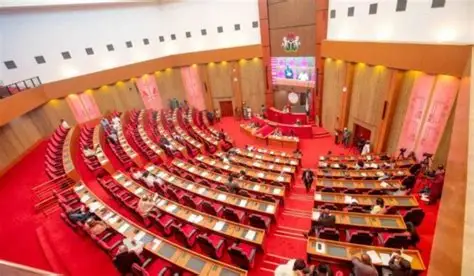
The resolution followed a motion sponsored by Senator Abdulaziz Yar’Adua, Chairman of the Senate Committee on Army, during Tuesday’s plenary at the National Assembly.
The motion was prompted by the increasing attacks, abductions, and killings of serving and retired military personnel, including the recent killing of former Director of Defence Information, retired Major General Rabe Abubakar.
Lawmakers expressed concern that the continued release and reintegration of former insurgents under the Federal Government’s deradicalisation programme could be undermining efforts to restore security, particularly in northern Nigeria.
The Senate also condemned the rehabilitation of Boko Haram insurgents, bandits, kidnappers, and other violent criminals, describing the trend as a threat to national security.
The lawmakers highlighted several attacks on retired military officers between 2023 and 2026, including the killing of retired Major General Richard Duru in Owerri after a reported $50,000 ransom payment, the murder of retired Brigadier General O.M. Harlord Udokwere in Abuja, the 56-day abduction of former NYSC Director-General, retired Brigadier General Maharazu Tsiga, and the death of retired Major Aja while in captivity in Kogi State.
According to the Senate, the targeting of retired senior military officers poses serious risks because many of them previously held strategic intelligence and command positions.
As part of its resolutions, the Senate observed a minute of silence in honour of Major General Rabe Abubakar and all victims of terrorism, banditry, kidnapping, and other violent crimes across Nigeria.
The Upper Chamber urged the Federal Government to ensure that all perpetrators of violent crimes are arrested and prosecuted.
It also called on security and intelligence agencies to strengthen intelligence gathering, surveillance, threat assessment, intelligence sharing, and early warning systems to improve the country’s response to security threats.
The Senate further urged the government to accelerate the deployment of modern security technologies to combat terrorism, banditry, and kidnapping.
The Federal Government introduced Operation Safe Corridor in 2016 as a deradicalisation, rehabilitation, and reintegration programme for former Boko Haram fighters who voluntarily surrendered.
The initiative is built on five pillars: disarmament, demobilisation, deradicalisation, rehabilitation, and reintegration. According to government figures, thousands of former insurgents have passed through the programme and returned to civilian life.
However, concerns have persisted over reports that some rehabilitated individuals allegedly returned to armed groups, prompting renewed criticism of the initiative.
Reacting to the Senate’s decision, political scientist and security expert Dr. Babayo Sule described the resolution as “unfortunate” and potentially counterproductive.
According to him, deradicalisation remains a globally recognised component of counter-insurgency strategies and should be strengthened rather than abolished.
He argued that the Federal Government adopted the programme only after conventional military operations failed to completely end insurgency.
Dr. Sule acknowledged that the programme has recorded shortcomings but maintained that the solution lies in improving oversight, funding, and implementation rather than scrapping it.
He urged the Senate to investigate the challenges facing Operation Safe Corridor and engage security agencies to address operational gaps.
The security expert also argued that there is no established evidence directly linking the rehabilitation programme to the resurgence of insecurity.
Instead, he attributed Nigeria’s security challenges to factors including weak security infrastructure, corruption, inadequate logistics, negligence, and the politicisation of security issues.
Dr. Sule warned that abandoning deradicalisation efforts without an effective alternative could further worsen the country’s security situation.