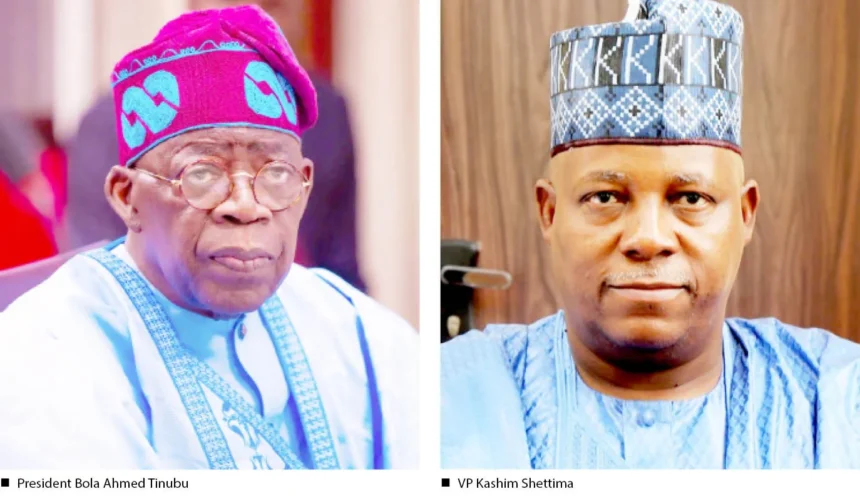
Questions have emerged over the constitutional status of presidential authority following President Bola Ahmed Tinubu’s decision to extend his stay abroad beyond the initially announced three-week vacation.
Tinubu left Nigeria on August 30 for a three-week vacation in Europe. The Presidency later announced that he had extended his stay by another week and would return home over the weekend. (Daily Trust)
The development has renewed attention on Section 145 of the 1999 Constitution, which provides for the transfer of presidential functions to the Vice President when the President is on vacation or otherwise unable to discharge the functions of his office.
The Constitution requires the President to transmit a written declaration to the President of the Senate and the Speaker of the House of Representatives. Until another declaration is transmitted, the Vice President is to perform the functions of the President as Acting President.
Section 145(2) further provides that if the President fails to transmit such a declaration within 21 days, the National Assembly may, by a simple majority of each chamber, mandate the Vice President to perform the functions of the President as Acting President. (Trust Radio)
The extension of Tinubu’s stay has therefore triggered questions over whether a formal handover letter was transmitted to the National Assembly.
Daily Trust reports that attempts to establish whether such a letter was transmitted were unsuccessful, while the Senate is currently on recess. A source at the Senate reportedly said determining whether a letter had been received could be difficult while lawmakers were away. (Trust Radio)
The Presidency has also not publicly confirmed whether Tinubu transmitted a formal declaration or explained the constitutional arrangements governing his extended absence.
Special Adviser to the President on Information and Strategy, Bayo Onanuga, said the President would return home over the weekend. He also said Secretary to the Government of the Federation, George Akume, would continue representing Tinubu at official functions during his absence. (Trust Radio)
The issue has attracted reactions from opposition figures and civil society organisations.
Former Vice President Atiku Abubakar called on the Presidency to clarify who is exercising presidential authority, arguing that the constitutional 21-day period had elapsed.
The African Democratic Congress also questioned the absence of publicly available information on whether the required declaration had been transmitted.
The Centre for Democracy and Development, however, said the matter could be subjected to judicial interpretation, with its Director, Dauda Garuba, noting that citizens have the right to seek clarification through the courts. (Trust Radio)
Legal opinions have also differed.
Lawyer and rights activist Hamza Dantani argued that administrative representation at official events should not be confused with the constitutional exercise of presidential powers, while Senior Advocate of Nigeria Taiye Oniyide said he did not consider the situation, as reported, to amount to a constitutional infraction.
Oniyide also raised a practical question over the situation created by the President and Vice President both being outside the country, particularly regarding who would exercise presidential functions if a formal transfer had been made to the Vice President. (Trust Radio)
Nigeria has previously experienced situations in which presidents formally transmitted power to their deputies while away.
Former President Muhammadu Buhari transmitted letters to the National Assembly on several occasions, including during his vacations in 2016 and 2017, allowing Vice President Yemi Osinbajo to perform presidential functions.
The country also faced a major constitutional and political crisis during the prolonged absence of former President Umaru Musa Yar’Adua in 2010. The National Assembly eventually invoked the Doctrine of Necessity to empower then-Vice President Goodluck Jonathan as Acting President. (Trust Radio)
The current debate therefore centres on the interpretation and application of Section 145, particularly the requirements that arise when a President is unable or fails to formally transmit a declaration after 21 days.
As Tinubu’s extended stay abroad continues, the question of whether presidential authority has been formally transferred — and, if not, what constitutional mechanism applies — remains a subject of public and legal debate. (Trust Radio)