Human trafficking is no longer limited to forced labour or sexual exploitation as criminal networks are increasingly trapping victims inside scam compounds and forcing them to carry out online fraud, making cyber-enabled exploitation one of the fastest-growing forms of modern slavery.
This shift has drawn global attention to a disturbing reality. Behind many online scams are people who never intended to become fraudsters. Instead, they were deceived with promises of legitimate jobs, only to find themselves imprisoned, abused and forced to scam strangers under constant threats of violence.
The global campaign theme, “Trapped Behind the Scam,” highlights this growing crisis and reminds governments that many people committing online fraud are victims of human trafficking who need protection rather than punishment.
Human trafficking has evolved significantly over the past decade.
While sexual exploitation and forced labour remain widespread, criminal groups now use technology to recruit victims through fake job advertisements, social media platforms and fraudulent recruitment agencies.
According to the International Organization for Migration (IOM), hundreds of thousands of people have been trafficked into heavily guarded scam compounds where they are forced to commit financial fraud.
Victims are often promised well-paying jobs abroad, but after arriving in another country, traffickers confiscate their passports, restrict their movement and subject them to violence, intimidation and debt bondage.
Many survivors have described being beaten, deprived of food, isolated from the outside world and monitored around the clock while being forced to carry out online scams.
Why Victims End Up Inside Scam Compounds
Most victims do not knowingly join criminal organisations.
Instead, traffickers exploit people’s desire for better opportunities by advertising fake jobs in customer service, technology, hospitality or sales.
Once victims arrive, they quickly discover they have been deceived.
Many have their travel documents taken away, while armed guards prevent them from escaping. Those who refuse to participate in online scams often face physical abuse, torture or additional financial penalties designed to keep them trapped.
Human trafficking has therefore expanded beyond traditional exploitation into what experts now describe as forced criminality.
Nigeria Remains Vulnerable to Human Trafficking
Nigeria continues to be a source, transit and destination country for human trafficking.
According to available data, about 65 percent of trafficking cases occur within Nigeria, while 35 percent involve cross-border movement.
Thousands of Nigerians leave the country each year hoping to find better jobs and improved living conditions. Unfortunately, many fall victim to organised trafficking networks that exploit poverty, unemployment and misinformation.
Women and young people remain among the most vulnerable groups.
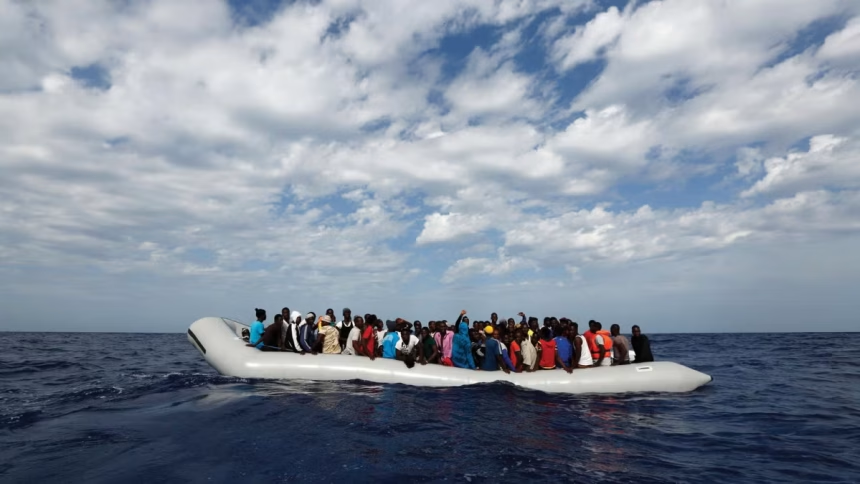
The IOM reported that about 11,000 Nigerian women arrived in Italy through the Mediterranean in 2016, compared with 1,454 two years earlier. Many later became victims of sexual exploitation.
In 2017, about 18,000 Nigerians reached Europe through Mediterranean migration routes, while the United Nations Development Programme (UNDP) reported that Nigerians accounted for 17 percent of African migrants travelling to Europe in 2019.
Why So Many People Take the Risk
Migration itself is not a crime.
However, irregular migration often exposes people to trafficking networks that prey on vulnerable individuals searching for better opportunities.
The UNDP estimates that 93 percent of irregular migrants face serious risks during their journey.
Although poverty remains an important factor, researchers say it is not the only reason people migrate. Many victims also leave because they believe promises of quick financial success or attractive overseas jobs that later prove to be fraudulent.
Traffickers deliberately exploit hope, desperation and limited access to accurate information.
A Criminal Industry Worth Billions
Human trafficking has become one of the world’s most profitable criminal enterprises.
In recent years, organised crime groups have increasingly relied on trafficked victims to operate large-scale online scam operations targeting people across the globe.
The United Nations Office on Drugs and Crime (UNODC) estimates that scam-related crimes caused financial losses of between $88.3 billion and $114.1 billion across East Asia, Southeast Asia, Australia and New Zealand in 2025 alone.
Many of those scams were allegedly carried out by victims working under coercion inside organised scam compounds.
To tackle the growing problem, the IOM has launched a regional strategy focused on preventing trafficking for forced criminality, protecting victims and strengthening international cooperation.
Between 2022 and 2025, the organisation assisted more than 3,500 victims of trafficking for forced criminality from 39 countries.
Rescue Is Only the Beginning
Escaping a trafficking network rarely marks the end of a survivor’s ordeal.
Many return home carrying severe emotional trauma after months or even years of abuse. Others struggle with debt, unemployment, missing identity documents and the fear of being treated as criminals instead of victims.
Organisations such as the IOM work alongside governments and civil society groups to identify survivors, provide temporary shelter, reunite families and offer medical, psychological and legal support.
Helping survivors rebuild their lives has become just as important as rescuing them.
Stopping Human Trafficking Requires More Than Arrests
Law enforcement alone cannot solve human trafficking.
Experts say stronger border cooperation, public awareness campaigns, better employment opportunities and safer migration pathways are all essential to reducing the influence of trafficking networks.
Governments must also improve international cooperation because these criminal organisations often operate across several countries at the same time.
At the same time, the public has an important role to play by verifying overseas job offers, reporting suspicious recruitment agencies and learning how traffickers operate.
The Bottom Line
Human trafficking continues to evolve alongside technology, making it more difficult to detect and easier for organised criminal networks to exploit vulnerable people across borders.
Understanding that many people trapped inside online scam operations are victims rather than willing participants is an important step towards developing more effective responses.
As technology changes the nature of organised crime, governments, businesses and individuals will all need to work together to prevent exploitation, protect survivors and dismantle the networks that profit from modern slavery.