What would happen if a Nigerian trader could travel to Ghana, a Ghanaian manufacturer could buy goods from Côte d’Ivoire, and a Senegalese company could expand into Nigeria without worrying about converting currencies at every step?
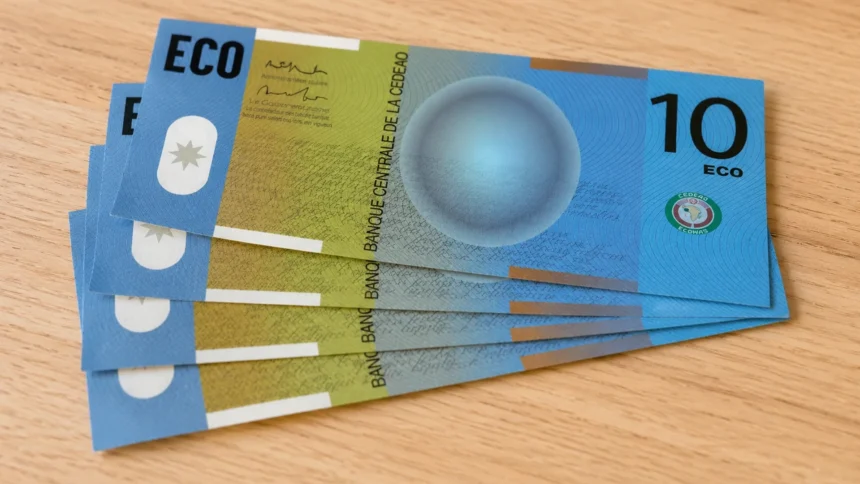
That is part of the ambition behind the Eco single currency, West Africa’s long-running plan to establish a common monetary system for participating ECOWAS countries.
Inspired partly by Europe’s experience with the euro, the Eco is designed to make cross-border trade easier, encourage investment and strengthen economic integration across the region. The idea is straightforward: participating countries would operate under a shared monetary framework, reducing some of the currency barriers that currently complicate regional commerce.
But the Eco remains a project rather than a currency in circulation. After decades of discussions, postponed deadlines and difficult economic negotiations, West Africa is still working towards the possibility of a common currency.
And now, with ECOWAS maintaining a 2027 target and considering a phased approach, the question has returned with renewed urgency: is West Africa finally ready to share one currency?
Why West Africa Wants a Common Currency
West Africa is already connected by trade, migration and economic activity. Goods and services regularly move across borders, while businesses operate in markets that extend beyond their home countries.
Yet, every national currency introduces another layer of complexity.
A Nigerian company doing business with Ghana, for instance, has to consider the exchange rate between the naira and the cedi. Businesses trading across several countries may have to manage multiple currencies, exchange-rate fluctuations and additional transaction costs.
For small businesses operating on tight margins, these challenges can become significant.
A common currency could reduce some of these barriers by allowing participating countries to conduct transactions without constantly converting between national currencies. It could also make prices easier to compare and provide businesses with greater certainty when planning regional investments.
The objective, therefore, is not simply to introduce a new banknote.
It is to make economic activity across West Africa feel more like operating within one larger market.
More Than a Currency
The Eco is part of a much broader ambition for regional integration.
A common monetary system could encourage companies to expand into neighbouring countries because they would face fewer currency-related obstacles. Manufacturers could potentially source raw materials from different parts of the region, establish production networks across borders and sell into a larger market.
That could have implications for investment, manufacturing, employment and regional supply chains.
Imagine, for example, a manufacturer sourcing agricultural products from one West African country, processing them in another and selling the finished products across several markets without having to navigate multiple currency systems at every stage.
That is the kind of economic integration the Eco is intended to support.
But creating a common currency does not automatically create a common economy.
And that is where the real difficulty begins.
The Euro Provides Inspiration — But Also a Warning
Europe’s euro provides one of the most visible examples of what a common currency can achieve.
By bringing participating European economies under a shared currency, the euro removed the need for currency conversion for many transactions within the monetary union and helped deepen economic integration.
West Africa hopes to capture some of those advantages.
However, the European experience also demonstrates that a monetary union requires more than political agreement.
Countries sharing a currency must accept that decisions about interest rates, monetary stability and other aspects of economic management can no longer be made entirely at the national level.
That creates a fundamental question for ECOWAS: how much economic sovereignty are member states prepared to share in exchange for deeper regional integration?
The Problem of Different Economies
West Africa is not one uniform economy.
Nigeria has a large and diversified economy with significant oil production, while other countries depend more heavily on agriculture, mining, tourism, services or other sectors.
Inflation, public debt, foreign reserves, fiscal positions and economic growth also vary from one country to another.
These differences matter because a single monetary policy may not produce the same result everywhere.
If one country is experiencing high inflation and needs tighter monetary conditions while another is struggling with weak economic growth and needs policies that encourage spending and investment, a common interest-rate decision could benefit one economy while creating difficulties for another.
This is one of the central challenges of monetary union.
The Eco, therefore, is not simply a question of printing a common banknote. It requires participating economies to become sufficiently aligned for a shared monetary policy to function effectively.
The Conditions Countries Must Meet
To address these differences, ECOWAS has established economic convergence requirements for countries seeking to participate in the monetary union.
These requirements are intended to encourage greater economic stability before countries adopt a common currency.
Among the conditions are expectations around inflation, fiscal deficits, foreign reserves and broader monetary and fiscal stability.
The principle is straightforward: countries should not enter a monetary union while their economies are moving in completely different directions.
However, meeting these requirements has also contributed to the slow progress of the project.
For governments facing inflation, fiscal pressures, debt challenges or limited reserves, achieving the required level of economic convergence can be difficult.
The result has been a recurring tension between the political desire to launch the Eco and the economic reality of preparing countries for a common monetary system.
Why Has the Eco Taken So Long?
The dream of a West African single currency is not new.
The project has been discussed for decades as part of ECOWAS’s broader integration agenda. The name Eco was formally adopted by ECOWAS in 2019, but earlier launch expectations were repeatedly postponed.
Economic challenges, convergence difficulties and disagreements over how the currency should operate have continued to push the project forward.
In 2021, ECOWAS adopted a new roadmap targeting 2027.
By 2026, the project remains alive, with ECOWAS leaders reaffirming their commitment to the 2027 target and considering a phased approach under which countries that meet the required conditions could potentially join first.
That approach could change the dynamics of the project.
Instead of waiting for every ECOWAS member to become ready at the same time, a phased system could allow countries that achieve the necessary economic conditions to move ahead.
But it would also raise new questions about how a monetary union would function if some major economies were outside it at the beginning.
The CFA Franc Question
No discussion about a West African common currency can avoid the CFA franc.
Eight West African countries currently use the West African CFA franc through the West African Economic and Monetary Union.
The proposed Eco has been associated with efforts to reform the region’s existing monetary arrangements, creating debates about monetary independence and the historical role of France in the CFA franc system.
For supporters of the Eco, a broader regional currency could represent a new stage of monetary integration.
For critics and observers, however, the transition raises questions about how monetary sovereignty would be structured and how the new currency would relate to existing monetary arrangements.
The broader ECOWAS project is ultimately intended to provide a regional currency for participating member states, but getting there requires resolving both economic and political questions.
What Would the Eco Mean for Nigeria?
Nigeria would be one of the most important economies in any West African monetary union.
The country is a major regional trading hub, with businesses operating across neighbouring markets and significant commercial links throughout West Africa.
For Nigerian businesses, a successful Eco could reduce some of the currency barriers associated with regional trade. Companies seeking to expand into neighbouring countries could potentially operate within a more predictable monetary environment.
It could also strengthen regional economic integration and potentially create a larger market for Nigerian goods and services.
But the benefits would come with a major trade-off.
Nigeria would surrender part of its independent monetary policy.
Decisions affecting interest rates, monetary conditions and currency management would increasingly be influenced by a regional monetary framework rather than being determined solely by Nigeria’s domestic economic priorities.
For one of Africa’s largest economies, that would be a significant change.
The Road to 2027
The Eco has survived decades of postponed deadlines and difficult negotiations.
Yet the project has not disappeared.
The 2027 target represents another attempt to turn the long-standing ambition into a functioning monetary union. The consideration of a phased approach also suggests that ECOWAS is looking for ways to overcome the problem of different levels of economic readiness among member states.
But a deadline alone cannot create a successful currency.
The participating economies must be able to meet convergence requirements, maintain credible institutions and coordinate monetary and fiscal policies effectively.
There must also be confidence in the institutions responsible for managing the currency.
For ordinary citizens, the ultimate measure will be much simpler: whether the Eco makes economic life easier.
Can West Africa Create Its Own Euro?
The Eco represents one of West Africa’s most ambitious economic projects.
If successfully implemented, it could reduce currency barriers, support regional trade, encourage investment and deepen economic integration among participating countries.
But the risks are equally significant.
Countries would have less control over their individual monetary policies, while economic shocks could affect member states differently. The success of the project would therefore depend on strong institutions, economic discipline and the willingness of governments to coordinate their policies.
The challenge is particularly significant because West Africa is home to economies with very different structures, levels of development and economic priorities.
That makes the Eco more complicated than simply creating a common currency.
It is ultimately an experiment in how much economic integration West African countries are willing to embrace.
For decades, the region has talked about breaking down the barriers separating its economies.
The Eco could become one of the most visible expressions of that ambition.
But before the first Eco note enters circulation, West Africa must answer a much bigger question than what the currency will look like:
Can diverse economies surrender part of their monetary independence and build enough economic trust to share one currency?
That is the real test of the Eco.