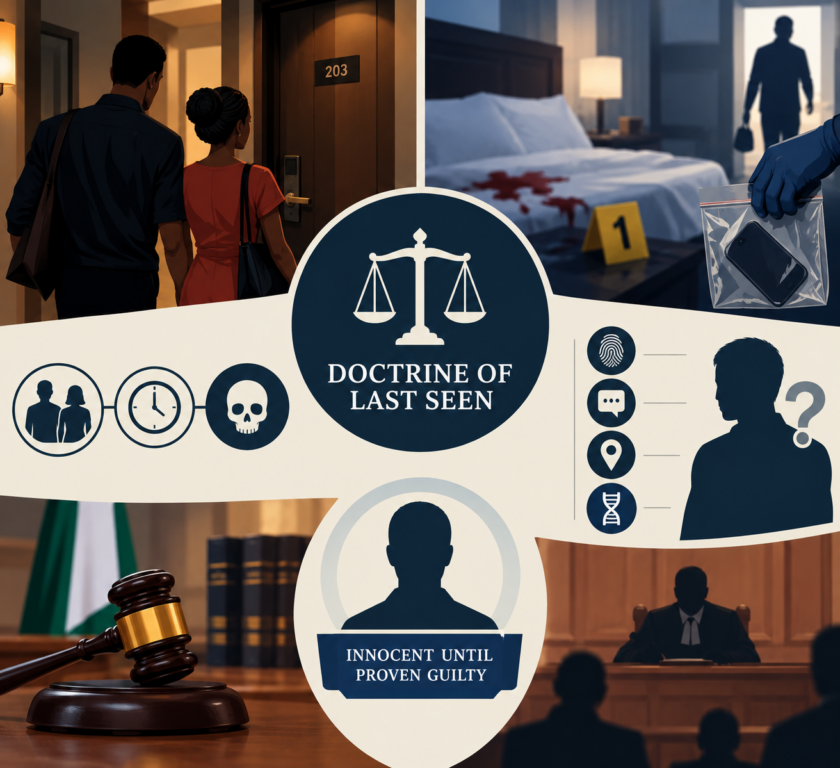
The Doctrine of Last Seen concerns the evidential significance of the last known encounter between a deceased person and someone suspected of involvement in their death. It may become relevant when the circumstances surrounding the death, together with other evidence, point towards the person last seen with the deceased.
However, the principle does not mean that the last person seen with a deceased individual is automatically guilty. Its significance depends on the strength of the evidence, the circumstances of the death and whether the prosecution can establish guilt beyond reasonable doubt.
How the Doctrine of Last Seen Works
In cases involving suspicious deaths, investigators often work to establish a timeline of events, including when the deceased was last seen alive, who was with them and what happened afterwards.
Where the evidence shows that an accused person was last seen with the deceased shortly before the death, that encounter may form an important part of the prosecution’s case. Its weight may increase when other circumstances, such as unexplained events, inconsistent accounts or physical evidence, connect the accused to the death.
The court must, however, examine the circumstances as a whole. The fact that two people were together before one died does not, by itself, establish that the surviving person caused the death.
The central question is whether the evidence provides a sufficiently strong and reliable connection between the accused and the offence.
The Hotel Room Mystery: When the Last Encounter Raises Questions
Consider a situation in which a man and a woman check into a hotel together. About two hours later, hotel staff knock on their door after receiving no response. When the room is eventually checked, the woman is found dead, while the man is nowhere to be found.
The circumstances immediately raise questions. What happened inside the room? When did the woman die? Why was the man absent, and can the available evidence establish what occurred?
In a case of this nature, investigators may focus on the man because he was reportedly the last person known to have been with the deceased. His whereabouts, account of events and any forensic evidence may become relevant to the investigation.
Yet, his presence in the room and subsequent absence cannot independently answer every question. A court must determine whether the evidence establishes his responsibility for the death rather than treating suspicion as proof.
The legal practitioner whose explanation informed this example identified a case as Achibong v. State. The precise case citation and facts should be verified against the original judgment before publication.
When a Journey Ends in Death
The doctrine may also arise in circumstances involving people who travel together before one of them disappears or is later found dead.
In another illustrative account, a driver and a conductor reportedly left together in a vehicle but did not return as expected. The vehicle was eventually returned to its owner by another person, prompting concerns about the missing men. Months later, the conductor’s body was reportedly discovered.
The driver was said to have provided an explanation of what happened during the journey. In a criminal investigation, that account could be examined alongside the timeline, the circumstances of the disappearance, any inconsistencies and other available evidence.
Such facts may help investigators reconstruct events, but they do not automatically establish murder. The court must determine whether the evidence sufficiently connects the accused to the death and whether any reasonable alternative explanation remains.
Does the Doctrine Shift the Burden of Proof?
A crucial distinction is that the Doctrine of Last Seen is not an automatic presumption of guilt. It must be understood within the broader principles governing criminal trials in Nigeria.
Section 36(5) of the Constitution of the Federal Republic of Nigeria 1999, as amended, provides for the presumption of innocence of a person charged with a criminal offence until proven guilty. Under the general rule in criminal proceedings, the prosecution must prove its case beyond reasonable doubt.
Consequently, an accused person does not become guilty merely because they were the last known companion of the deceased. The prosecution must establish the necessary elements of the alleged offence through admissible evidence.
An accused person’s explanation, conduct or disappearance may be relevant when considered alongside other evidence. However, the court must evaluate the circumstances carefully and determine whether they establish guilt to the required legal standard.
The doctrine gives evidential significance to the last known encounter; it does not replace the prosecution’s obligation to prove the offence.
Why Circumstantial Evidence Matters
Criminal cases are not always established through eyewitness testimony. In some investigations, the prosecution may rely substantially on circumstantial evidence: facts from which a court may draw conclusions about what happened.
The last known encounter may be one such fact. Other relevant circumstances could include forensic findings, the timing of the death, communications, movements, witness accounts and inconsistencies in explanations offered during the investigation.
Individually, some facts may appear inconclusive. When considered together, however, they may help establish a sequence of events and whether the accused was responsible.
The court must still examine the reliability of the evidence and determine whether the combined circumstances support the charge beyond reasonable doubt. Suspicion, even when strong, is not the same as proof.
The Difference Between a Person of Interest and a Guilty Person
Being the last person seen with someone who later dies can attract police attention, lead to questioning and make an individual central to an investigation. But these developments must be distinguished from a finding of criminal guilt.
Investigators seek to establish what happened. Prosecutors must present sufficient evidence to prove the alleged offence. The court then determines whether the evidence satisfies the applicable legal standard.
This distinction is essential to protecting both the integrity of criminal investigations and the rights of accused persons. Treating the last known companion as automatically responsible could encourage premature conclusions before all relevant evidence has been examined.
Ultimately, the Doctrine of Last Seen is about how a person’s last known encounter with the deceased may contribute to a wider body of evidence. It can help direct an investigation and strengthen a circumstantial case, but it does not make proximity proof of murder.
The decisive question remains whether the evidence, assessed as a whole, establishes guilt beyond reasonable doubt.