
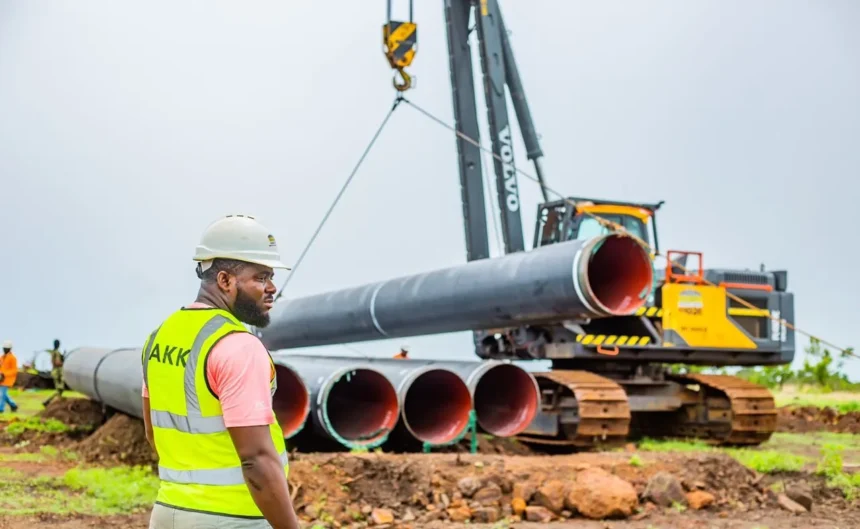
Six years after it was launched with promises of transforming Nigeria’s energy landscape and accelerating industrial development in the North, the multi-billion-dollar Ajaokuta-Kaduna-Kano (AKK) Gas Pipeline Project is yet to commence gas supply despite nearing completion.
The Nigerian National Petroleum Company Limited (NNPCL) says the 614-kilometre pipeline has reached 98 percent completion, with the entire pipeline stretching from Ajaokuta in Kogi State to Kano already laid. However, key supporting infrastructure needed for gas distribution remains incomplete, leaving the project without a definitive operational date.
NNPCL’s Chief Corporate Communications Officer, Andy Odeh, disclosed that work is now focused on above-ground facilities and intermediate pigging stations, which are essential for monitoring, regulating and safely transmitting gas through the pipeline.
Although no official commissioning date has been announced, the company said it is targeting September 2026 for the commencement of gas delivery on a phased basis, beginning with the Ajaokuta-Gwagwalada corridor.
A Project Designed to Transform Northern Nigeria
The AKK pipeline, valued at approximately 2.8 billion US dollars, is regarded as Nigeria’s largest domestic gas transmission project.
First conceived under the Nigerian Gas Master Plan approved in 2008, the project forms Phase One of the Trans-Nigeria Gas Pipeline and is expected to connect the country’s abundant gas reserves with industries and power plants across Abuja, Kaduna and Kano.
Construction officially commenced in June 2020 after years of planning and procurement, with the Federal Government promising completion within 24 months.
The pipeline was designed to transport approximately 2.2 billion standard cubic feet of natural gas per day, support the generation of 3,600 megawatts of electricity, revive manufacturing industries, particularly textiles in northern Nigeria, and stimulate investments in fertiliser, petrochemical and methanol production.
The project is also expected to strengthen Nigeria’s ambition of becoming a regional gas hub by supporting the proposed Trans-Saharan Gas Pipeline to Europe.
Multiple Missed Deadlines
Despite these ambitious goals, the AKK project has suffered repeated delays.
Originally scheduled for completion in June 2022, the deadline has been shifted several times.
Subsequent completion dates announced by NNPCL officials included late 2023, December 2024, the first quarter of 2025 and July 2026.
Each target was missed due to a combination of financial constraints, security challenges, difficult terrain and engineering complexities.
NNPCL now says September 2026 remains its latest projected timeline, although completion still depends on finishing critical support infrastructure.
Pipeline Completed, Stations Still Missing
Investigations along the pipeline corridor indicate that while underground pipeline installation has largely been completed, several major gas stations and distribution terminals remain unfinished.
In Kano, the terminal located at Tamburawa has reportedly seen little progress beyond fencing and basic security installations more than a year after its expected completion.
The facility currently consists of perimeter fencing, security towers, office cubicles, solar-powered installations and utility structures, while the main processing infrastructure has yet to be constructed.
Construction activities have only recently begun on an adjacent site designated for a second terminal.
Industry observers note that without these facilities, gas cannot be received, processed or distributed to industries and power plants.
Technical and Security Challenges
The project encountered significant engineering difficulties, particularly during the crossing of the River Niger near Koton Karfe in Kogi State.
Engineers eventually deployed Horizontal Directional Drilling (HDD), a sophisticated underground drilling technology, after earlier methods proved unsuccessful.
Construction was also disrupted by insecurity.
Project engineers disclosed that kidnappings and attacks on construction workers forced work to stop for several months until additional security measures were introduced.
The terrain itself presented further obstacles, with contractors navigating rocky formations, hills, rivers and valleys across Kogi and other states along the pipeline route.
Private Investors Preparing for Gas Supply
Although government infrastructure remains incomplete, private investors have already begun developing gas off-take facilities around Ajaokuta.
Industry sources say these investments are intended to facilitate early gas distribution to industries while construction of other supporting infrastructure continues.
Officials believe this phased approach could accelerate gas utilisation once the first sections become operational.
Economic Expectations Remain High
Energy experts say the AKK pipeline remains one of Nigeria’s most strategically important infrastructure projects.
Beyond improving domestic gas supply, the pipeline is expected to reduce dependence on diesel, lower energy costs for manufacturers, increase electricity generation and create thousands of jobs across northern Nigeria.
The project is also central to Nigeria’s “Decade of Gas” initiative aimed at positioning natural gas as a major driver of industrialisation and economic diversification.
Experts Warn of Rising Costs and Lost Opportunities
Energy economist Bala Zakka described the prolonged delay as disappointing, warning that Nigeria is losing valuable opportunities while other energy-producing nations continue expanding their gas infrastructure.
He argued that the repeated postponements have increased project costs significantly due to inflation, currency depreciation and rising financing expenses.
According to him, had the project been completed earlier, Nigeria would have benefited from lower construction costs, improved electricity generation, expanded industrial activity and stronger export opportunities.
He added that the delays have slowed job creation and weakened the country’s competitiveness in the global energy market.
Similarly, Professor Dayo Ayoade, an energy law expert at the University of Lagos, warned that the delays could undermine investor confidence and threaten Nigeria’s long-term gas development strategy.
He noted that prolonged completion timelines may affect financing arrangements, increase refinancing risks and weaken the country’s credibility in delivering major infrastructure projects.
According to him, delayed gas supply also affects the expansion of Liquefied Petroleum Gas (LPG), Compressed Natural Gas (CNG) and other cleaner energy alternatives that Nigeria hopes to promote.
NNPCL Maintains Optimism
Despite the setbacks, NNPCL insists substantial progress has been made.
The company says the pipeline itself is complete, with remaining work limited to above-ground facilities required for safe operations.
According to the corporation, gas delivery will commence in phases as each section becomes fully operational, with the first supply expected to reach Gwagwalada before extending to Kaduna and Kano.
If completed as projected, the AKK Gas Pipeline is expected to become one of Nigeria’s most important energy infrastructure projects, boosting electricity generation, supporting industrial growth and strengthening gas distribution across the country after nearly two decades of planning and six years of construction.