

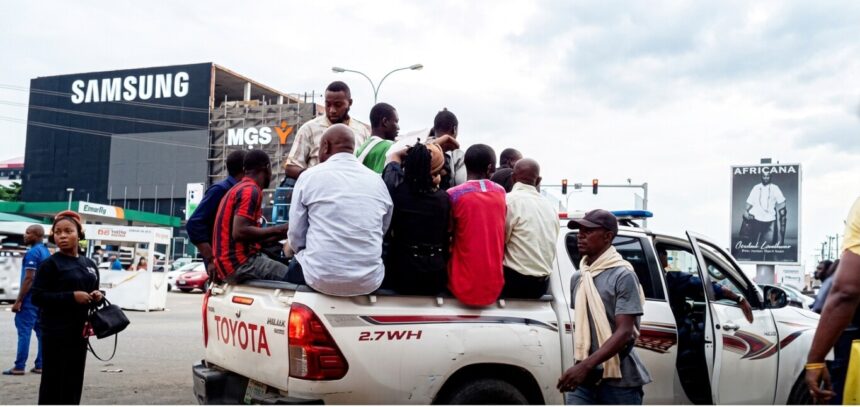
Workers in the Federal Capital Territory (FCT), Abuja, are adopting desperate measures to cope with rising transportation costs and declining purchasing power, with some commuters resorting to riding in the open backs of pick-up vans while others turn their private cars into commercial taxis to supplement their incomes.
For workers earning around the N70,000 national minimum wage, the rising costs of transportation, food, accommodation and education have made it increasingly difficult to meet basic household needs.
Some commuters now risk their safety by travelling in pick-up vans because they are cheaper than commercial buses, while employees who own vehicles charge colleagues for rides to offset rising fuel expenses.
Patience, 28, who lives in Masaka, a satellite community on the outskirts of Abuja, earns N77,000 monthly but spends about N2,000 daily on transportation.
She said commercial fares could reach N1,500 for a journey, while waiting for cheaper transport often meant arriving home as late as 8pm or 9pm after closing from work at 5pm.
Patience said she sometimes travelled in the open backs of pick-up vans, where passengers scramble for limited space, despite sustaining a scratch on her leg while trying to board one.
She explained that some drivers charged N300 from Masaka, making the option more affordable than regular commercial transport.
She called on the government to take measures to reduce fuel prices and ease the burden on commuters.
For some workers who own cars, rising fuel prices have also made it difficult to continue offering free rides to colleagues and friends.
An employee of a private company in Abuja, who spoke on condition of anonymity, said he had started charging colleagues for rides after finding it increasingly difficult to cover the cost himself.
He said the decision had affected his relationships with colleagues, but his salary could no longer cover fuel and other essential expenses.
The worker disclosed that he spent about N11,000 on fuel on a day he went to work, adding that the amount was barely enough for his commute from the Mararaba-Nyanya axis.
At that rate, fuelling his vehicle for 22 working days would cost N242,000, far exceeding the monthly minimum wage.
Workers Struggle to Feed Their Families
The pressure is particularly severe for workers with families, who must divide their earnings among food, education, healthcare and other household expenses.
Adamu Umar, 50, a government employee, said his salary often went towards food and outstanding school fees immediately after payday, leaving little for other needs.
He said he sometimes used his earnings to buy a bag of maize and relied on income from poultry farming to meet additional family expenses.
Umar called for a substantial wage increase, arguing that workers needed salaries that reflected prevailing economic realities.
Teachers Battle Transport and Housing Costs
The education sector is also feeling the impact of rising living costs, with teachers spending substantial portions of their earnings on transportation and struggling to secure affordable accommodation near their workplaces.
Jane Ama, a primary school teacher in Abuja, said she spent N3,000 daily commuting to and from Jiwa because she could not afford accommodation closer to the city centre.
With four children, including two in university, she said meeting school fees, transportation costs and other household expenses had become increasingly difficult.
Ama called for the provision of staff accommodation for primary school teachers, saying it would reduce transportation expenses and ease the financial pressure on workers.
Another primary school teacher, Raphael Omale, who works in Utako District, said he spent about N2,800 daily commuting from Kuje.
He said the high cost of accommodation had forced many teachers to live in distant communities such as Masaka and Mararaba.
According to him, the long journeys could affect teachers’ punctuality and productivity, particularly when they struggled to arrive before the first lessons of the day.
Transport Fares Consume Workers’ Salaries
Transportation remains a major burden on Abuja workers, particularly those commuting from satellite communities to the city centre.
Petrol prices reportedly reached about N1,500 per litre in some parts of the country in September 2026 before easing to between N1,350 and N1,400 in early October.
For a worker commuting from the Nyanya-Mararaba axis to the city centre, daily return fares can reach at least N2,500.
A worker spending that amount over 20 working days would pay N50,000 monthly on transportation alone, leaving just N20,000 from a N70,000 salary for food, rent, healthcare and other necessities.
An Abuja-based transport expert and Chief Executive Officer of Nairaxi, Kingsley Eze, said the FCT lacked sufficient vehicles to meet the transportation needs of its growing population.
He said studies indicated that the city needed about 15,000 buses to ease congestion and provide more comfortable journeys for commuters.
However, Eze noted that purchasing and maintaining such a fleet would require substantial investment, making sustainable financing essential.
He added that the government needed to improve residents’ purchasing power so that commuters could afford fares without sacrificing other basic needs.
The limited availability of public transport, alongside the underutilisation of the Abuja light rail system, has placed additional pressure on existing services, contributing to long journeys and high fares.
NLC Demands Minimum Wage Review
The Nigeria Labour Congress (NLC) has said the N70,000 minimum wage introduced in 2024 has lost much of its purchasing power because of inflation and the depreciation of the naira.
Its president, Joe Ajaero, said the economic conditions under which the wage was negotiated had changed significantly, reducing its value relative to the cost of living and the exchange rate.
He argued that wage increases alone would not provide lasting relief unless the government also addressed inflation and the rising costs of essential goods and services.
Ajaero said wage demands should reflect the costs of housing, transportation, food and education, cautioning that salary increases without addressing underlying economic problems could trigger further price increases.
In September 2026, members of the Joint National Public Service Negotiating Council protested in Abuja, demanding a N500,000 minimum wage.
Ajaero said government intervention in transportation, housing, energy and food production could help ease workers’ financial burden.
He maintained that affordable public services and measures to reduce living costs would help workers stretch their incomes further.
Economist Says N70,000 Wage Is Inadequate
An economist at the Institute of Professional Economists and Policy Management, Abuja, Dr Yushau Aliyu, said the N70,000 minimum wage was inadequate compared with prevailing living costs.
He argued that workers could not reasonably be expected to cover transportation, healthcare, education and food expenses with such earnings, particularly amid high fuel prices.
Aliyu said declining purchasing power had widened the gap between household income and expenditure, worsening the financial difficulties faced by workers.
According to the National Bureau of Statistics, headline inflation eased marginally from 15.43 per cent in July to 15.39 per cent in August 2026.
Despite the decline, the cost of essential goods and services remains a concern for households whose incomes have not kept pace with their expenses.
Aliyu said commodity prices continued to change while workers’ incomes remained largely unchanged, further worsening their financial difficulties.
The growing pressure on Abuja workers has renewed calls for improved public transportation, affordable housing, wage reviews and broader economic measures to reduce the cost of living.