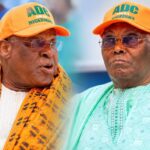



Less than 24 hours after the African Democratic Congress (ADC) successfully held the flag-off of its presidential campaign in Sokoto, the party has suffered another setback, as a Federal High Court in Abuja on Thursday nullified the processes that led to the emergence of former Vice President Atiku Abubakar as its presidential candidate.
Justice Peter Lifu of the Federal High Court, in a judgement, also voided the emergence of the former Senate President, David Mark, Rauf Aregbesola and others as national officers of the ADC. The judge nullified all actions taken by the David Mark leadership, including the nominations of all the ADC candidates contesting the 2027 general elections, for emerging from an “illegal and unlawful” leadership of the party.
Justice Lifu upheld the case of Nafiu Bala Gombe, a former Deputy National Chairman of the ADC, that the emergence of David Mark and Rauf Aregbesola as the leaders of the party was unlawful.
Atiku condemned the judgement, describing it as a calculated attempt to weaken the ADC and frustrate his candidacy.
Addressing a crowd of party supporters during a campaign rally at the party secretariat complex in Birnin Kebbi on Thursday, Atiku stated that the court verdict was a deliberate move to derail his 2027 presidential campaign programmes.
“My root is in Northern Nigeria, but my candidacy belongs to all Nigerians. Hunger and hardship do not recognise boundaries,” he added.
Atiku said Nigerians across the country are suffering under the APC-led government and deserve a leader with credible plans to make life affordable again.
He noted that Justice Musa Liman of the Federal High Court had earlier dismissed a previous challenge to David Mark-led leadership and wondered why another case was filed to reopen the same dispute.
“This is a calculated attempt to circumvent a subsisting judgement. We will challenge this judicial maneuver at the Court of Appeal,” he said.
He added that the journey to rescue Nigeria from hardship imposed by the APC government is a long one, insisting that he would continue to campaign because Nigerians deserve relief from “this crushing cost of living crisis.”
Meanwhile, Gombe, in an interview with Daily Trust, commended the judgement, saying it’s a victory for democracy.
He said, “We thank God for the judgement. This is not about Nafiu Bala. Democracy is the winner here. We already have candidates across the country. Our next move is to continue our campaign across the country for the 2027 elections. We were already in Sokoto last week. Our campaign council will be out tomorrow (Friday) and our campaign will continue.”
Gombe had sought an order restraining Mark, Aregbesola and others from parading themselves as leaders of the party.
The plaintiff sued the ADC, Mark, Aregbesola, INEC and the party’s former National Chairman, Ralph Nwosu, as first to fifth defendants, respectively.
Gombe’s argument was premised on the claim that the emergence of Mark, Aregbesola and others as national leaders of the party violated the provisions of the ADC constitution as well as the Electoral Act guiding how political parties’ leadership should emerge through national conventions.
Mark, Aregbesola, ADC and others had filed a total of 27 separate motions to counter the case and prayed for its dismissal at the preliminary stage, but the motions were thrown out by the judge for being frivolous and baseless.
Ruling can undermine democracy – Peter Obi
The presidential candidate of the NDC, Mr Peter Obi, expressed shock over the court ruling nullifying the emergence of Mark as the ADC national chairman and all the actions he had taken.
Obi, via his verified X handle, described the judgement as unsettling, noting that it is time to strengthen democracy in Nigeria by allowing the opposition to thrive.
He maintained that the sustenance of democracy in Nigeria amid encroaching military rule in West Africa should strengthen the resolve to protect opposition politics and not stamp out opposition parties.
Obi stated, “I do not challenge the ruling of the court. The court of law is constituted to determine disputes according to the law. My concern is that three months before a general election, it is in the public interest to have certainty.
“It is not good to have too many uncertainties about candidates and parties a few weeks before a presidential election. This instability is obviously engineered by the ruling party, just as they have done against me in the Labour Party and continue to do so to close down civic space for a robust campaign. It is also from the same rulebook that manufactures violence against us in our campaigns.”
‘Judgement overtaken by events’
The African Democratic Congress Presidential Campaign Council (ADC PCC) dismissed the judgement delivered by Justice Lifu, describing it as an “academic exercise that has been overtaken by events”.
Director, Media and Publicity of the ADC PCC, Kola Ologbondiyan, in a statement, however, said its legal team is prepared to appeal the verdict.
He said the council maintains that the judgement is of no practical effect and cannot override or displace an existing court ruling on the same subject matter.
“The leadership question has already been subjected to judicial scrutiny by a court of coordinate jurisdiction. It is therefore untenable to suggest that a subsequent pronouncement can simply erase or displace an existing judicial decision without due regard to the principles governing judicial authority and the administration of justice,” it said.
The ADC PCC further said the ruling is an exercise in futility, particularly as the party’s legal team is taking immediate steps to challenge the decision through the appropriate judicial channels.
“Beyond its legal implications, however, the timing of this judgement raises serious concerns. It comes against the backdrop of the failed APC presidential campaign flag-off in Kaduna and the hugely successful and unprecedented ADC presidential campaign flag-off in Sokoto.
“The contrast is unmistakable: while the ADC is gaining momentum and attracting growing national acceptance, the ruling party appears increasingly unsettled by the prospect of a formidable opposition.
“Rather than confront the ADC politically and through the ballot box, the APC appears increasingly desperate to deploy every available instrument to frustrate the opposition and undermine its growing electoral momentum,” the statement added.
Ologbondiyan said it is particularly unfortunate that Justice Lifu has once again become associated with a controversial judicial pronouncement involving the ADC.
“He is the same judge whose earlier judgement declaring the party deregistered was subsequently set aside by the Court of Appeal. The Council is also aware of developments surrounding the proceedings, including allegations of pressure and political interference. We consider it imperative that the independence, impartiality and integrity of the judiciary must never be compromised or sacrificed on the altar of partisan political interests,” the campaign said.
Judicialisation of political contest – YIAGA Africa
The Executive Director of YIAGA Africa, Samson Itodo, said the judgement raised serious concerns about the growing “judicialisation” of political competition ahead of the 2027 elections.
He said while the courts have a constitutional responsibility to resolve political disputes, people must be concerned about the increasing use of litigation to determine who can participate in elections.
“I would hesitate to conclude that this judgement is part of a deliberate plot to muzzle the opposition without concrete evidence. However, the cumulative effect of these legal battles is the shrinking of political competition and the restriction of voter choice.
“My greatest concern is that we are gradually shifting the contest for political power from the ballot box to the courtroom. The courts must protect democratic competition, not become instruments for eliminating political alternatives before Nigerians cast their votes,” Itodo said.
But a Kano-based political analyst and National Vice-President of the Nigerian Political Science Association (NPSA), Prof. Murtala Muhammad, said the judgement raised fundamental questions about constitutionalism, institutional discipline and the future of multiparty democracy in Nigeria.
He said the controversy surrounding the ADC leadership is not an isolated case, noting that party crises have become a recurring feature across the country’s political landscape.
According to him, democratic governance cannot thrive when political parties themselves fail to operate democratically.
He argued that in many political parties, internal elections are either not conducted in a democratic manner or established procedures and protocols are not strictly followed.
How verdict may affect states
The ambitions of several prominent politicians contesting on the platform of the ADC could also be threatened by the court judgement.
Our correspondents report that there are states where the ADC and its governorship, senate and House of Representatives candidates appear to be doing well so far.
They include governorship candidates like Modibbo Hammantukur Ribadu in Adamawa; Isa Mohammed Ashiru Kudan in Kaduna; Senator Ahmad Babba Kaita, Katsina; former Attorney-General of the Federation Abubakar Malami, Kebbi; Manir Mohammad Dan’iya, Sokoto and Senator Sabo Mohammed Nakudu, Jigawa.
Various analyses have suggested that these ADC candidates are known to be giving the candidates of the ruling parties a run for their money in the respective states.
Controversy over Justice Lifu’s previous ruling
Daily Trust reports that the Court of Appeal, Abuja Division, had on July 28 set aside a judgement by Justice Lifu that ordered deregistration of the African Democratic Congress (ADC), Accord Party and three other political parties.
Justice Lifu had directed the Independent National Electoral Commission (INEC) to deregister the five political parties, which allegedly failed to meet the constitutional requirements needed to warrant their continued existence and participation in future elections.
The ruling also barred INEC from according further recognition to the parties, accepting nominations of candidates from the affected parties, or giving effect to their activities for purposes of participating in the 2027 general elections.
Justice Lifu had ruled that he found merit in the suit filed by the National Forum of Former Legislators (NFFL).
The NFFL claimed that the five political parties listed as defendants had persistently failed to meet the constitutional benchmarks required to retain their registration.
The former legislators stressed that the requirements include winning at least 25 per cent of the votes in a state during a presidential election, or securing at least one elective seat at the national, state, or local government level.
They told the court that the ADC and the four other parties had performed poorly in both the 2023 general elections and the by-elections conducted by INEC, thereby failing to win seats across key tiers of government.
The litigants maintained that the continued existence of the ADC and the other defendants as recognised political parties was unlawful and undermined the integrity of the country’s electoral system.
The Attorney General of the Federation and Minister of Justice, Prince Lateef Fagbemi, SAN, who was also a defendant in the matter, threw his weight behind the plaintiffs.
The AGF argued that the continued existence of the said political parties violated extant provisions of the 1999 Constitution (as amended) and ultimately undermined the nation’s electoral integrity.
However, dissatisfied with the trial court’s verdict, all the defendants, including INEC, urged the appellate court to set it aside.
The appellate court subsequently ordered a stay of execution of the Federal High Court judgement, while slamming the trial judge for disregarding the judicial hierarchy.
The panel berated Justice Lifu for disobeying an order it had made on May 22, directing him to stay proceedings in the case pending the outcome of an appeal by the parties.
The appellate court, while describing the judgement “a nullity,” held that “what the learned trial court did amount to judicial impertinence or what the Supreme Court called judicial insubordination. The three-man panel of the appellate court presided over by Justice Abba Mohammed, in a unanimous decision, held that the trial court had no judicial power to hear the case initially.
Who is Justice Lifu?
Justice Peter Odo Lifu, a judge at the Federal High Court in Abuja, was born in Okpoma, Yala Local Government Area of Cross River State.
Before he joined the federal bench, he obtained his Law degree from the University of Jos. He was called to the Nigerian Bar in 1990.
He also holds a Masters degree in Political Science and a Master of Laws (LL.M.) from the University of Ibadan.
Before his judicial appointment, he practiced law in Ibadan and lectured at the Department of Public and International Law, University of Ibadan.
He has presided over several high-profile political and constitutional cases.
Justice Lifu frequently handles high-stakes political disputes, election matters, and regulatory cases. Some of his notable judgements are; the recent affirmation of the Senator Nenadi Usman-led caretaker committee as the legitimate leadership of the Labour Party.
Before issuing the court orders mandating the INEC to deregister the ADC and four other political parties, he had earlier presided over multiple cases involving the Peoples Democratic Party (PDP).
One of them was issuing injunctions restraining the party from removing Umar Damagum as Acting National Chairman and stopping the PDP’s national convention.
Justice Lifu was also the judge who restricted INEC from releasing the voters’ register to the Rivers State Independent Electoral Commission (RSIEC) for the conduct of local government elections in the state.
The judge was also the one, who dismissed the motion filed by a plaintiff identified as Johnmary Jideobi and cleared a former President of Nigeria, Goodluck Jonathan, to participate in the 2027 presidential race.
Following his orders and judgements, various groups and individuals had earlier filed a series of petitions against the judge.
The leadership of the ADC had earlier petitioned the National Judicial Council (NJC) over alleged bias against the Judge.