

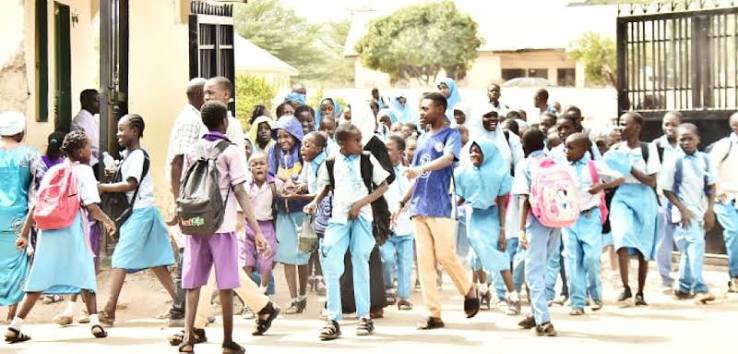
Some schoolchildren from low-income families in the Federal Capital Territory (FCT) are missing classes as rising transportation costs make daily journeys to school increasingly unaffordable.
Parents, students and school administrators who spoke with the News Agency of Nigeria (NAN) in Abuja on Friday said escalating transport fares had disrupted school attendance, affected academic performance and forced some families to reconsider their children’s education arrangements.
Solomon Enemona, a tailor and parent living in Dutse Alhaji, said he now spends N2,000 daily transporting his two children to school in Kubwa, compared with the N800 he previously paid.
He said the increased cost had forced him to reduce their school attendance from five days to three days a week to enable him to meet other household expenses.
“I have no choice but to take this measure because, if I don’t, I may not be able to feed the family, pay our rent and other utility bills,” Enemona said.
Another parent, Danjuma Musa, said he was considering withdrawing his children from a private school in Wuse and enrolling them in a government school closer to their residence in Mpape.
Musa explained that transportation costs had tripled, making it increasingly difficult to ensure his children attended classes regularly.
“Sometimes, they miss school because I am unable to pay for their transportation,” he said.
He added that although he enrolled his children in the private school to give them access to quality education, the prevailing economic situation might force him to reconsider the decision.
Andrew Innocent, another parent, said he sometimes had to choose which of his children’s transportation fares to pay when he could not afford the cost for all of them.
He added that he occasionally borrowed money to ensure his children attended school, warning that prolonged absenteeism could affect their academic performance.
Schools Report Increased Absenteeism
The Vice-Principal of Goke Akinwale International Academy, Dawaki, Mrs Rachel Musa, said rising transportation costs had increased absenteeism among pupils and negatively affected their academic performance.
According to her, transporting four children to school could cost as much as N4,000 daily, placing considerable pressure on parents already struggling with household expenses.
She noted that the situation was also affecting teachers, some of whom spend about N2,000 daily commuting to school.
“Even the teachers themselves too miss classes because of transportation,” she said.
The vice-principal explained that pupils who frequently missed lessons often struggled to keep pace with their classmates.
To minimise the effects, she said the school sometimes organised make-up tests for absent pupils and allowed them to copy notes from classmates to catch up on missed lessons.
She added that the school had withdrawn some of its buses because of rising operational costs and complaints from parents about transportation charges.
Musa also attributed the problem to poor road conditions, which increase vehicle maintenance costs, and called on the government to rehabilitate roads and address rising fuel prices.
Similarly, the Principal of Smartmind Success Academy, Jikwoyi, Mr Oneyi Edwin, said the school had discontinued bus services for pupils living far away because the operation had become financially unsustainable.
Edwin said some pupils, including those living in Kurudu, had previously depended on the school buses to get to classes.
He explained that the school lost some pupils after discontinuing the service because their parents could no longer afford alternative transportation.
Students Resort to Trekking, Reduce Attendance
The rising cost of transportation has also forced students to walk long distances and miss classes.
Samson Daruwana, a Senior Secondary School student, said he had missed school twice within two weeks because he could not afford transportation.
He disclosed that on one occasion, he arrived late after walking to school and missed a test.
Another student, Jonah Jock, said missing classes while his classmates continued learning had affected his morale and academic performance.
Tony Nwachukwu, a Junior Secondary School student who lives in Giri but attends school in Gwagwalada, said he now attended classes four days a week because of the high cost of transportation.
Nwachukwu explained that the fare from Giri to Gwagwalada had increased from N200 to N500, leaving him with little choice but to trek to school.
“It used to be N200 from Giri to Gwagwalada, but now, they collect N500, so I just trek Mondays to Thursdays and start my weekends on Fridays, so I can rest properly,” he said.
Parents Urge Government to Intervene
Parents, students and school administrators called on the government to address rising transportation costs and improve road infrastructure to reduce the burden on families.
They warned that continued increases in transport fares could worsen absenteeism, disrupt teaching and learning, and widen educational inequalities between children from low-income households and those whose families can afford daily transportation.
NAN reports that transportation costs have risen sharply in recent months, with transport operators attributing the increase to persistent increases in fuel prices.
The development has added to the financial pressures facing families, leaving some parents struggling to balance their children’s education with essential household expenses.