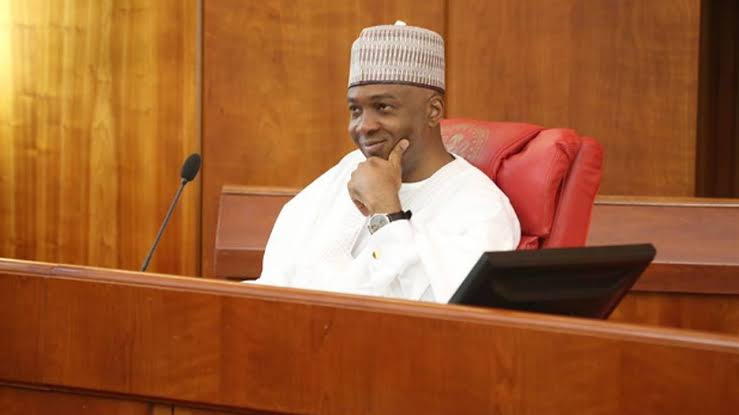
The 8th Senate’s four-year tenure, led by former Senate President Bukola Saraki from 2015 to 2019, remains one of the most debated periods in Nigeria’s Fourth Republic legislature.
Supporters of the Senate have described it as one of the most productive legislative sessions since 1999, pointing to its legislative output, landmark economic reforms, constitutional amendments and relatively assertive oversight of the executive.
Critics, however, argue that the chamber’s frequent confrontations with the Muhammadu Buhari administration, disputes over budgets and appointments, and questions about legislative accountability make any claim that it was Nigeria’s “best” Senate hard to sustain without qualification.
A review of official records, independent assessments and contemporary reactions shows that the 8th Senate recorded significant legislative achievements, but its overall performance depends heavily on what criteria are used to define legislative effectiveness.
Legislative output
One of the strongest arguments advanced in favour of the 8th Senate is the volume of legislation it processed.
A 2023 study published by the National Institute for Legislative and Democratic Studies (NILDS), which assessed the committee system and legislative functions of the 8th Senate, found that the Senate passed 172 bills during the 2015–2019 period. The study also found that Senate committees conducted public hearings, considered petitions, screened executive nominees and carried out oversight functions. (NILDS)
A separate YIAGA Africa assessment of the entire 8th National Assembly recorded 2,166 bills introduced and 515 passed by both chambers. Of that figure, 172 were passed by the Senate and 343 by the House of Representatives. (ICIR News)
The figures represented a significant increase in legislative activity compared with earlier assemblies.
In April 2018, the National Assembly itself reported that the Senate had passed 200 bills after 33 months. It said the figure had surpassed the totals recorded by the 7th, 6th and 5th Senates during their respective four-year terms. (NASS)
However, legislative output alone does not establish that one Senate was better than another.
A YIAGA Africa assessment noted that only a portion of the legislation passed by the 8th National Assembly received presidential assent. Of the 515 pieces of legislation passed by both chambers, 53 were declined by the President, while about 80 had received assent at the time of the assessment, with some bills still awaiting action. (EU-SDGN)
The same assessment also found that many bills took considerable time to pass. Only 47 of the 515 bills, or 9.1 per cent, were passed within 50 days, while 271, representing 52.6 per cent, took more than 351 days. (Punch)
This suggests that the quantity of bills passed should be considered alongside their quality, implementation and impact.
Landmark legislation
The 8th Senate can point to several pieces of legislation that had substantial policy significance.
Among them was the Companies and Allied Matters Act, which was eventually enacted in 2020 after the 8th National Assembly passed the bill. The legislation represented a major overhaul of Nigeria’s corporate regulatory framework.
The Senate also passed legislation relating to secured transactions in movable assets and credit reporting. Contemporary accounts linked the reforms to improvements in Nigeria’s business environment and access to credit. (The Guardian)
Another significant development was the Nigerian Financial Intelligence Unit legislation. The 8th Senate argued that the legislation helped Nigeria maintain its membership of the Egmont Group, an international network of financial intelligence units. (Abubakar Bukola Saraki)
The chamber also passed the North-East Development Commission Act, legislation relating to witness protection, whistleblower protection, mutual assistance in criminal matters and other economic and institutional reforms.
The 8th Senate additionally passed the Discrimination Against Persons with Disabilities Bill and legislation relating to railways, transportation, bankruptcy and insolvency, among others. (ThisDayLive)
The “Not Too Young To Run” reform
Perhaps the most politically visible constitutional reform associated with the 8th National Assembly was the “Not Too Young To Run” amendment.
The legislation lowered the minimum age requirements for certain elective offices, including the presidency and governorship, and was signed into law by President Buhari in 2018.
The reform was widely welcomed by youth organisations because it removed one of the constitutional barriers to younger Nigerians seeking elective office.
For supporters of the Saraki Senate, the amendment is an example of legislation whose significance goes beyond the number of bills passed because it directly altered the rules governing political participation.
Petroleum Industry Bill
The 8th Senate also made substantial progress on the long-running Petroleum Industry Bill.
Rather than passing the original omnibus proposal in one piece, lawmakers separated it into different components. The Senate passed the Petroleum Industry Governance Bill, although the proposed legislation did not become law during the 8th Assembly.
Saraki described the development as a breakthrough after years of legislative deadlock surrounding petroleum-sector reform. (Abubakar Bukola Saraki)
However, the fact that the wider petroleum reform remained incomplete is also part of the assessment of the Senate’s limitations.
The eventual Petroleum Industry Act was not enacted until 2021, during the 9th National Assembly.
Oversight and executive-legislative relations
Perhaps the most defining feature of the Saraki Senate was its relationship with the executive.
Saraki emerged as Senate President in 2015 despite opposition from elements within the ruling All Progressives Congress and the preferences of the party leadership at the time.
That political background contributed to tension between the National Assembly and the Buhari administration.
Academic analysis of executive-legislative relations during the Buhari years identifies the Saraki-led 8th National Assembly as having a particularly conflictual relationship with the executive. Issues included budgets, appointments and the exercise of legislative oversight. (RSIS International)
Saraki and his supporters presented that relationship differently. They argued that an independent legislature was necessary for constitutional checks and balances.
In a 2026 speech, Saraki again defended the 8th Senate’s approach, arguing that oversight is a constitutional mechanism through which elected representatives hold the executive accountable. He cited the Senate’s handling of executive nominations and its rejection of a proposed $29.96 billion borrowing request in 2016 because, according to him, sufficient details on its intended use had not been provided. (Abubakar Bukola Saraki)
The rejection of some executive nominees also became a major source of tension.
One prominent example was Ibrahim Magu, whose confirmation as substantive chairman of the Economic and Financial Crimes Commission was rejected by the Senate following security concerns.
At the same time, Saraki’s claim of an unusually confrontational Senate should be balanced against the fact that the chamber confirmed the overwhelming majority of presidential nominees.
Saraki said in 2018 that of 240 nominations submitted by the Presidency, the Senate had confirmed 227 and rejected 13. (The Guardian)
What analysts said
The assessment from outside the Senate was mixed.
Musa Rafsanjani, then Executive Director of Transparency International’s Nigeria-related civil society advocacy platform, commended the 8th National Assembly’s legislative output but was more critical of its oversight and constituency-accountability record.
Speaking to The PUNCH at the end of the Assembly’s tenure, Rafsanjani said the legislature had performed strongly in lawmaking but raised concerns about other core constitutional responsibilities. (Punch)
This distinction is important because a legislature is not judged solely by the number of laws it passes.
Its constitutional functions also include representation, oversight of public expenditure and executive agencies, scrutiny of government policies, confirmation of certain appointments and constituency representation.
A 2023 NILDS study offers a somewhat more favourable assessment of the committee system. Its findings indicated that committees of the 8th Senate conducted public hearings, processed petitions, screened nominees and undertook oversight activities. It specifically recorded 139 petitions concluded by the Senate Committee on Ethics, Privileges and Public Petitions, with 126 reports laid and considered. (NILDS)
These findings provide evidence that the committee system was active, although they do not by themselves establish that its impact was superior to every other Senate.
The budget controversy
The 8th Senate’s relationship with the executive also produced major disputes over the national budget.
The Buhari administration accused the National Assembly of altering executive budget proposals and introducing projects into appropriations.
The controversy surrounding the 2018 budget was particularly intense.
Critics argued that the legislature’s alterations amounted to excessive interference in executive policy priorities.
The National Assembly countered that reviewing and amending appropriation proposals was part of its constitutional responsibility.
The dispute was not simply about political rivalry; it reflected a fundamental question in presidential systems: how much discretion should the legislature exercise over public expenditure proposed by the executive?
Contemporary reporting documented repeated disagreements between the two branches over the 2018 budget and other areas of governance. (Punch)
Transparency and public engagement
Another feature frequently associated with the Saraki Senate was its effort to increase public access to legislative activities.
Saraki said the 8th Senate opened details of its budget to the public and introduced live streaming of plenary proceedings. He also highlighted public hearings and engagement initiatives as part of the Senate’s attempt to improve transparency. (TheCable)
The Senate also organised public engagements around issues including security and economic policy.
The chamber held a National Security Summit and interacted with security chiefs over the country’s worsening security situation. (PRNigeria News)
The significance of these initiatives, however, should be measured by whether they produced sustained institutional improvements rather than simply by the existence of the initiatives.
The criticisms
The 8th Senate was not without serious criticism.
One of the strongest criticisms concerned its relationship with the executive and the circumstances surrounding Saraki’s emergence as Senate President.
His election in 2015 occurred against the preference of sections of the APC leadership and was supported by lawmakers from opposition parties. The episode immediately created political tensions between the legislative leadership and the ruling party leadership. (The Guardian)
Critics also questioned the National Assembly’s handling of constituency projects, legislative remuneration and budget alterations.
Some critics went much further in their assessment.
For example, Prof. Itse Sagay, who served as Chairman of the Presidential Advisory Committee Against Corruption under Buhari, gave a sharply negative assessment of the 8th Senate, accusing it of attempting to assume executive powers and engaging in excessive confrontation with the Presidency. Those were his political assessments at the time, rather than an independent empirical measurement of legislative performance. (The Nation)
Other commentators defended the Senate’s independence, arguing that conflict between the branches was partly a natural consequence of checks and balances in a presidential system.
The Guardian, for example, characterised the period as one in which the Senate adopted a more assertive approach to legislation and oversight despite the political hostility surrounding its emergence. (The Guardian)
Was it really the “best”?
The available evidence supports a more careful conclusion than simply declaring the 8th Senate the best in Nigeria’s democratic history.
On legislative productivity, the record is strong. Independent research puts the Senate’s total bills passed at 172, while the entire National Assembly passed 515 pieces of legislation. Several of those laws dealt with important areas including corporate regulation, financial intelligence, youth participation, disability rights, economic regulation and regional development. (NILDS)
On institutional independence, the 8th Senate was unusually assertive. Its disagreements with the Buhari administration demonstrated that the legislature was prepared to challenge executive preferences. Whether that should be interpreted as effective checks and balances or counterproductive political confrontation depends partly on the particular episode being examined.
On oversight, the record is mixed. There is evidence of extensive committee activity and petitions, but civil society assessments also raised concerns about the quality of oversight and constituency accountability. (NILDS)
On implementation, the record is also mixed. A significant number of bills did not receive presidential assent during the life of the Assembly, while some of its most ambitious reforms, particularly petroleum-sector reform, were completed only after the 8th Assembly had left office. (Punch)
That means the label “best” ultimately depends on the yardstick.
If the yardstick is legislative volume and the passage of several consequential reforms, the 8th Senate has a substantial record.
If the yardstick is executive-legislative cooperation, speed of budget passage, implementation of legislation and the quality of oversight, the evidence is considerably more complicated.
The historical record therefore presents the Saraki Senate as a highly productive and unusually assertive legislature, but not one whose superiority over every previous or subsequent Senate can be established as an objective fact.
The more defensible assessment is that the 8th Senate occupies a significant place in Nigeria’s Fourth Republic because it combined high legislative activity with strong institutional friction, producing both notable reforms and considerable controversy.
That combination, rather than an uncontested claim of being Nigeria’s “best” Senate, is what makes the 2015–2019 period particularly important for understanding the evolution of legislative independence and executive-legislative relations in Nigeria.