
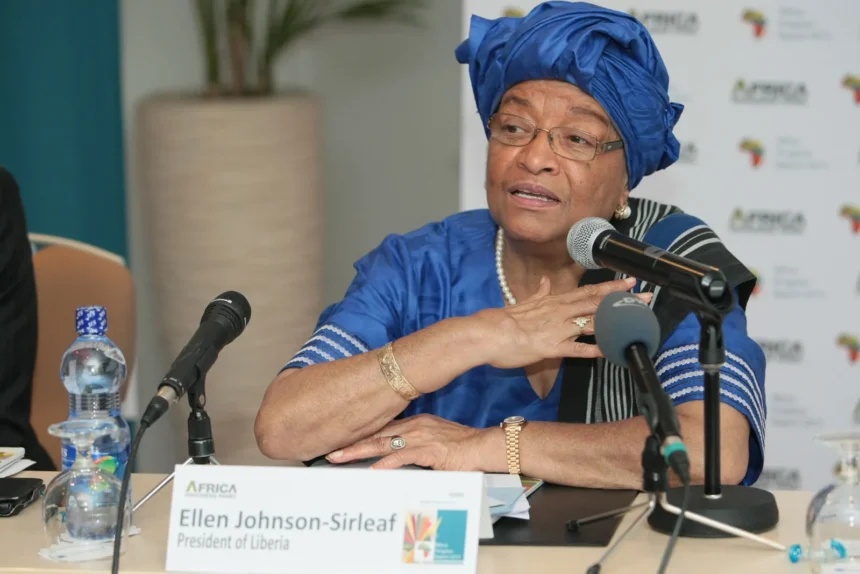
Ellen Eugenia Johnson Sirleaf’s political journey is a story of persistence, public service, political setbacks and eventual historic achievement.
Born on October 29, 1938, in Monrovia, Liberia, Sirleaf became the country’s 24th president, serving from January 2006 to January 2018. Her election made her the first woman elected president of an African country.
Long before reaching the Liberian presidency, however, Sirleaf had spent decades working in government, economics and international finance while navigating some of the most turbulent periods in Liberia’s history.
From Monrovia to Harvard
Sirleaf’s early education was in Liberia before she travelled to the United States to continue her studies. She studied accounting at Madison Business College and later earned a degree in economics from the University of Colorado. She subsequently attended Harvard Kennedy School, where she earned a Master in Public Administration in 1971. Harvard Kennedy School identifies her as one of its notable alumni and describes her as Africa’s first elected female head of state. (Harvard Kennedy School)
Her education in economics and public administration became important to a career that would repeatedly move between government, international finance and politics.
From Government Official to Political Critic
Sirleaf first entered Liberia’s government during the administration of President William Tolbert. She served as Assistant Minister of Finance and later became Minister of Finance in 1979. (Harvard Kennedy School)
Her political career was interrupted by the 1980 coup that brought Samuel Doe to power and resulted in the killing of President Tolbert and members of his government.
Sirleaf left Liberia and worked abroad, including in the banking sector. But she eventually returned to Liberian politics.
Her opposition to the military government came at considerable personal cost. After publicly criticising Doe’s government, she was arrested and imprisoned. Harvard Kennedy School’s account of her life notes that she was sentenced to 10 years in prison after being charged with sedition, although she was later released. (Harvard Kennedy School)
Her political ambitions nevertheless continued.
A Presidential Defeat Before Victory
Sirleaf contested the 1997 Liberian presidential election but finished second to Charles Taylor.
That defeat did not end her political career.
Instead, she continued to participate in Liberian politics until she eventually contested the 2005 presidential election.
The 2005 election became the turning point.
Sirleaf won and was inaugurated on January 16, 2006, becoming Africa’s first elected female president. She entered office at a particularly difficult moment in Liberia’s history, following years of civil war and destruction. Harvard Kennedy School reported that Liberia was still struggling with the consequences of a 14-year civil war that had ended in 2003. (Harvard Kennedy School)
Leading Post-War Liberia
Sirleaf’s presidency focused heavily on rebuilding Liberia after conflict.
Her government faced major challenges involving infrastructure, employment, public services, debt and national reconciliation.
Her administration also placed considerable emphasis on women’s participation in public life. Before and during her presidency, Sirleaf frequently spoke about expanding opportunities for women and ensuring that women had a greater role in Liberia’s economic and political development. (Harvard Kennedy School)
Her presidency also gave Liberia significant international visibility.
In 2011, Sirleaf was awarded the Nobel Peace Prize alongside Leymah Gbowee of Liberia and Tawakkol Karman of Yemen. The award recognised their non-violent struggle for the safety of women and women’s rights to participate fully in peace-building.
Sirleaf was subsequently re-elected in 2011 and completed her second term in January 2018.
Her Political Journey Also Demonstrates That Power Is Temporary
Sirleaf’s story is particularly relevant to discussions about political power.
She eventually occupied Liberia’s highest elected office, but her presidency had a constitutional endpoint.
After 12 years in office, she handed power to another elected president, George Weah, in January 2018.
The transition was significant because it demonstrated that even a historic presidency eventually becomes part of a country’s political history.
The office remained.
The occupant changed.
That distinction is important in African politics, where political influence can sometimes become closely associated with individual personalities.
Sirleaf’s own career illustrates that political circumstances can change dramatically.
She went from government official to political exile, from presidential candidate to defeated opposition figure, and eventually to president of Liberia.
Her journey therefore demonstrates another reality of politics: political positions are not permanent, and political fortunes can change over time.
A Historic Place for Women in African Politics
Sirleaf’s election had significance beyond Liberia.
When she took office in 2006, she became the first woman elected president of an African country. Harvard Kennedy School continues to identify her in that historic capacity. (Harvard Kennedy School)
Her presidency also became an important reference point in discussions about women’s participation in African politics.
Her career demonstrated that a woman could move from senior economic management and political opposition to the highest elected office in an African state.
Her achievement, however, was not the result of one election alone. It followed decades of education, public service, political activism, international experience, electoral defeats and persistence.
From President to Elder Stateswoman
Leaving the presidency did not end Sirleaf’s public life.
Her experience continued to place her in international discussions about governance, leadership, women’s participation and public policy.
Harvard Kennedy School has continued to feature Sirleaf as an example of public leadership, describing her as an alumna who went on to lead Liberia’s post-conflict recovery. (Harvard Kennedy School)
Her post-presidential status also illustrates an important distinction between political office and political legacy.
A politician eventually leaves office.
What remains is the record of what was done while in office, the institutions that were strengthened or weakened, the policies that were implemented and the historical memory attached to the administration.
The Larger Lesson
Ellen Johnson Sirleaf’s political journey offers a broader lesson about political careers.
Political power can change hands.
Political fortunes can rise and fall.
Electoral defeats do not necessarily end a political career, just as occupying the highest office does not guarantee permanent political influence.
Sirleaf lost a presidential election before eventually winning one. She was imprisoned for opposing a military government before becoming president of the country. She became Africa’s first elected female president before eventually leaving office through constitutional succession.
Her story therefore extends beyond the historic achievement of becoming Liberia’s first female president.
It is also a reminder that political careers are shaped by time, institutions, elections, crises, setbacks and changing public circumstances.
For politicians across Africa, the lesson is straightforward: political office is temporary.
Presidents leave.
Governors leave.
Ministers leave.
Party leaders leave.
Political alliances change.
New generations emerge.
The office survives the individual who occupies it.
For citizens, the same history offers another lesson: leaders should be judged by the record they leave behind rather than by the power they temporarily possess.
Ellen Johnson Sirleaf’s journey—from Monrovia to Harvard, from government service to political exile, from imprisonment and electoral defeat to the presidency—remains one of the most consequential political journeys in modern African history.
And perhaps the most enduring lesson is this: power may place a politician at the centre of history, but it does not allow anyone to remain there forever.