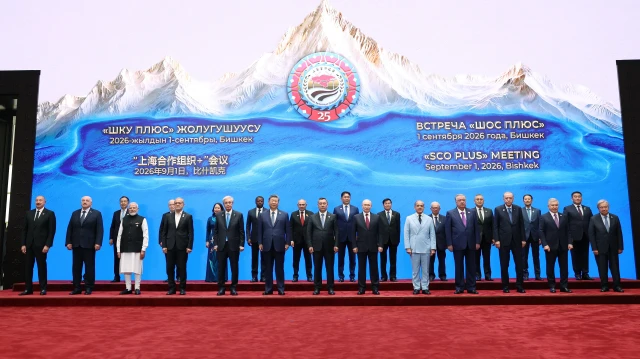
Leaders of China, Russia, India, Iran and other major powers have gathered in Bishkek, Kyrgyzstan, for a Shanghai Cooperation Organisation (SCO) summit focused on security, trade, energy, technology and regional cooperation amid rising global tensions.
The summit opened on Tuesday, September 1, as the organisation marked its 25th anniversary. Chinese President Xi Jinping, Russian President Vladimir Putin, Indian Prime Minister Narendra Modi and Iranian President Masoud Pezeshkian are among the leaders attending the gathering.
The meeting brings together the SCO’s 10 member states: China, Russia, India, Iran, Pakistan, Belarus, Kazakhstan, Kyrgyzstan, Tajikistan and Uzbekistan.
Security is expected to dominate discussions as conflicts and geopolitical tensions continue to raise concerns about regional and global stability.
The Russia-Ukraine war remains a major international concern, while tensions involving Iran have added further pressure on relations between major powers. SCO leaders are expected to discuss ways to strengthen regional security and deepen cooperation among member states.
Chinese President Xi Jinping has called on SCO members to strengthen cooperation, protect regional peace and oppose outside interference in their internal affairs.
The summit has also provided an opportunity for some of the bloc’s most influential leaders to hold bilateral discussions.
Putin met Xi on the sidelines of the gathering, with the two leaders discussing closer China-Russia relations. Modi also held talks with Putin, with discussions reportedly covering areas including trade, energy, defence and regional connectivity.
The meetings come as China, Russia and India seek to strengthen economic and strategic relationships while navigating an increasingly complex international environment.
The Shanghai Cooperation Organisation was established in 2001, initially focusing heavily on regional security and cooperation.
Over the years, its agenda has expanded to include political, economic and strategic cooperation. India and Pakistan became full members in 2017, while Iran joined as a full member in 2023 and Belarus followed in 2024.
The organisation now spans much of Eurasia and brings together countries with significant economic, political and military influence.
Beyond security, leaders are expected to consider measures aimed at increasing trade and investment among member states.
Energy cooperation, technology, regional connectivity and economic development are also expected to feature prominently in discussions. Supporters of greater SCO cooperation see the organisation as a platform for expanding economic partnerships and strengthening links across Eurasia.
The summit could therefore produce agreements covering both immediate security concerns and longer-term economic cooperation.
The presence of China, Russia, India and Iran has placed the SCO summit under considerable international attention.
Greater cooperation among these powers could strengthen the organisation’s influence in discussions surrounding international security, trade and the emerging global order. At the same time, differences among member states could shape how far the organisation is able to translate its growing membership and economic weight into coordinated action.
As the Bishkek summit continues, attention will focus on the agreements reached by the leaders and whether they lead to stronger regional cooperation.
The outcome could help determine the Shanghai Cooperation Organisation’s future direction and its role in an increasingly multipolar global system.