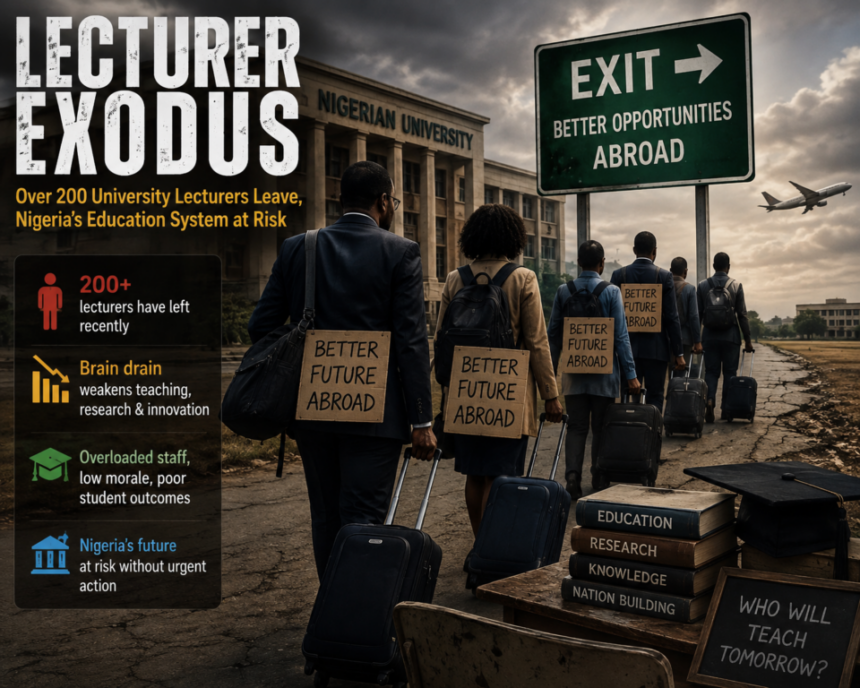
The alarm raised by the Academic Staff Union of Universities (ASUU), Kaduna State University (KASU) chapter, over the departure of more than 200 professors and other academic staff has brought Nigeria’s worsening university manpower crisis into sharp focus.
At a press conference in Kaduna on August 17, 2026, ASUU-KASU Chairman, Dr Abubakar Abdullahi, said more than 200 academic staff had left the institution, attributing the exodus largely to poor conditions of service and the delay in implementing the 2025 Federal Government-ASUU agreement. The union subsequently issued a two-week ultimatum to the university authorities and other stakeholders, warning that failure to address its demands could lead to a total and indefinite strike.
The development is particularly concerning because it involves experienced academics, including professors, whose loss cannot be addressed simply by recruiting replacements. Universities depend heavily on accumulated academic experience for teaching, postgraduate supervision, research, curriculum development, accreditation and institutional leadership.
The question, therefore, is bigger than KASU.
What happens to Nigeria’s university system if the departure of experienced lecturers becomes a sustained national trend?
KASU as a Warning Sign
KASU itself illustrates the scale of the challenge.
According to information published by the university, it has more than 25,000 students, 964 academic staff and 169 professors, alongside 899 non-academic staff. The institution operates six campuses, 15 faculties, 59 undergraduate programmes and 113 postgraduate programmes. (Kaduna State University)
Against that background, the reported departure of more than 200 academic staff represents a substantial loss of institutional manpower.
It is important to distinguish between the number of academic staff who have left and the number of professors among them. ASUU-KASU’s statement referred to more than 200 professors and other academic staff; it should therefore not be interpreted as saying that 200 professors alone resigned.
Nevertheless, the scale is significant.
If a university loses hundreds of academics while student enrolment remains high, the immediate consequence is likely to be greater pressure on the lecturers who remain.
More courses may have to be handled by fewer academics. Class sizes can increase. Supervisory responsibilities can become heavier. Research time can decline. Administrative responsibilities can expand.
Eventually, the quality of teaching and research can suffer.
The National Picture Is Even More Concerning
The KASU development is not occurring in isolation.
In October 2025, ASUU’s Zonal Chairman for Sokoto, Kebbi, Zamfara and Katsina, Professor Abubakar Sabo, said 309 professors had left Nigeria’s public university system within nine months. He said some moved to private universities in Nigeria while others relocated to countries including the United Kingdom, Saudi Arabia and Cameroon. (Punch Newspapers)
That figure provides an important national context for the current KASU situation.
The two figures should not be added together as though they represent the same category or period. The 309 figure was a national ASUU estimate concerning professors who had left public universities, while the current KASU figure concerns more than 200 academic staff from one institution.
But taken together, they point to a broader concern: Nigeria is struggling to retain the human capital required to sustain its expanding university system.
ASUU has repeatedly linked the problem to poor remuneration, inadequate funding, unpaid or delayed entitlements, weak research support and difficult working conditions. ASUU President Professor Emmanuel Osodeke also previously warned that increasing numbers of Nigerian lecturers were relocating abroad because many were finding it difficult to make ends meet. (Punch Newspapers)
Nigeria Has More Universities, But Does It Have Enough Academics?
Nigeria’s university system has expanded dramatically.
The National Universities Commission reported in 2024 that Nigeria had 274 universities — 62 federal, 64 state and 148 private institutions — serving about two million students with approximately 60,000 academic staff and 50,000 non-teaching staff. (National Universities Commission)
That expansion has increased access to university education, but it has also created a fundamental policy question:
Can Nigeria continue expanding the number of universities without simultaneously expanding the pool of qualified academics?
The answer is increasingly problematic.
A university is not simply a collection of classrooms and buildings. Its most important asset is its human capital.
You can construct a lecture theatre within months. You cannot produce an experienced professor overnight.
A professor may have spent decades acquiring academic qualifications, conducting research, supervising postgraduate students, publishing scholarly work and developing expertise in a particular discipline.
When that person leaves, the university loses more than one employee.
It loses institutional memory.
NUC Standards Make the Situation More Serious
The National Universities Commission’s accreditation standards show why staff shortages can become an academic-quality problem.
For example, NUC’s current curriculum guidelines prescribe specific staff/student ratios for programmes. In one 2026 CCMAS guideline for education, the Commission specified a 1:30 staff/student ratio for Arts programmes, with at least six full-time academic staff required for commencement of a programme and a substantial proportion of staff expected to hold PhDs. (National Universities Commission)
NUC accreditation reports also demonstrate that staffing problems already exist in individual programmes.
In a 2024 accreditation assessment of Linguistics at KASU, the NUC reported that the programme’s staff mix did not meet approved guidelines and classified the programme for interim accreditation. The Commission also identified shortcomings involving staff development and teaching infrastructure. (National Universities Commission)
Another KASU accreditation report for Radiography identified concerns including inadequate practical work, insufficiently qualified or experienced academic staff, inadequate staff development and insufficient office space. The programme received interim accreditation. (National Universities Commission)
These findings are important because they demonstrate that the staffing question is not theoretical.
The regulator is already identifying manpower and staff-development deficiencies in some university programmes.
What Happens When Experienced Lecturers Leave?
The first consequence is an increase in workload.
The lecturers who remain will have to absorb some of the responsibilities left behind by those who have departed.
That can mean more courses, more examination scripts, more project supervision, more administrative assignments and larger classes.
The second consequence is reduced research capacity.
Universities are expected not only to teach students but also to produce knowledge. Research requires time, funding, collaboration and experienced academics.
When lecturers are overwhelmed by teaching and administrative responsibilities, research productivity can decline.
The third consequence is a postgraduate crisis.
Masters and PhD programmes depend heavily on experienced supervisors.
If senior academics leave, universities may struggle to provide enough qualified supervisors for postgraduate students.
This could lead to delays in thesis supervision, longer completion periods and weaker postgraduate research.
The fourth consequence is loss of mentorship.
Young lecturers do not only learn from textbooks and formal training. They develop professionally through interaction with experienced professors and senior academics.
When senior scholars leave in large numbers, the academic succession pipeline becomes weaker.
Accreditation Could Become a Major Problem
There is another issue that may not immediately attract public attention: accreditation.
NUC accreditation considers staffing, academic matters, infrastructure, libraries, funding and other components when assessing university programmes.
A university may have a beautiful campus and modern lecture theatres, but if it cannot demonstrate adequate qualified academic manpower, particular programmes can face accreditation challenges.
The NUC’s own accreditation reports show that staffing deficiencies can lead to recommendations for additional recruitment and corrective measures. At the University of Lagos, for example, a 2024 accreditation report noted that a programme’s student-lecturer ratio fell short of the relevant recommendation and called for urgent recruitment. (National Universities Commission)
Therefore, sustained lecturer departures could eventually affect the ability of universities to maintain accreditation for certain programmes.
That would have consequences for students.
Students Will Ultimately Pay the Price
The most vulnerable group in this crisis may be students.
A student who enters a university expects access to qualified lecturers, practical instruction, supervision, examinations and academic guidance.
If the university does not have sufficient academic staff, students may experience:
- larger classes;
- fewer lecturer-student interactions;
- delays in project supervision;
- reduced research opportunities;
- longer academic processes;
- reduced access to senior academics;
- weaker practical training; and
- potentially lower-quality learning outcomes.
The danger is particularly serious in professional disciplines where practical instruction and specialised expertise are essential.
The Brain Drain Also Weakens Nigeria’s Research Capacity
The departure of academics is not merely an employment issue.
It is a national development issue.
Universities supply the human capital required by the public sector, private industry, medicine, engineering, law, education, technology and scientific research.
When Nigeria loses experienced academics, it also loses researchers capable of developing solutions to Nigerian problems.
The country then becomes increasingly dependent on foreign expertise.
This creates a paradox.
Nigeria spends public resources educating and training highly skilled professionals, but poor working conditions can push some of those professionals to countries where their expertise is better rewarded.
The receiving countries benefit from Nigerian-trained human capital, while Nigeria bears much of the cost of producing it.
The ASUU-Federal Government Agreement Question
At the heart of the current dispute is the issue of agreements between the Federal Government and ASUU.
There is, however, an important distinction in the official record.
In August 2025, the Federal Ministry of Education clarified that the 2009 FGN-ASUU Agreement remains the last formally signed and binding agreement, while the 2021 Nimi Briggs document was a draft and had not been formally executed at that time. (Federal Ministry of Education)
Since then, however, government institutions have referred to a 2025 FGN-ASUU agreement and its implementation.
The NUC reported in June 2026 that the Minister of Education, Professor Suwaiba Ahmad, inaugurated an Implementation Monitoring Committee for the 2025 FG-ASUU Agreement. (National Universities Commission)
The NUC also reported that the Federal Government released funds in June 2026 for five months of accumulated Consolidated Academic Tools Allowance for eligible academic staff in federal universities. The Commission said the allowance had been reviewed under the Federal Government-ASUU agreement signed on January 14, 2026. (National Universities Commission)
This suggests that implementation has been taking place in at least some areas at the federal level.
But the KASU dispute illustrates a separate challenge: implementation across federal and state universities is not necessarily uniform.
ASUU-KASU says the agreement has not been domesticated and implemented at the institution, despite the union’s engagements with the university authorities and Kaduna State Government. (Punch Newspapers)
That federal-state distinction is critical.
State Universities Face a Different Problem
Federal universities are directly tied to federal funding and federal policy.
State universities depend substantially on their respective state governments.
Therefore, even when the Federal Government reaches an agreement with ASUU, implementation can become complicated in state-owned institutions.
This raises a fundamental policy question:
Should conditions of service for academics be substantially different depending on whether they work for a federal or state university?
If the gap becomes too wide, academics will naturally seek institutions that offer better remuneration and working conditions.
The result is an internal migration of lecturers from weaker institutions to stronger ones.
ASUU-KASU says many of the academics who left subsequently obtained appointments at newer universities within and outside Kaduna State. (Vanguard News)
That means Nigeria may not necessarily be losing all these lecturers to foreign countries.
Some are simply moving from one Nigerian university to another.
This still creates a problem.
It can leave established universities struggling while newer or better-funded institutions attract experienced personnel.
The Threat of Another Strike
The staffing crisis is now intertwined with the possibility of industrial action.
ASUU-KASU has issued a two-week ultimatum and warned that failure to address its demands could lead to a total and indefinite strike. The chapter said its Congress had resolved on August 12 to commence an industrial dispute, in line with a resolution of ASUU’s National Executive Council meeting held on August 8 and 9. (Punch Newspapers)
A strike would compound the existing problem.
Nigeria has experienced repeated university strikes, with the 2022 ASUU strike lasting approximately eight months.
Repeated disruptions create academic delays, financial losses for families, uncertainty for students and additional pressure on universities.
The danger is that Nigeria could find itself dealing with two crises simultaneously:
lecturer shortages and industrial disputes.
Either one is damaging.
Together, they can significantly weaken the university system.
What Should Government Do?
The solution cannot simply be to tell lecturers to remain in Nigeria.
Government must make staying economically and professionally viable.
First, the implementation of negotiated agreements must be transparent and time-bound.
Where federal institutions are concerned, the Federal Government should publish a clear implementation schedule and regularly report progress.
Where state universities are concerned, state governments should be brought into a coordinated framework so that academics are not subjected to radically different conditions across institutions.
Second, universities need an aggressive recruitment programme.
Vacancies created by resignations, retirements and deaths should not remain open for years.
Third, government must strengthen research funding.
A university lecturer should not be expected to become internationally competitive while personally financing most of the research, conferences, academic publications and professional development required to remain competitive.
Fourth, postgraduate training must be expanded.
Nigeria needs to produce more PhD holders and future professors to replace the generation currently leaving or retiring.
Fifth, universities need stronger institutional autonomy.
NUC itself identifies data collection on staff, students and facilities as part of its responsibilities for monitoring compliance with university standards. (National Universities Commission)
Government should therefore have accurate, regularly updated data showing:
How many lecturers each university has.
How many are professors.
How many have PhDs.
How many vacancies exist.
How many lecturers resign annually.
How many retire.
How many migrate abroad.
How many move between Nigerian universities.
And which programmes are at risk because of inadequate staffing.
Without this data, government is effectively managing the university system in the dark.
The Bigger Question for Nigeria
The most important lesson from KASU is that the crisis should not be viewed as simply another disagreement between ASUU and government.
It is a warning about the sustainability of Nigeria’s knowledge economy.
Nigeria currently has a university system serving millions of students across hundreds of institutions. The NUC has acknowledged both the size of the system and the continuing demand for university education. (National Universities Commission)
But expansion without adequate manpower can create the appearance of progress without delivering corresponding improvements in educational quality.
A university is only as strong as its academic community.
If professors continue to leave, if younger academics cannot see a viable career path, if research becomes financially impossible and if industrial disputes continue to interrupt academic calendars, Nigeria risks producing graduates from increasingly overstretched institutions.
The consequence will not necessarily be the immediate collapse of universities.
It could be something more gradual and therefore more dangerous:
the erosion of quality.
Degrees may continue to be awarded. Campuses may remain open. Students may continue to graduate.
But the quality of teaching, research, innovation and professional preparation could steadily decline.
That is why the more than 200 academic staff reported to have left KASU should be treated not merely as a Kaduna story, but as a warning about Nigeria’s capacity to retain the intellectual manpower required for national development.
The Federal Ministry of Education, ASUU, NUC, state governments and university governing councils must therefore move beyond periodic crisis management.
Nigeria needs a long-term national strategy for lecturer recruitment, retention, remuneration, research funding, postgraduate training and institutional autonomy.
Otherwise, the country may continue building more universities while losing the people capable of making those universities work.