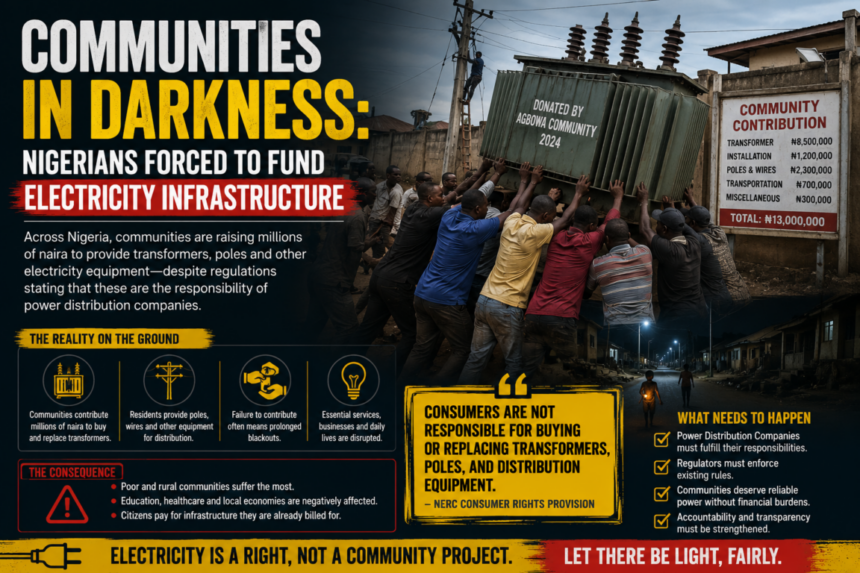
Despite regulations that place the responsibility for electricity infrastructure on distribution companies, many Nigerian communities continue to bear the cost of replacing and repairing transformers, poles, and other power equipment.
The Nigerian Electricity Regulatory Commission (NERC) states that consumers should not be responsible for purchasing, replacing, or maintaining electricity distribution assets. However, many residents say the reality on the ground tells a different story.
Across the country, communities are contributing millions of naira to restore power whenever critical infrastructure fails.
Piwoyi Residents Face ₦22 Million Burden
One of the latest examples comes from Piwoyi, a community along Airport Road in Abuja.
Residents say they have struggled with unstable electricity supply since 2024 due to repeated transformer failures.
According to community members, they reported the problem several times to the Abuja Electricity Distribution Company (AEDC). When no lasting solution came, residents pooled funds to repair the transformer themselves.
The transformer failed again in 2025, forcing another round of community contributions for repairs and reinstallation.
Now, in 2026, residents say the transformer has become irreparable.
They claim AEDC informed them that no replacement transformer is available and advised the community to source one independently.
As a result, the area has remained without electricity for months.
Cost of Restoring Power
Residents estimate that restoring electricity will cost about ₦22 million.
The proposed expenses include:
- Transformer – ₦13 million
- Conductor wire – ₦6.6 million
- Concrete poles and transportation – ₦800,000
- Wooden poles, transportation and installation – ₦165,000
- D-Irons – ₦100,000
- Outage charges – ₦50,000
- G & P – ₦45,000
- Transformer transportation – ₦120,000
- Conductor wire transportation – ₦120,000
- Workmanship – ₦500,000
- Miscellaneous expenses – ₦500,000
The total estimated cost stands at approximately ₦22 million.
Economic Hardship Deepens the Crisis
For many residents, raising such an amount is unrealistic.
Families already face rising food prices, transportation costs, school fees, and rent increases. Many tenants and low-income earners say they cannot afford another financial obligation.
The situation has created a growing divide between wealthy communities that can fund infrastructure projects and poorer areas that remain in darkness for extended periods.
Some residents describe the trend as “electricity inequality.”
A National Problem
The challenge extends beyond Piwoyi.
Across Nigeria, communities frequently raise money to buy transformers, repair damaged equipment, and replace electricity poles.
Despite these contributions, residents continue to pay monthly electricity bills.
Many consumers question why they must finance infrastructure that distribution companies are expected to provide and maintain.
Critics argue that the arrangement places an unfair burden on citizens already struggling with economic challenges.
Questions Over Power Sector Accountability
The situation has renewed concerns about accountability within Nigeria’s electricity sector.
Many Nigerians expected power sector privatization to improve service delivery and infrastructure management.
Instead, some communities believe responsibilities have gradually shifted from service providers to consumers.
Residents argue that if distribution companies cannot replace damaged transformers promptly, regulatory authorities should intervene.
Calls for Stronger Enforcement
Consumer advocates say NERC must go beyond policy statements and enforce its regulations.
They argue that distribution companies should not pressure communities into funding public electricity infrastructure.
Stakeholders also want stronger oversight and penalties for operators that fail to meet their obligations.
For many Nigerians, paying for transformers while still receiving electricity bills represents a double burden in an already difficult economy.
Until stronger enforcement measures are introduced, communities like Piwoyi may continue to face prolonged blackouts and rising costs just to access a service they already pay for.