Across many countries, government and private mortuaries receive bodies from hospitals, road traffic crashes, violent crimes, abandoned buildings, and unidentified emergencies.
Some arrive with names and addresses; others carry nothing more than the clothes they died in. Days become weeks, weeks become months, sometimes months become years.
Eventually, another difficult question emerges.
Family members travel across states, friends gather to share memories, neighbours fill compounds with condolences, prayers and meals, funeral posters appear on street corners, while social media timelines overflow with tributes.
But not every death ends with tears, embraces or a proper goodbye. it has a way of bringing people together.
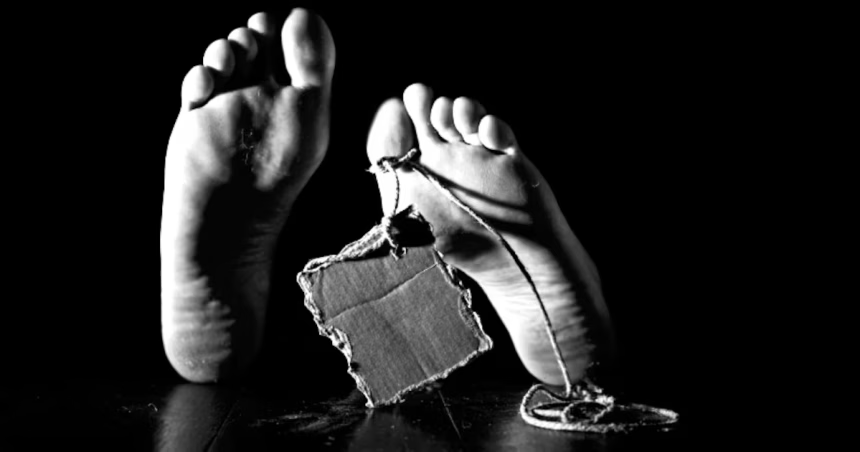
Some people die, and no one comes, no grieving mother, no anxious spouse, no child asking when they can take their loved one home. Only a body lying quietly in a morgue, waiting for someone who may never arrive. It is one of the least discussed realities in Nigeria, yet it happens every day.
What happens when nobody comes to claim the dead?
Hospital staff record, every available detail. Police officers document cases involving accidents, suspicious deaths or unidentified persons. Personal belongings, if any exist, are carefully stored. In many cases, authorities circulate information through police stations, hospitals, radio announcements or public notices, hoping a family member recognizes the description. Every unidentified or unclaimed body is treated as though someone will come looking.
Sometimes it works, a missing father is found after a newspaper notice a daughter recognizes a photograph shared online a relative finally connects weeks of unanswered phone calls with a visit to the morgue. But many bodies remain unidentified.
Some belong to migrant workers living far from home. Others belong to people experiencing homelessness or living with mental illness. Victims of road crashes may carry no identification. Floods, fires and communal violence can leave bodies so badly damaged that identification becomes extremely difficult. Then there are those whose families know exactly where they are but cannot afford to take them home, it is a painful reality few people speak about.
In many parts of Nigeria, claiming a body involves more than grief. Families often face mortuary fees, transportation costs, burial expenses and traditional funeral obligations. For households already struggling to survive, these costs can become overwhelming. There have been reports of families delaying burials for weeks or months while raising money to settle mortuary bills. Others never return at all. The deceased slowly becomes another unclaimed body.
According to the World Health Organization, every country needs systems that ensure the respectful handling, identification and burial of the dead, not only for public health reasons but also to preserve human dignity during disasters and routine deaths alike. Nigeria’s laws also provide guidance. The Coroners Act empowers coroners to investigate certain deaths, particularly sudden, suspicious or unexplained cases. When authorities exhaust reasonable efforts to identify or locate relatives, they may authorize the burial of unclaimed bodies in accordance with legal procedures. That process, however, is rarely simple, Mortuaries have limited space.
Every occupied compartment means one less space for a newly deceased patient. As the number of unclaimed bodies grows, hospitals face difficult operational challenges. Some government hospitals have, over the years, published long lists of names in newspapers and on notice boards, giving families a final opportunity to claim their loved ones before mass burials take place. Those notices often contain little more than names, dates and reference numbers. To most readers, they are just columns of text. To someone searching for a missing relative, they can change everything.
When no one responds, authorities eventually arrange public burials. The ceremonies are usually quiet. There are no choirs. No family photographs. No long tributes celebrating a life well lived. Workers carefully lower strangers into graves marked only by records held in government files. Someone signs paperwork. Another body leaves the morgue.
Life moves on. Yet each unclaimed body carries unanswered questions.
Who was waiting for them to come home?
Did someone spend years searching without ever knowing where they ended up?
Did a parent die believing their missing child was still alive somewhere?
Or did loneliness outlive life itself?
Technology is beginning to offer new possibilities. Around the world, forensic DNA databases, fingerprint systems, dental records and facial recognition tools have helped identify people years after their deaths. Some countries also maintain national missing-person databases that allow families to compare information across hospitals, police departments and forensic laboratories. Nigeria has made progress in digital identity systems, but experts say stronger coordination between hospitals, law enforcement agencies and forensic services could improve the identification of unknown victims and reduce the number of people buried without names.
Humanitarian organisations have also called for better support for families searching for missing relatives, especially after disasters, conflicts and mass displacement.
Still, technology cannot solve every case. Some people simply disappear from everyone’s memory long before they disappear from life. Perhaps that is the hardest truth. An unclaimed body is not always evidence that nobody cared.
Sometimes families search in the wrong city, sometimes poverty stands between love and a proper burial, sometimes conflict separates relatives for years. Sometimes records fail and sometimes life moves so quickly that one person’s absence goes unnoticed until it is too late.
The measure of a society is often seen in how it treats its most vulnerable. Perhaps it should also be measured by how it treats those who can no longer speak for themselves. Because every unclaimed body was once someone’s child.
Someone’s friend, someone’s first love, someone’s neighbour, someone who laughed, dreamed, worried about tomorrow and expected, like the rest of us, that when their final day came, someone would remember their name. The saddest part is not that these people died. It is that, for many of them, the last person to say goodbye was a stranger.