
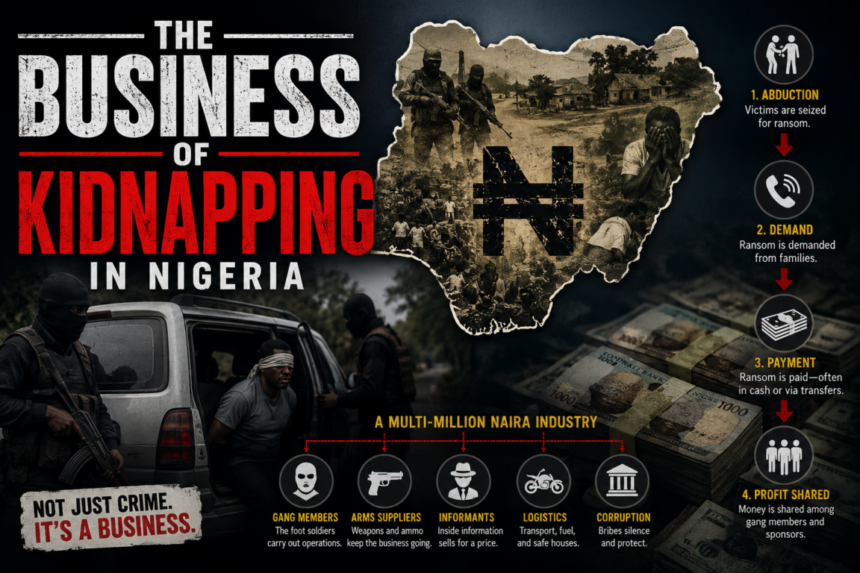
In Nigeria today, kidnapping no longer arrives as shock. It arrives as calculation.
From rural roads in Zamfara to highways in Kaduna, from forest corridors in Niger State to expanding flashpoints in the southwest, abduction has evolved into a structured economy, one that operates with pricing logic, territorial control, negotiation networks, and predictable cycles of supply and demand.
Between July 2024 and June 2025, Nigeria recorded an estimated 4,722 kidnapped victims across 997 incidents, with ₦48 billion demanded in ransom and about ₦2.57 billion actually paid, according to SBM Intelligence tracking of verified cases and media reports. In the same period, at least 762 people were killed in connection with kidnappings.
These figures are not anomalies. They are balance sheets. Kidnapping in Nigeria is no longer episodic violence. It is an economy of fear.
From Crime to System: The Evolution of Abduction
The modern kidnapping economy did not emerge overnight. It evolved through phases shaped by insurgency, fragmentation, and economic collapse in rural governance.
In the early 2010s, abductions were concentrated in the northeast, tied to insurgent groups operating in Borno and Yobe. These kidnappings were largely ideological tools of political messaging and territorial control.
The 2014 Chibok abduction marked a global turning point, exposing kidnapping as both a weapon of war and a tool of leverage. But what followed was not containment. It was diffusion.
As military pressure fractured insurgent command structures, violence decentralised. Smaller armed groups multiplied across the northwest and north-central regions. These groups were no longer driven primarily by ideology but by survival economics. Kidnapping became funding. Ransom became revenue. And violence became sustainable.
The Geography of Abduction: Nigeria’s High-Risk States
Kidnapping in Nigeria is now spatially concentrated, with clear regional hotspots and expanding corridors.
Zamfara State: The Epicentre
Zamfara remains the most affected state, with SBM Intelligence data consistently placing it at the top of national kidnapping figures. In some reporting periods, it accounts for over 1,000 victims annually, driven by armed groups embedded in forested territories and rural settlements. Entire communities have been displaced, and farming zones have become operational bases for armed networks.
Kaduna State: The Highway Economy
Kaduna functions as both corridor and battlefield. Major highways, including routes linking Abuja to the north, have become repeated targets. Rural districts also face mass abductions of farmers, traders, and students. Kaduna consistently ranks among the top two states for kidnapping incidents nationwide.
Katsina and Sokoto: Rural Abduction Zones
These states experience frequent attacks on farming communities and inter-village routes. Abductions often occur in groups, with victims taken during night raids or highway interceptions.
Niger State: The Strategic Corridor
Niger State has emerged as a critical linkage zone connecting multiple kidnapping hotspots across the north-central region. Forested areas and sparse policing make it a recurring operational route for armed groups.
Borno State: Insurgency-Linked Abductions
Unlike the northwest bandit economy, Borno’s kidnappings remain tied to insurgent structures, primarily Boko Haram and ISWAP-linked factions. However, overlaps now exist between insurgent and criminal networks.
South-West Nigeria: Emerging Frontline
Once considered relatively secure, states such as Oyo, Ekiti, and Ondo are now experiencing forest-based abductions and school kidnappings that mirror northern tactics. International reporting confirms that the kidnapping model is expanding southward. The geography of kidnapping is no longer regional. It is national.
The Ransom Economy: Pricing Fear
Kidnapping in Nigeria now operates through an informal but highly structured pricing system that resembles an underground market more than random criminal extortion. What appears outwardly as chaotic violence is, in practice, shaped by predictable negotiation patterns, economic calculation, and a clear understanding of what different victims and communities can realistically pay.
Recent estimates suggest that kidnappers demand as much as ₦48 billion annually in ransom across the country, while the actual amount paid is far lower, at about ₦2.57 billion, reflecting both negotiation breakdowns and the economic limits of affected families and communities. Within this system, individual ransom payments commonly range between ₦1 million and ₦10 million per household case, depending on perceived financial capacity, location, and the dynamics of negotiation.
Payments are often negotiated through intermediaries and delivered via informal channels that bypass formal banking systems.
This has created a shadow financial ecosystem that operates parallel to the formal economy.
Mass Abductions: Scaling the System
One of the defining features of Nigeria’s kidnapping economy is its ability to scale.
In recent years, the country has witnessed repeated mass abductions involving dozens, and sometimes hundreds, of victims in a single operation. School raids have become particularly common, with documented cases involving over 100–300 abductees per incident across northern and central states.
In many cases, victims are released in phases, sometimes through negotiation, sometimes after payment, and sometimes following military pressure or breakdowns within armed groups.
Even large-scale recoveries reported in insurgency zones, including operations in Borno’s broader conflict landscape, reflect the continued capacity of armed groups to detain and move large populations before eventual release or rescue.
These events are not exceptional. They are system outputs.
The Economics of Survival and Violence
The persistence of kidnapping is closely linked to several structural challenges. Weak rural policing coverage across vast and difficult terrain leaves many communities with limited security presence. Forest zones in some regions also create ungoverned spaces that armed groups exploit as operational bases. In addition, porous borders with neighbouring countries such as Niger, Chad, and Cameroon make it easier for criminal networks to move across jurisdictions.
Economic conditions also play a major role. High unemployment among rural youth, combined with the collapse of agricultural productivity and local livelihoods in conflict-affected areas, has created an environment where illegal activities become more attractive. In such settings, kidnapping is no longer viewed only as a criminal act but often emerges as an alternative source of income.
Armed groups take advantage of these vulnerabilities by recruiting from communities with limited formal opportunities, embedding themselves into local survival economies and further weakening already fragile social structures.
The Normalization of Abduction
Perhaps the most profound shift is psychological. Kidnapping is now part of everyday risk calculation in many parts of Nigeria.
Families choose schools based on security risk, not just quality. Communities develop informal early warning systems. Transport routes are selected based on kidnapping history. Farmers abandon fields near forest corridors.
Fear is no longer exceptional. It is infrastructural.
A System That Adapts, Not Breaks
Nigeria’s response to kidnapping has been a mix of military operations, intelligence-led raids, and in some regions, negotiation or mediated releases.
But each intervention reshapes rather than eliminates the system.
Pressure in one area leads to fragmentation. Fragmentation leads to new groups. New groups intensify abductions elsewhere. Negotiated outcomes in some cases reinforce incentives in others.
The system absorbs disruption and continues.
An Economy Built on Captivity
Nigeria’s kidnapping crisis is often described as insecurity. But insecurity implies instability.
What exists today is more structured than that. It is an economy. It has geography. It has pricing. It has supply chains. It has adaptation mechanisms. And it has continuity.
The numbers, thousands abducted, billions demanded, hundreds of incidents are not just indicators of violence. They are evidence of a functioning system operating in the shadows of the state.
And until that system is dismantled at its economic and territorial core, kidnapping in Nigeria will remain what it has become: not an interruption of life, but an industry within it.