Why would anyone spend a fortune to acquire something they know they must return the moment their tenure ends? That question captures one of Nigeria’s deepest leadership problems: the tendency to treat public power as personal property.
We have mistaken power for ownership, public trust for private enterprise and political office for an investment that must be recovered. We campaign as though we are acquiring a company, not accepting an assignment, and spend heavily to win power without always preparing for the responsibility that comes with it.
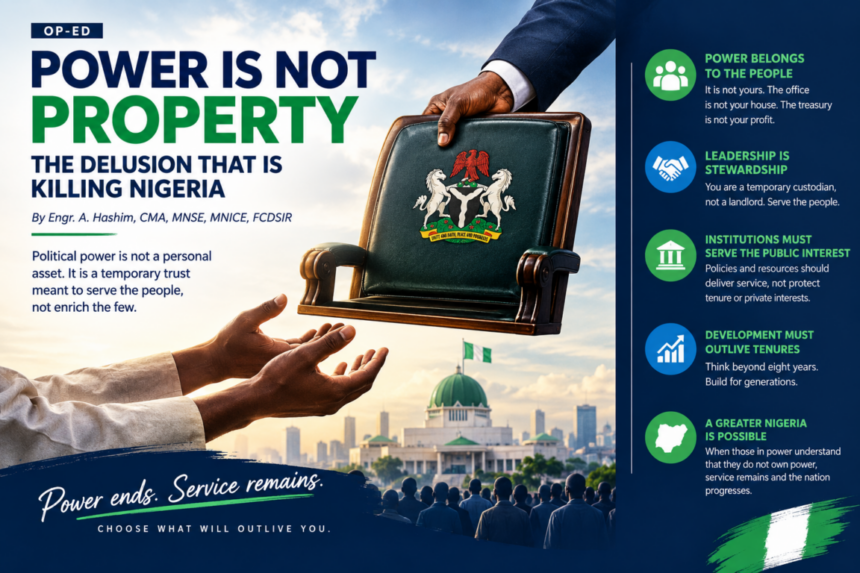
Power Is Not Property
Let us be clear: power is not yours. The office is not your house. The treasury is not your profit.
Political office is temporary, but the institutions attached to it are not. At most, an office holder has an eight-year window to serve, after which the signature, convoy and official position disappear. The chair remains, the flag remains and, most importantly, the people remain.
That alone should teach us humility.
The structures leaders inherit were not built by them. The civil service, ministries, ports, schools, barracks and other institutions of government were developed and maintained over many years, often through the work and sacrifice of people who never occupied the highest offices.
A leader therefore does not inherit these structures to own them. The responsibility is to use them properly, strengthen them and ensure they continue to serve the people.
Leadership Is Stewardship
If governance were about the individual in power and his associates, it would not need to outlive him. But governance must outlive every office holder because it is ultimately about the child who has not yet been born.
That is what true leadership should mean, and it is a principle Nigeria must rediscover: leadership is stewardship.
Whether one becomes a councillor, governor, minister or president, public office does not make the holder a landlord. The office holder is a temporary custodian of power entrusted by the people.
Even if someone enters office through difficult political circumstances or with strong alliances behind them, occupying the seat creates a responsibility that cannot be negotiated away: to serve the people.
The question, therefore, should not simply be who controls the structure, but whether the structure is delivering for the public.
Institutions Must Serve the Public Interest
Public institutions and government policies should be designed to protect the public interest and deliver services. They should not be reduced to instruments for protecting political tenure or private interests.
When institutions become centred on the survival of those in power, governance loses its purpose. Resources that should strengthen public services can instead become tools for political consolidation, while long-term development takes a back seat.
This is partly why enormous resources can be committed to winning political power without an equally strong plan for how that power will be used to improve people’s lives.
Nigeria must reverse that thinking.
The first principle should be simple: power belongs to the people, structures exist for the people, and public institutions must serve the public interest.
Development Should Outlive Political Tenures
A governor who understands public office as stewardship will not abandon a hospital started by a predecessor simply because it does not carry his name. He will complete it because the project belongs to the people.
A president who sees the economy as a national inheritance will not treat it as a personal enterprise limited to eight years. The responsibility will be to strengthen it for generations yet to come.
That mindset changes how leaders approach projects, institutions, policies and public resources. It shifts the focus from personal recognition to continuity and from political ownership to public value.
Nigeria’s progress will depend not only on prayers or political promises, but also on whether those entrusted with public power understand its temporary nature.
Power ends. Service remains.