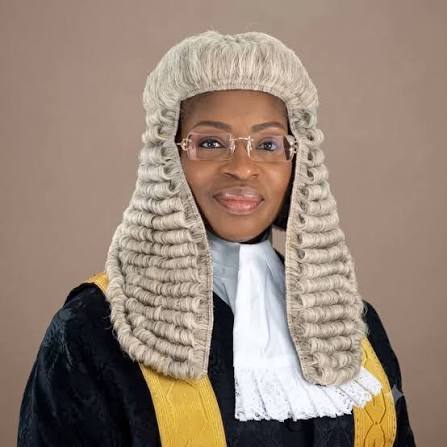
Oyinkansola Badejo-Okusanya NBA President has become the headline capturing the attention of Nigeria’s legal community following her election as the 33rd President of the Nigerian Bar Association (NBA).
The new NBA boss is the first woman ever elected by members of the Bar to lead the association and only the second woman to head the NBA in its more than 120-year history.
Oyinkansola victory marks more than a personal achievement because it represents a defining moment for Nigeria’s legal profession, where women have excelled as judges, academics, Senior Advocates, arbitrators and public policy experts but had never before won the Bar’s highest elected office.
Oyinkansola victory carries even greater significance when viewed against the NBA’s remarkable history.
The association traces its roots to 1900. That year, Christopher Sapara Williams, Nigeria’s first indigenous lawyer, became the first national chairman of the organised legal profession. After his death in 1915, Sir Kitoyi Ajasa succeeded him. He remains the longest-serving national leader, having led the Bar until 1937.
Before the NBA emerged as a national body, lawyers in major cities formed independent associations. They met regularly to discuss legal practice and professional issues. The Ibadan Branch, widely known as the “Mother Branch,” became the first organised local Bar association in 1954.
The profession entered a new era in 1959. Twelve regional Bar associations came together to form the Nigerian Bar Association. After Nigeria gained independence in 1960, the association changed the title of its leader from Chairman to President. The legendary Chief Frederick Rotimi Alade (F.R.A.) Williams became its first president.
Over the decades, the NBA grew into one of Africa’s most respected professional bodies. It introduced the zoning principle to reflect Nigeria’s diversity. It also limited presidential tenures to two years from 1973. More importantly, it became a fearless defender of democracy, judicial independence and human rights.
No period reflected that courage more than the presidency of the late Alao Aka-Bashorun. He rejected attempts by the military government to compromise the Bar’s independence. His leadership strengthened the NBA’s reputation as the conscience of the nation.
Today, the NBA enjoys observer status at the African Commission on Human and Peoples’ Rights. It also remains one of Nigeria’s most influential civil society organisations.
Despite this proud history, men dominated the association’s highest office for more than a century.
From Dame Priscilla Kuye to Oyinkansola Badejo-Okusanya
Badejo-Okusanya is the second woman to lead the NBA. However, she is the first to earn the office through a direct election.
The first woman was Dame Priscilla Olabori Kuye. She served between 1991 and 1992 after assuming office as First Vice-President. She stepped in when then NBA President Clement Akpamgbo accepted his appointment as Attorney-General of the Federation under General Ibrahim Babangida’s administration.
Kuye did not reach the office through an electoral victory. She assumed the presidency through constitutional succession.
For more than three decades after her tenure, women continued to excel across the legal profession. They became Senior Advocates, judges, professors and managing partners of leading law firms. Still, none succeeded in winning the NBA presidency.
Ironically, Kuye consistently urged the Bar to elect a woman as president. Thirty-four years later, that aspiration has finally become reality.
Badejo-Okusanya secured 12,317 votes, representing 47.18 per cent of the valid ballots. She defeated fellow Senior Advocates Lateef Akangbe and Aare Olumuyiwa Akinboro. In doing so, she broke one of the oldest glass ceilings in Nigeria’s legal profession.
The symbolism is impossible to ignore.
More Than Gender
History will remember Badejo-Okusanya as the first woman elected NBA president. However, her success rests on far more than gender.
She is a founding partner of Africa Law Practice NG & Company (ALP NG & Co.). She also co-heads the firm’s Litigation and Dispute Resolution Practice. Over the years, she has built an outstanding reputation in commercial litigation, arbitration, mediation and regulatory compliance.
The Legal Practitioners’ Privileges Committee elevated her to the rank of Senior Advocate of Nigeria in September 2025. The honour crowned years of distinguished legal practice.
She has also built an impressive reputation in arbitration. As a Fellow of the Chartered Institute of Arbitrators (UK), she served on the institute’s Executive Committee in Nigeria. She also chaired its Annual Conference Planning Committee in Lagos, Abuja and Port Harcourt.
Within the NBA, she steadily climbed the leadership ladder. She served as Assistant Secretary of the Lagos Branch. She also chaired several important committees and contributed to conference planning at the national level.
Her influence extends beyond private legal practice. She served as Senior Special Assistant on Justice Sector Reform to former Lagos State Governor Babatunde Fashola. In that role, she helped drive reforms aimed at strengthening the administration of justice in Lagos State.
Her experience spans litigation, arbitration, public policy and institutional leadership. Many believe those qualities convinced NBA members that she was ready to lead the association.
A Legacy Rooted in Excellence
Badejo-Okusanya’s story reflects a long tradition of excellence.
Born on January 15, 1967, she is the eldest child of the late Professor Olufolabi Olumide, the pioneer Vice-Chancellor of Lagos State University. Her mother, Clara Folasade Abiodun Olumide, became the first female Registrar of the University of Lagos.
She grew up on the University of Lagos campus in Akoka. She first earned a degree in English before studying Law at the same university. She later attended the Nigerian Law School and gained admission to the Bar in 2002. She also obtained a Master of Laws in Commercial and Corporate Law from Queen Mary University of London.
A Profession Ready for Change
Her election comes at a defining moment for the legal profession.
Women now serve as Supreme Court justices, Attorneys-General, Senior Advocates, professors and managing partners of leading law firms. Even so, the NBA presidency remained beyond their reach for decades.
That reality has changed.
For thousands of young female lawyers, Badejo-Okusanya’s victory sends a powerful message. The Bar’s highest office is no longer an impossible dream.
Her election also reinforces an important principle. Leadership should depend on competence, integrity and vision,not gender.
The Challenges Ahead
History alone will not define her presidency.
The 2026 NBA election exposed divisions within the association. Members disagreed over zoning, candidate selection and the conduct of the electronic voting process. A cyberattack also threatened to disrupt the election.
Outgoing President Mazi Afam Osigwe, SAN, has urged members to unite behind the new leadership. Senior Advocate Kemi Pinheiro has echoed that call. He believes healing internal divisions should become her first priority.
Badejo-Okusanya appears ready for that challenge.
In her acceptance speech, she promised an NBA where lawyers would “earn better, live better and practise better.” She also pledged to lead with courage, humility, fairness and accountability.
Her campaign slogan,“A Bolder Bar That Works for Everyone”,now faces its greatest test. She must transform that vision into measurable progress for thousands of lawyers across Nigeria.
Beyond a Personal Victory
Every great institution reaches defining moments that reshape its future.
For the Nigerian Bar Association, the election of Oyinkansola Badejo-Okusanya is one of those moments.
Her emergence crowns more than a century of institutional evolution. It links the pioneering era of Christopher Sapara Williams and F.R.A. Williams with the courageous activism of Alao Aka-Bashorun and the trailblazing service of Dame Priscilla Kuye. It also opens a new chapter in which the NBA has finally elected a woman to its highest office.
This achievement goes beyond gender.
It reflects a profession that increasingly values merit, leadership and service above tradition.
As Badejo-Okusanya prepares to assume office at the NBA’s Annual General Conference in Port Harcourt, history has already reserved a special place for her. She now carries the hopes of one of Africa’s largest professional associations. Her task is clear: preserve the NBA’s proud legacy while leading it boldly into a new era.