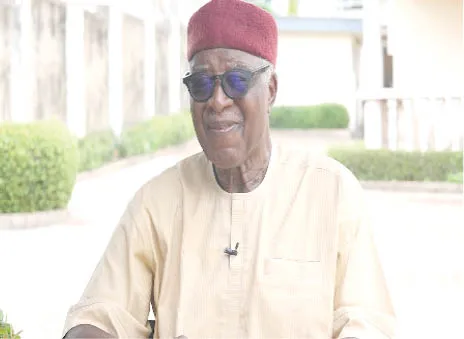
Former Ahmadu Bello University (ABU) Vice-Chancellor and ex-Senator representing Benue State, , says he regrets spending much of his personal resources on politics, revealing that his investments were largely depleted during his political career.
Saror, 85, made the disclosure in an interview with Weekend Trust at his residence in Makurdi, where he reflected on his career in academia, public service, banking and politics.
The former university administrator said his financial difficulties became particularly pronounced after his unsuccessful attempts to become governor of Benue State in 2007 and 2011.
“Maybe I can regret using my resources on politics. Between 2007 and 2011, most of my investments were gone. Everything else was gone, so I had to teach,” Saror said.
After leaving the Senate, Saror returned to academia and taught at Joseph Tarka University in Makurdi until 2023. He said he enjoyed teaching and supervising postgraduate students, but the university eventually stopped paying contract staff following changes surrounding the payment of university employees.
According to him, the university still owes some former staff members substantial sums.
Saror also disclosed that his pension, which was about N99,000 several years ago, had risen to approximately N200,000. However, he said rising living costs, particularly electricity bills, have made it difficult to live on the pension alone.
“I thank God that my children support me. But it is still not easy,” he said.
Saror began his professional career in veterinary medicine before joining ABU in 1970 as a lecturer. He rose through the ranks to become Head of Department, Dean of Veterinary Medicine, Deputy Vice-Chancellor and eventually Vice-Chancellor.
His appointment as Vice-Chancellor came unexpectedly in the early 1990s. He said his tenure was marked by serious tensions with sections of the university community, including protests by members of the Academic Staff Union of Universities (ASUU).
Saror maintained that he eventually completed his tenure and chose not to seek a second term because of the hostility surrounding his administration.
After leaving ABU, he entered partisan politics and was elected to the Senate. He later won another Senate election and served for eight years.
During his time in the National Assembly, Saror said he participated in several important committees and played a role in the development of Nigeria’s telecommunications framework, including the Communications Act of 2003.
He also recalled his involvement in the introduction of GSM services in Nigeria.
Despite his political career, Saror said he never considered himself a conventional politician and maintained that he did not enter public office to enrich himself.
“I always tell anybody who wants to hear, that in my public life I never asked for or received a bribe from anybody,” he said.
He added that his record in public service had been subjected to investigations and that he was satisfied that no wrongdoing was established against him.
Saror also served as chairman of International Merchant Bank after being appointed by former President Shehu Shagari.
Reflecting on Nigeria’s development, the former senator expressed concern about the country’s economic trajectory and the persistent underdevelopment of northern Nigeria.
He argued that the region’s large population has not been matched by sufficient investment in industries, agriculture, education and healthcare.
According to him, the North has also been weakened by excessive emphasis on ethnicity and religion at the expense of competence and development.
“We are more concerned with ethnicity and religion. And you don’t see people based on what they are and what they can contribute; it is what they worship and tribe,” he said.
Saror said northern Nigeria must invest more heavily in human capital, agriculture, healthcare and education if the region is to overcome its developmental challenges.
He also expressed concern over the spread of banditry in parts of the North-West, saying insecurity has made life increasingly difficult for rural communities.
The former senator urged wealthy northerners to invest more in the region rather than concentrating their businesses and investments elsewhere.
He argued that the absence of sufficient private-sector investment has contributed to unemployment and an excessive dependence on government employment and political office.
“Only government, so everybody wants to be a politician – young and old,” Saror said.
At 85, Saror said he now prefers a quiet life away from partisan politics and traditional contests. He spends his time writing a textbook on veterinary haematology, managing his farm and maintaining close relationships with his family.
He said his experiences in academia and politics had taught him that public service could be conducted without compromising personal principles.
“I am happy that I have served my people. I have demonstrated that you can do a job without compromising on principles,” he said.