
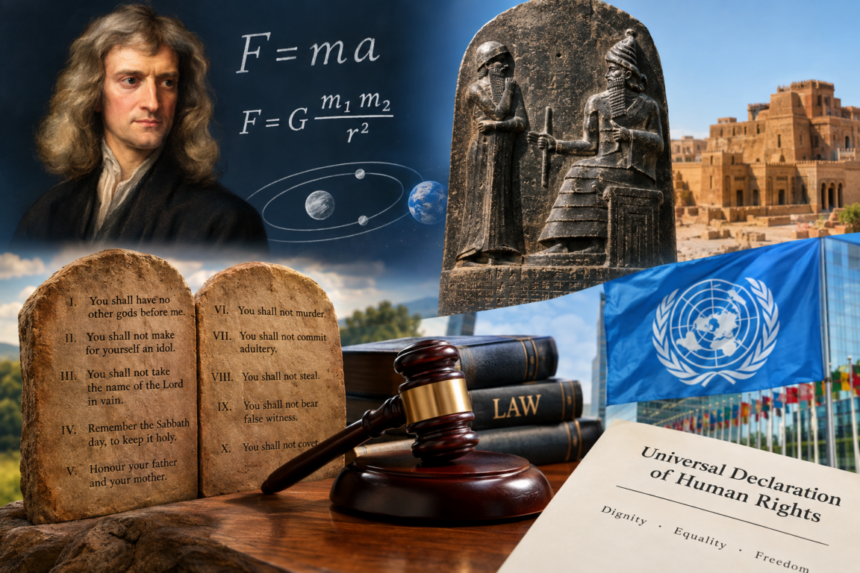
From explaining how objects move to guiding moral conduct and protecting human dignity, some laws have influenced the world for centuries, with these principles emerging from different cultures and fields, yet they continue to shape education, science, religion and government.
The famous laws in the world include scientific theories, ancient legal codes and international declarations. Although they do not all carry the same legal status, each has played a major role in shaping how people understand nature or organise society.
1. Newton’s Laws of Motion
Sir Isaac Newton introduced his three laws of motion in 1687. The laws explain how objects respond to forces and form the foundation of classical mechanics. The first law states that an object remains at rest or in uniform motion unless an external force acts on it. The second law connects force, mass and acceleration through the formula F = ma.
The third law states that every action has an equal and opposite reaction. These principles help explain everyday activities, including driving, jumping and launching rockets. Engineers and scientists still apply Newton’s laws in transport, construction and space exploration.
2. The Law of Universal Gravitation
Newton also proposed the Law of Universal Gravitation in 1687. It states that every object with mass attracts every other object with mass. The force of attraction depends on the masses involved and the distance between them.
The law helped explain why objects fall toward Earth, why the Moon orbits Earth and why planets travel around the Sun. Although Albert Einstein’s theory of general relativity later provided a broader explanation of gravity, Newton’s law remains useful for many practical calculations.
3. The Ten Commandments
The Ten Commandments rank among the most recognised moral and religious laws in the world. They appear in the Bible and are traditionally associated with Moses and the Israelites. The commandments address religious devotion and ethical behaviour.
They include instructions on worship, respect for parents and prohibitions against murder, theft, false testimony and coveting. Over centuries, they have influenced religious education, moral discussions and aspects of legal and cultural traditions, particularly in societies shaped by Judaism and Christianity.
4. The Code of Hammurabi
The Code of Hammurabi, established by King Hammurabi of Babylon around 1754 BCE, remains one of the earliest and most famous written legal codes. It contained rules covering property, trade, marriage, employment and criminal offences.
The code is widely associated with the principle of proportional punishment, often summarised as “an eye for an eye.” However, its punishments varied according to social status, unlike modern principles of equal treatment before the law. Despite this, the code remains an important example of early efforts to record and organise legal rules.
5. The Universal Declaration of Human Rights
The United Nations General Assembly adopted the Universal Declaration of Human Rights on December 10, 1948. The document sets out fundamental rights and freedoms that should belong to every person, including the rights to life, liberty, education and freedom of expression.
Although the declaration itself is not a treaty that automatically binds every country, it has influenced national constitutions, international agreements and human-rights laws. It remains a major reference point in global efforts to promote equality, justice and human dignity.
Why These Laws Still Matter
These five examples show how influential laws can shape science, morality and society. Newton’s laws transformed the study of motion and gravity, while the Code of Hammurabi demonstrated the importance of written rules in ancient civilisation.
The Ten Commandments influenced religious and ethical thought, and the Universal Declaration of Human Rights established a global framework for discussing fundamental freedoms. Together, they demonstrate that the world’s most famous laws can influence everything from scientific discovery to the way societies define justice and responsibility.