
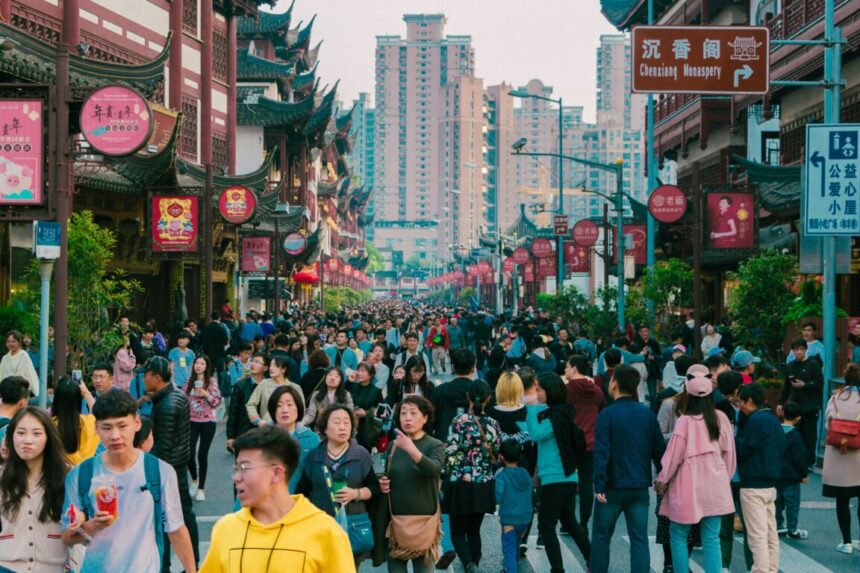
China population history spans thousands of years, revealing how wars, dynasties, famines, agricultural innovations, and government policies shaped the world’s most populous civilization.
From ancient empires to the modern One-Child Policy, China Population History explains how demographic changes influenced China’s economy, culture, and global power.
A Civilization Built on Population Growth
China’s population history stretches back thousands of years, during every major dynasty, population growth often symbolized prosperity and stability.
Yet wars, invasions, epidemics, and natural disasters repeatedly reduced the number of people, creating cycles of expansion and decline.
For much of recorded history, China accounted for about one-quarter of the world’s population, making it one of history’s largest civilizations.
During the Han Dynasty, official census records counted more than 50 million people, while major cities such as Chang’an and Luoyang became among the largest urban centers in the ancient world.
Farming Innovations Sparked a Population Boom
China’s greatest population explosion occurred during the Qing Dynasty.
Improved irrigation, better farming methods, and the introduction of crops such as sweet potatoes, peanuts, and potatoes from the Americas allowed farmers to harvest more food. Fast-growing rice varieties even made it possible to produce multiple harvests each year.
As food supplies increased, so did the population.
By the mid-1800s, China’s population had surged to approximately 450 million people, making it the largest population on Earth at the time.
When Growth Turned Into Crisis
Rapid population growth also brought enormous challenges.
Throughout history, China experienced thousands of recorded famines caused by droughts, floods, poor harvests, and political instability.
One of the deadliest disasters occurred during the Great Leap Forward (1958–1961), when agricultural collectivization, unrealistic production targets, and policy failures triggered the largest famine in modern history. Researchers estimate that between 18 million and more than 40 million people died, while millions of births never occurred because families delayed or lost the chance to have children.
The tragedy permanently changed how Chinese leaders viewed population management.
The One-Child Policy That Changed Families Forever
In 1980, China introduced the One-Child Policy to slow rapid population growth and reduce pressure on resources.
For more than three decades, most urban families could have only one child. The government enforced the policy through financial incentives, penalties, and, in some cases, compulsory birth-control measures.
The policy succeeded in lowering fertility rates, but it also reshaped family life.
Many only children became responsible for supporting two parents and four grandparents, creating what became known as the “4-2-1” family structure.
Meanwhile, a shrinking younger generation meant fewer workers would eventually support an aging population.
From Limiting Births to Encouraging Them
By the early 2010s, China realized that declining births had created a new demographic challenge.
The government gradually relaxed the One-Child Policy, first allowing some couples to have two children before introducing a nationwide Two-Child Policy in 2016.
When birth rates continued to fall, officials expanded the limit again to three children in 2021.
Despite these changes, many couples remain reluctant to have larger families because of rising housing costs, expensive education, childcare expenses, and demanding work schedules.
In 2023, China reached a symbolic milestone when India overtook it as the world’s most populous country.
The shift marked the end of an era that had lasted for centuries.
Today, China’s challenge is no longer controlling population growth but encouraging young people to have children in an increasingly expensive and competitive society.
More Than Numbers
China’s population story is more than a collection of census records.
It is the story of empires built on agriculture, families shaped by government policy, and generations adapting to changing economic realities.
As China searches for solutions to its aging population and declining birth rates, one lesson remains clear: population policies can transform a nation, but they also leave lasting social, economic, and cultural consequences that echo for generations.