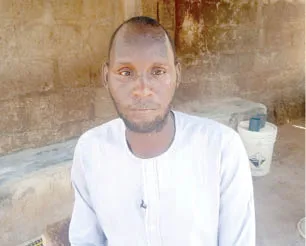
A 30-year-old man, Abdullahi Abubakar, who reportedly lived with blindness for 27 years, has regained his sight following eye surgery at Makkah Specialists Eye Hospital in Kano State.
According to a report by Daily Trust, Abubakar, who was born in Kebbi State and raised in Wudil, Kano, lost his sight at the age of three and spent most of his life navigating daily challenges without vision.
He underwent surgery seven weeks ago after being diagnosed with glaucoma and optic neuritis, bringing renewed hope after years of unsuccessful attempts to find treatment.
Abubakar said he had visited several hospitals and tried different medications before eventually giving up on the possibility of regaining his sight.
Despite his condition, he pursued Islamic education and engaged in different activities to earn a living, including selling water and trading livestock. He said he resorted to begging only when other options were unavailable.
He also relied on friends to guide him through unfamiliar places.
Local Government Support Made Surgery Possible
Abubakar told Daily Trust that a neighbour, who is a police officer, recently took him to a hospital in Kano, where medical examinations indicated that his condition could be treated through surgery.
He said the procedure was estimated to cost ₦180,000, an amount he could not afford despite efforts to raise money from relatives and friends.
His opportunity for treatment came after Wudil Local Government announced assistance for people experiencing eye problems.
Following the presentation of his medical reports, he was referred to Makkah Specialists Eye Hospital, where doctors confirmed that surgery was possible.
Abubakar identified the chairman of Wudil Local Government as the person who paid for the operation.
Seeing His Daughter for the First Time
Describing his first experience after surgery, Abubakar said he began noticing light immediately after the procedure, which started at about 8 a.m.
When the eye covering was removed the following day, he said the brightness was overwhelming.
Medical personnel tested his vision by asking him to identify fingers. Although he initially struggled to understand the visual experience, he gradually began counting what he could see.
He said doctors informed him that his sight could improve progressively because he had lived with blindness since childhood.
One of his most emotional experiences was seeing his daughter’s face for the first time.
Abubakar said he used his phone camera to examine his own face and noticed the resemblance between himself and his daughter, something his wife had previously told him about.
He described seeing his daughter as the greatest joy of regaining his sight.
Wudil River, Stars Among His New Discoveries
Since the surgery, Abubakar said he has been fascinated by ordinary sights that were previously unfamiliar to him.
Among them is the Wudil River, where he enjoys watching the water flow, people diving from a bridge and boats being used in sand-related activities.
He also expressed amazement at the stars in the night sky, explaining that his wife helped him distinguish the moon from the stars.
The sights of shops, market stalls and people trading in the town have also become sources of excitement.
Abubakar said he can now walk independently to familiar locations, including the University of Science and Technology in Wudil, because he memorises routes when visiting places with others.
However, he continues to ask friends about unfamiliar objects and activities as he adjusts to his new visual experience.
Plans to Return to Livestock Trading
Beyond regaining his sight, Abubakar said he hopes to rebuild his economic independence through livestock trading, a business he previously pursued.
He disclosed that the Wudil Local Government chairman recently gave him ₦100,000 to establish the business, adding that his brother accompanied him to the livestock market.
He said additional financial support would help him expand the venture and improve his livelihood.
Abubakar also expressed his intention to learn how to read and write, explaining that although he can now see letters, he has yet to learn to recognise them.
Before surgery, he relied on a phone with voice features and memorised the Qur’an by listening rather than reading Braille.
He has since begun using social media platforms, particularly Facebook and WhatsApp, although doctors advised him to limit screen time.
Reflecting on his transformation, Abubakar said regaining his sight had given him renewed confidence and opened opportunities to conduct business with people who had previously been reluctant to engage with him because of his blindness.
His experience highlights the importance of access to eye care, timely medical intervention and community support in helping people with disabilities pursue greater independence and economic participation.