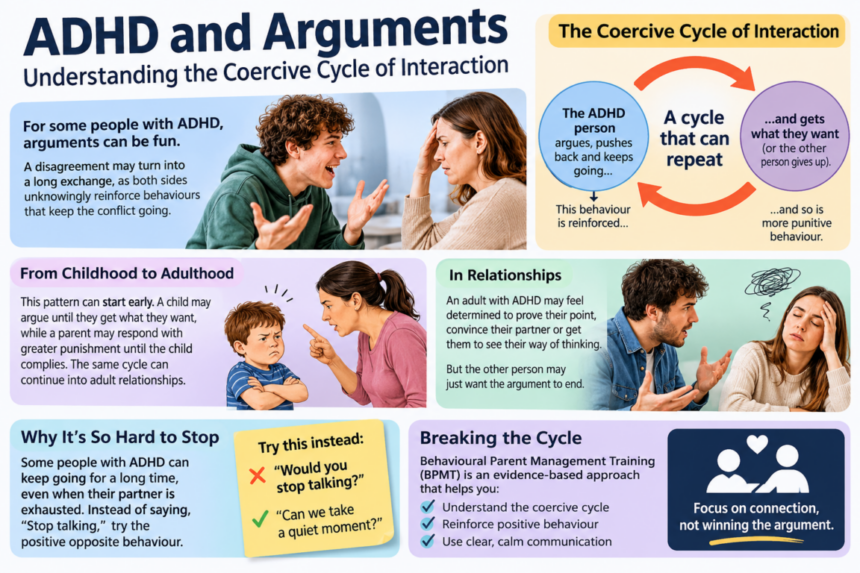
An expert discussing ADHD describes this pattern as a coercive cycle of interaction, in which both sides unintentionally reinforce behaviours that keep the conflict going. While this does not apply to everyone with ADHD, the speaker says it can help explain why some arguments become difficult to end.
The cycle often begins when a child repeatedly argues with a parent. The child may eventually get what they want after refusing to give up, while the parent may resort to increasingly punitive responses until the child complies. Both parties, in different ways, learn that their behaviour produces a result.
According to the speaker, this pattern can continue into adulthood and affect romantic relationships and other personal interactions. A person who has become accustomed to arguing until they win may approach disagreements with the determination to prove their point, convince the other person or make them adopt the same way of thinking.
However, the other person may not experience the exchange in the same way. What one individual sees as an opportunity to explain their position or reach an understanding may feel exhausting to someone who simply wants the argument to end.
The speaker explains that some people with ADHD can sustain these exchanges for a long time, even when their partners have become frustrated or emotionally drained. The argument may only end when one person gives in or runs out of the energy to continue.
Breaking the coercive cycle
The speaker links this behaviour to the principles taught in behavioural parent management training, an evidence-based intervention for ADHD. One of its early steps is helping parents understand the coercive cycle and recognise how their reactions can unintentionally reinforce unwanted behaviour.
Rather than relying only on commands that tell a child what to stop doing, the approach encourages parents to identify and reinforce the positive behaviour they want to see.
For example, instead of saying, “Would you stop talking?” a parent could say, “Can we take a quiet moment?” The difference is a shift from focusing on the behaviour to be stopped to communicating the behaviour expected.
This approach offers a practical way to interrupt patterns that may otherwise become established through repeated interactions. It also highlights the importance of understanding how both sides contribute to a cycle of conflict.
Ultimately, recognising the coercive cycle can help parents and partners respond differently to prolonged arguments. Rather than treating every disagreement as a battle that someone must win, the focus can shift towards healthier communication, clearer expectations and behaviours that support a more constructive relationship.