
The Independent Corrupt Practices and Other Related Offences Commission (ICPC) has exonerated the Presidency from any involvement in the creation of the controversial Presidential Foreign Investment Promotion Council (PFIPC) and the appointment of its purported Director-General, Adeniyi Adeyemi Matthew, declaring that the documents used to establish the agency were forged.
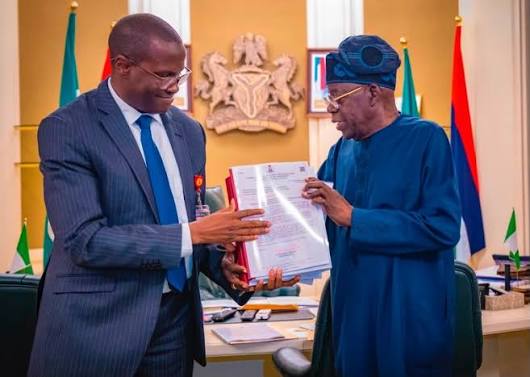
The ICPC Chairman, Musa Adamu Aliyu, disclosed this on Thursday after presenting the commission’s interim investigation report to President Bola Ahmed Tinubu at the Presidential Villa in Abuja.
According to Aliyu, investigations revealed that Adeyemi was never appointed by the Federal Government and that the PFIPC had no legal backing, executive approval or official recognition.
“The appointment letter presented by Adeniyi Adeyemi Matthew was forged and did not originate from the State House,” Aliyu said.
ICPC Uncovers Two More Fake Government Agencies
Beyond the PFIPC, the anti-corruption agency said it uncovered two additional fictitious government institutions allegedly created by Adeyemi.
They include:
- FCT Investment Promotion Agency (FIPA)
- Foreign Investment Promotion Agency and Public Private Partnership (FIPA-PPP)
According to the ICPC chairman, the discovery points to a wider scheme involving forged government documents and the unlawful creation of public institutions.
Tinubu Ordered Probe
President Tinubu had, on July 7, directed the ICPC to investigate the activities of the PFIPC and submit its findings within 30 days following allegations surrounding the council’s operations.
The investigation established that Adeyemi was never appointed by any government authority, while the PFIPC itself was never created by any law, executive order or valid government instrument.
The ICPC further alleged that Adeyemi assumed the identity of the defunct Presidential Economic Advisory Council (PEAC), illegally occupied its former office and used forged government documents to conduct the activities of the fake agency.
Investigators also found that the office had been unlawfully accessed after its locks were broken.
No Government Funds Released
Despite widespread concerns over the agency’s activities, the ICPC said no federal funds were approved or disbursed to the PFIPC.
However, Aliyu admitted that the investigation exposed significant institutional weaknesses.
“Our investigation found that weaknesses in verification, inter-agency oversight and government processes were exploited by Adeyemi with some level of negligence,” he said.
Head of Civil Service Approved Requests Based on Forged Documents
The revelations came weeks after the Office of the Head of the Civil Service of the Federation admitted before the House of Representatives Ad Hoc Committee investigating the matter that it processed official administrative approvals for the council.
Head of the Civil Service, Didi Esther Walson-Jack, had informed lawmakers on July 29 that her office issued an authorised establishment and recruitment waiver after receiving what appeared to be legitimate establishment documents and the appointment letter of the council’s Director-General.
The documents have now been declared forged by the ICPC.
State House Distances Itself from PFIPC
The State House also firmly denied any involvement in establishing the council.
Appearing before the House committee, the Director of Administration, Abdulkadir Idris, who represented the Permanent Secretary, said the Presidency only became aware of the PFIPC through media reports.
“We did not send any correspondence or any request to the Office of the Accountant-General regarding this council. We never knew anything about it until we saw reports in the media,” Idris said.
He also dismissed documents purportedly originating from the Presidency as fabricated.
According to him, the individual identified in the letters as Akande Adewale, allegedly Director of Administration and Support Services, never worked in the State House.
Idris explained that official records dating back to 2003 contain no such name, adding that the Presidency has no department known as the Directorate of Administration and Support Services.
He further noted that appointments of directors-general of federal agencies are processed through the Office of the Secretary to the Government of the Federation (SGF), not the State House.
FRSC Admits Issuing Seven Official Number Plates
The Federal Road Safety Corps (FRSC) also appeared before the House committee, admitting that it issued seven official government number plates to the PFIPC after completing what it believed were standard verification procedures.
Corps Marshal Shehu Mohammed explained that officials physically visited the office presented by the council, found it operational and approved the request based on documents submitted.
However, he admitted the agency’s verification system failed.
“This is the first time we have encountered a case like this. We have learnt valuable lessons and are strengthening our verification and intelligence processes,” Mohammed said.
He disclosed that the FRSC has already begun retrieving all government number plates issued to the council.
During the hearing, House Committee Chairman Yusuf Gagdi questioned how officials failed to notice glaring irregularities in the documents, including the absence of official government insignia and the suspicious inclusion of President Tinubu, the SGF and serving ministers as members of the council’s board.
Mohammed conceded that the documents should have raised immediate concerns.
House Committee Schedules Joint Hearing
The House of Representatives Ad Hoc Committee has adjourned proceedings until next Wednesday, when all government agencies involved in the investigation will appear together.
Chairman Yusuf Gagdi said the joint hearing is intended to reconcile conflicting testimonies and establish how the fake agency secured official recognition, office accommodation and other government privileges.
“We want all the relevant agencies to appear together so we can determine where the failures occurred and identify the weaknesses within each institution,” he said.
Questions Remain Over Adeyemi’s Testimony
Despite the latest developments, uncertainty remains over when Adeyemi will appear before lawmakers.
Earlier, the committee directed the Inspector-General of Police to produce him for questioning.
However, police informed lawmakers that Adeyemi is being held under a valid remand order issued by the Federal High Court and cannot be released without judicial approval.
The committee has since resolved to obtain the necessary court authorisation before compelling his appearance.
CISLAC Demands Wider Accountability
The Civil Society Legislative Advocacy Centre (CISLAC) has welcomed the ICPC’s findings but insisted that accountability should extend beyond Adeyemi.
Its Executive Director, Auwal Musa Rafsanjani, argued that public officials whose actions or negligence enabled the operations of the fake agency must also be sanctioned.
He questioned how a non-existent government institution managed to obtain office accommodation, process official documents, receive administrative approvals and operate within government structures.
“None of those involved should be politically protected. There must not be punishment for only one person,” Rafsanjani said.
He also criticised reports suggesting that Adeyemi could be questioned privately by the House committee, insisting that any interrogation should be conducted openly to preserve public confidence.
CODE Calls for Institutional Reforms
The Connected Development (CODE) described the ICPC findings as evidence of deep institutional weaknesses within Nigeria’s public administration.
The organisation said the scandal highlighted the urgent need for stronger verification systems, improved inter-agency coordination, transparent budgeting and greater public oversight.
CODE maintained that reforms in public financial management are necessary to prevent similar incidents in the future.
Family Opposes Closed-Door Interrogation
Meanwhile, Adeyemi’s family has opposed reports that lawmakers attempted to question him in police custody without his lawyers present.
His brother, Peter Adeyemi, alleged that committee members visited the detention facility but that the suspect declined to answer questions in the absence of his legal representatives.
The family’s position aligns with a statement earlier issued by Adeyemi’s lawyer, Ademola Oyedokun, who rejected any proposal for a closed-door interrogation.
According to the lawyer, his client is prepared to answer all allegations but insists that any testimony should be given publicly, just as previous witnesses appeared in open hearings.
As investigations continue, the PFIPC scandal has exposed serious gaps in Nigeria’s institutional verification systems, raising fresh concerns over oversight mechanisms within public administration. The upcoming joint hearing is expected to clarify how a fictitious agency allegedly obtained official recognition and administrative privileges despite lacking any legal foundation.