


At least 12 female pupils of an Islamic school in Maikujeri community, Rafi Local Government Area of Niger State, have reportedly been abducted by bandits while returning from their teacher’s farm, amid renewed attacks forcing farming communities to flee their homes and abandon their agricultural produce.
The pupils, who are between nine and 14 years old, were reportedly kidnapped around 10am on Saturday while returning from harvesting maize on their teacher’s farm on the outskirts of the community.
A resident, Mohammed Adamu, told Daily Trust that the children were on their way home when armed men intercepted them.
Another source close to the school, Madarasatul Nurul Islam, disclosed that 13 people were abducted, including 12 female pupils and the younger brother of the school proprietor, Mallam Mainasara.
According to the source, the victims stopped at a borehole to wash themselves and drink water after leaving the farm when the armed men attacked and whisked them away.
He explained that the pupils had been working on the farm with their teacher when the teacher received information that bandits were approaching the area.
The teacher reportedly instructed the children to return home immediately before leaving on his motorcycle.
However, the armed men reportedly intercepted the pupils at the borehole.
An Okada rider identified as Tasi’u, who reportedly attempted to escape during the attack, was shot and is currently receiving treatment at the IBB Specialist Hospital in Minna.
The source also disclosed that some women were abducted from another farm in the area.
When contacted, the spokesperson for the Niger State Police Command, SP Wasiu Abiodun, said he would verify the report and provide further information.
The police spokesperson, however, confirmed that six abducted persons were rescued during a separate security operation in the Rafi Local Government Area.
According to him, joint security tactical teams rescued the victims on October 29, 2026, during a clearance and rescue operation around Pandogari.
He said the victims were reportedly abducted on October 28 from their farms in Mahangi village and taken to Hanawanka Forest.
The rescued victims were later taken to Kagara Divisional Police Headquarters for debriefing and medical attention before being reunited with their families.
Farmers Abandon Farms As Attacks Intensify
Meanwhile, dozens of farming communities across Borgu, Mariga, Mashegu and Rijau Local Government Areas have reportedly continued to flee their homes following renewed attacks by armed bandits.
Farmers in the affected communities told Daily Trust that their agricultural produce, including rice, soybeans and maize, was being left to waste because insecurity had prevented them from harvesting their crops.
A resident of Mariga Local Government Area, Ibrahim Ayuba, said several communities had remained under the control of armed bandits for between 14 and 19 days.
He identified Ragada, Maburya, Mazame, Kuimo and Kura in Mariga, as well as Inana and Idaci in Rijau, among the affected communities.
According to him, the attacks had forced residents to flee to neighbouring towns, including Warari, Gulbin Boka and Rijau.
Ayuba said the violence had resulted in three deaths, injuries to several residents and alleged sexual assaults against women.
He also disclosed that residents of Kuimo were forced to flee again following reports of another attempted attack.
The farmer warned that rice and soybean crops risked being lost if farmers were unable to return to their farms to harvest and attend to them.
Security Experts Call for Stronger Forest Protection
Amid the worsening security situation, security experts have called on the Federal Government to strengthen forest surveillance, intelligence gathering and collaboration among security agencies to address the persistent abduction of schoolchildren, farmers and other residents.
A senior security consultant, Auwal Bala Durumin Iya, advocated the establishment of a specialised forest security system, which he described as a forest marshal arrangement.
He said properly trained and educated personnel should be deployed to secure forests and prevent criminal groups from using them as hideouts and operational bases.
According to him, securing forests would help protect rural communities and reduce threats to urban centres.
He also proposed establishing an independent Centre for Intelligent Research to conduct professional security studies, identify emerging threats and provide early-warning information and policy recommendations to governments.
Similarly, security and counter-terrorism expert Chidi Omeje said kidnapping should no longer be treated exclusively as a military problem.
He called for stronger grassroots intelligence gathering, the dismantling of kidnapping networks and their financiers, improved border security, inter-agency cooperation and the swift prosecution of perpetrators.
Omeje also maintained that the police should take the lead in internal security operations, with the military providing support where necessary.
Former NIA Chief Identifies Networks Behind Kidnappings
A former Director-General of the National Intelligence Agency, Ambassador Ahmed Rufai, has also attributed Nigeria’s kidnapping crisis to a complex network involving terrorist organisations, bandit militias, informants and financial facilitators.
Speaking at the Global Security Forum in Doha, Qatar, Rufai said the motives behind abductions had expanded beyond ransom collection to include recruitment, propaganda and attempts to secure the release of detained members of criminal groups.
He identified terrorist organisations, criminal bandit militias and other criminal gangs as major categories of perpetrators.
The former intelligence chief further warned that informants and financial facilitators played significant roles in sustaining kidnapping operations by providing information about potential targets and helping criminal groups move ransom proceeds through financial channels.
He called for responses tailored to the identities and motives of abductors, including discreet negotiations in cases involving hostage-taking for financial demands.
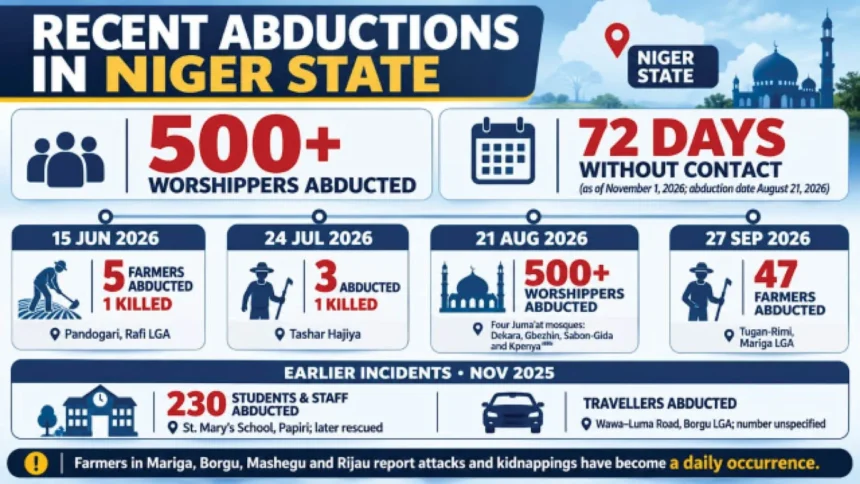
History of Mass Abductions in Niger State
Niger State has witnessed several incidents of mass abductions and attacks on farming communities in recent months.
On August 21, 2026, terrorists reportedly invaded four Juma’at mosques in Dekara, Gbezhin, Sabon-Gida and Kpenya communities, abducting more than 500 worshippers.
Families of the victims have reportedly remained without communication from the abductors.
On September 27, 47 farmers were also abducted while harvesting groundnuts in Tugan-Rimi community, Mariga Local Government Area.
Earlier, on June 15, bandits attacked farmlands in Pandogari District of Rafi Local Government Area, killing a resident, Dauda Galadima, and abducting five farmers, including Nasiru Yakubu and his son, Bilyaminu.
The state also recorded an attack on Tashar Hajiya community on July 24, during which gunmen reportedly killed 25-year-old Mustafa Murtala and abducted three residents, including a man identified as Alhaji Baza Baza, his wife and their daughter.
The latest attacks have renewed concerns over the safety of rural communities, agricultural production and access to education in Niger State.
The abduction of the pupils from Maikujeri has further highlighted the vulnerability of children and farming communities to attacks, particularly in areas where armed groups reportedly operate around forests and farmlands.