


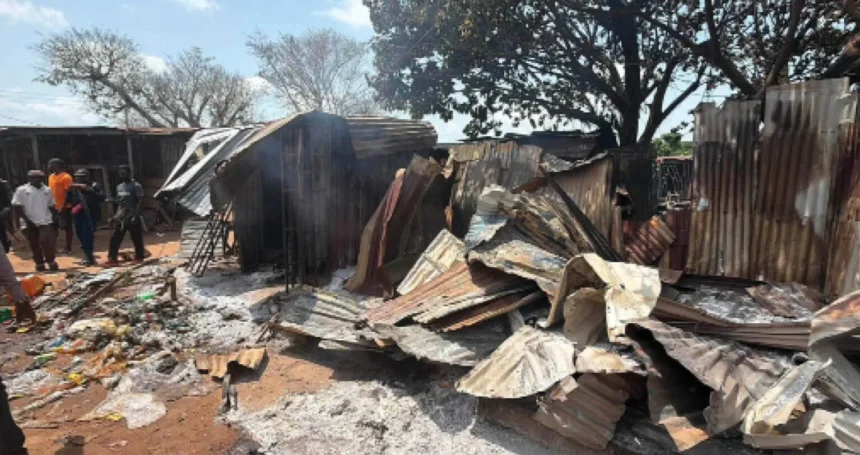
Three people have reportedly been killed and several others injured following a renewed farmers-herders clash in Paikon-Kore community, Gwagwalada Area Council of the Federal Capital Territory (FCT).
The violence, which began on Saturday afternoon and continued until Sunday morning, also left two houses, several shops and a motorcycle burnt, while goods were destroyed at the community market.
The latest incident has raised fresh concerns over recurring farmers-herders conflicts in rural communities across the FCT, with security experts warning that urgent intervention is needed to prevent further bloodshed.
A resident, Danlami Ibrahim, said the clash began after herders allegedly allowed their cattle into a groundnut farm containing crops that were yet to be harvested.
According to him, the farm owner confronted the herders, leading to a heated argument during which one of the herders allegedly attacked a farmer with a cutlass, severing one of his hands.
Ibrahim said the incident sparked anger among residents and triggered a reprisal attack in which three herders were reportedly killed.
He added that the violence spread through the community, leaving several people injured and properties destroyed.
Some of the injured victims were taken to hospitals in Gwagwalada for treatment.
A visit to the affected village market showed several wooden, zinc-built and container shops burnt, with smoke still rising from some of the damaged structures.
At Sabon Nakowa Hospital, a private medical facility in Gwagwalada, some victims were seen receiving treatment. Two others were also observed at the accident and emergency unit of the University of Abuja Teaching Hospital.
The Secretary of the Miyetti Allah Cattle Breeders Association of Nigeria (MACBAN), Gwagwalada Area Council chapter, Mohammed Usman, confirmed that three herders had died.
“For now, information at my disposal shows that three herders lost their lives. That is what I can say for now, while I am yet to get the number of those who sustained injuries,” he said.
Usman said he had informed the Gwagwalada Area Council chairman, Kasim Mohammed Ikwa, about the incident.
Ikwa visited the affected community on Sunday alongside the Divisional Police Officer, SP Aaron H. Kaura, and other security operatives.
He condemned the violence and described it as unfortunate, adding that the council would convene a stakeholders’ meeting on Monday to address the crisis and prevent further attacks.
The chairman urged the warring parties to embrace peace, warning youths against confrontation and retaliatory violence.
He advised farmers whose crops were damaged by cattle to report such incidents to the relevant security agencies instead of resorting to self-help.
Ikwa said conflicts of this nature often affected innocent residents who might not even know the circumstances that triggered the dispute.
He also urged residents to cooperate with security personnel deployed to the area and disclosed that youth leaders, the Sarkin Noma and other community leaders from both sides had been invited to an expanded security meeting to seek a lasting solution.
He said anyone who felt unfairly treated or believed their complaints had not received adequate attention should report directly to him for intervention.
Meanwhile, soldiers, police officers, vigilantes and personnel of the Nigeria Security and Civil Defence Corps (NSCDC) have been deployed to the community to restore calm.
The FCT Police Command spokesperson, SP Adeh Josephine, did not answer calls seeking the command’s reaction as of the time of filing this report.
Not the First Clash
The latest violence follows an earlier confrontation on August 11, 2026, involving Paikon-Kore, Ibwa and Rafin-Zurfi communities, during which a farmer reportedly lost a hand and three other people sustained machete injuries.
Following that incident, Ikwa convened an emergency security meeting attended by traditional rulers, community leaders, village and district heads, Fulani Ardos and representatives of security agencies.
The council chairman subsequently established a peace and investigative committee and visited the affected communities.
He promised that the committee’s report would be made public during the stakeholders’ meeting scheduled for Monday.
Some residents who spoke to reporters attributed the August incident to cattle allegedly straying into farms and destroying crops.
A farmer, Ishaku Danjuma, said similar confrontations had occurred in nearby communities after cattle allegedly entered maize farms.
“If you make your investigations, you will discover that 95 per cent of incidents of farmers and herders clashes across the three communities were as a result of cows straying into people’s farms,” he said.
Another resident, Usman Yakubu, said the destruction of crops by cattle had repeatedly triggered confrontations between farmers and herders in the area.
Grazing Reserves Under Pressure
The recurring violence has also renewed attention on the condition and management of grazing reserves in the FCT.
The Paikon-Kore Grazing Reserve, located in Gwagwalada Area Council, is one of Nigeria’s gazetted grazing reserves and covers approximately 9,500 hectares.
However, herders have complained that communities have encroached on parts of the reserve, while farmers have expressed concerns about the potential effects of grazing activities on their farmland.
In June 2022, tensions reportedly escalated when the then Minister of Agriculture and Rural Development, Dr Mohammad Mahmood Abubakar, visited the reserve to launch a pasture development programme. Youths from the community and herders reportedly began throwing stones at one another.
Some Gbagyi farmers opposed the programme and called for the reserve to be fenced, arguing that pasture development could attract more herders and threaten surrounding farms.
The grazing reserve at Kawu in Bwari Area Council has also reportedly remained underutilised because of inadequate infrastructure and basic facilities.
The approximately 9,000-hectare reserve was originally designed to accommodate about 30,000 cattle and 10,000 households.
Last year, the Federal Government announced a modernisation project for the facility, including plans to sink boreholes to improve livestock productivity and reduce farmers-herders conflicts.
However, local livestock farmer Mallam Inuwa Bawa said promised improvements, including the planting of modern pasture grasses, had yet to be fully implemented.
He also said insecurity and attacks on herders, alongside livestock rustling, had forced some pastoralists to leave the area.
Bawa called on the Federal Government to improve infrastructure and strengthen security around the reserve, warning that insecurity had disrupted both farming and livestock activities.
Deadly Clashes Across the FCT
Farmers-herders conflicts have claimed lives and caused injuries in several rural communities across the FCT, including Gwagwalada, Kwali and Kuje.
In 2023, a 32-year-old vigilante, Iliyasu Shuaibu Kolo, was killed in Dobi community, Gwagwalada, during a clash reportedly triggered by cattle entering a farm. Two other people sustained machete injuries, while houses were also destroyed.
In October 2024, a farmer, Ezekiel Yakubu, 52, was reportedly hacked to death at Tungan Sarki in Dafa ward, Kwali Area Council, following a dispute over cattle allegedly destroying his cassava farm.
Violence also escalated in Gurfata, Gwagwalada, in 2025, with community accounts documenting multiple deaths and injuries during a series of confrontations.
A Premium Times investigation published on June 30, 2026, reported that Hamza Yakubu was killed in May 2025, while Abdul Abubakar, Auwal Musa Lana and Abraham Moses, popularly known as Manya, sustained injuries in June.
Dahiru Yakubu was reportedly killed on July 29, 2025, while vigilante commander Musa Yatsu was killed the following day. Isa’ac Abubakar and Sa’ad Yakubu were also reportedly injured during the July 30 violence.
Casualty figures from the wider Gurfata crisis have differed. In August 2025, Ibrahim Ciroma, the Gwagwalada chairman of MACBAN, said the crisis had resulted in three deaths and injuries to seven herders.
On August 9, 2025, nine people, comprising six Bassa farmers and three Fulani herders, reportedly sustained machete injuries during a clash in Gomoni village, Kwali Area Council. The confrontation was linked to allegations that cattle had destroyed melon and maize farms.
In February 2026, four people, including three herders and one resident, were reportedly killed during a clash in Gudun-Karya, Kuje Area Council. Houses were burnt, forcing some residents to flee.
On April 7, 2026, another clash in Fogbe village, Kwali, left one person dead and another seriously injured, according to security sources cited by Zagazola Makama.
Three days later, a separate confrontation in Kudu community, near Takuro in Dafa ward, Kwali, reportedly left two people dead and six others injured.
A comprehensive official casualty figure for farmers-herders clashes across the FCT could not be established.
Herders Allege Encroachment on Grazing Reserve
The conflict has also been linked to disputes over land use, grazing routes and access to farmland.
In an investigation published by Weekend Trust on November 16, 2024, some herders at the Paikon-Kore Grazing Reserve alleged that farmers had encroached on designated grazing areas and blocked cattle routes.
A herder, Hussaini Hassan, said farming activities had extended into parts of the reserve close to Fulani homes and farms, leaving cattle with limited access to designated routes during the rainy season.
Idris Musa Maikarfi, a milk aggregator in the reserve, also complained about encroachment and said a committee had been established to resolve disputes.
Similarly, Suleiman Ahmad, secretary of the Ardon Paikon-Kore, said committees involving farmers and herders had been set up to delineate grazing routes, but disagreements persisted.
Ahmad also identified other sources of tension, including allegations that chemicals applied to farms had affected livestock and that children tending cattle had sometimes been beaten when animals strayed into farms.
The competing grievances highlight the need for effective land-use management, clearly designated grazing routes and accessible mechanisms for resolving disputes before they escalate.
Security Expert Calls for Early Warning Systems
Security analyst and chairman of Beacon Consulting, Dr Kabiru Adamu, called for stronger early warning mechanisms and faster responses by security agencies to prevent local disputes from turning deadly.
Adamu said the latest violence reportedly began after herders’ cattle entered a rice farm and fed on harvested and unharvested crops, triggering confrontations that spread across several settlements.
He said his information indicated that two people had been killed, while houses were burnt and attacks continued. His account differed from the three deaths reported by residents and MACBAN officials.
The analyst described the recurring violence as a longstanding problem, citing similar incidents in 2012, 2024, 2025 and earlier in 2026.
He argued that effective early warning systems and timely deployment of security personnel could prevent disputes from escalating.
“If early warning indicators had been picked up and then the response capability by our security forces had been deployed, the violence could have been prevented,” he said.
Adamu also stressed the importance of an effective justice system in addressing disputes over crop destruction and compensation.
He said farmers whose crops were destroyed by livestock should have access to timely remedies, adding that compensation could help prevent grievances from escalating into violence.
The analyst called for the impartial arrest and prosecution of anyone found to have taken the law into their own hands, regardless of whether they were farmers or pastoralists.
He further urged traditional rulers, religious leaders and other community stakeholders to intervene quickly whenever tensions arose.
Adamu warned that misinformation circulating on social media platforms, including Facebook, Instagram and TikTok, could aggravate communal violence by spreading false claims about the conduct of security forces and the parties involved.
He called on authorities to establish mechanisms for identifying and countering inflammatory misinformation, stressing that early intervention, impartial law enforcement and timely justice were essential to preventing further clashes.
With the latest violence occurring despite previous peace meetings and the establishment of a committee, the planned stakeholders’ meeting is expected to provide another opportunity for authorities, farmers, herders and community leaders to address the underlying disputes and develop measures to prevent further loss of lives and destruction of property.