Political assassination has remained one of the darkest features of Nigeria’s political history. From the killing of prominent politicians and political activists to attacks on candidates and party officials during election periods, targeted violence has repeatedly raised questions about the value placed on political competition, the protection of citizens and the effectiveness of Nigeria’s justice system.
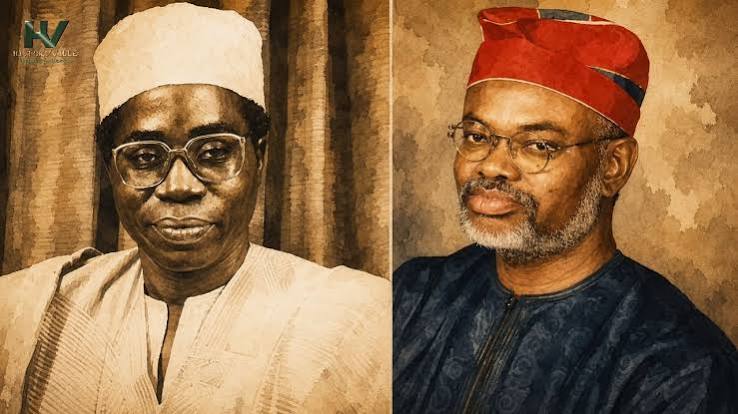
The deaths of Chief Bola Ige, Funsho Williams, Dipo Dina, Marshall Harry, Kudirat Abiola, Ayo Daramola and others are different cases with different circumstances. It would therefore be inaccurate to claim that all were killed for the same reason or that every case was conclusively established as a political assassination. However, together, these cases illustrate a recurring problem: the use or alleged use of violence to settle political disputes and eliminate perceived opponents.
Bola Ige: A killing that shocked Nigeria
On December 23, 2001, Chief Bola Ige, former Governor of old Oyo State and then Attorney-General of the Federation and Minister of Justice, was shot dead inside his residence in Bodija, Ibadan.
The Federal Ministry of Information records that Ige was killed by unknown gunmen in his bedroom. At the time of his death, he was one of the country’s most prominent political figures. (Federal Ministry of Information)
His assassination came amid intense political tensions in Osun State. Human Rights Watch reported that Ige was perceived as supporting one faction in a political crisis involving the state’s governor and deputy governor. Four days before Ige’s death, Osun State legislator Odunayo Olagbaju had also been stabbed to death. Human Rights Watch noted, however, that the precise motive for Ige’s murder was not confirmed. (Human Rights Watch)
The case became a defining example of the danger surrounding Nigeria’s political competition in the early years of the Fourth Republic.
Funsho Williams: A political ambition cut short
Five years later, another prominent political figure was killed.
On July 27, 2006, Chief Funsho Williams, a businessman and Peoples Democratic Party governorship aspirant in Lagos State, was found dead at his residence in Dolphin Estate, Ikoyi.
According to contemporary reporting, Williams was found with his hands and feet bound and his mouth gagged. Police said they were investigating all possibilities, including political assassination. (The New Humanitarian)
Williams’ death occurred while political competition was intensifying ahead of the 2007 elections. He was seeking the PDP governorship ticket in Lagos, making his death particularly significant in the context of the fierce contest for the party’s nomination.
Human Rights Watch later described the murder as one of the most notorious political killings associated with the 2006–2007 electoral period. It reported that the murder remained unresolved, despite a large number of suspects having been detained at one stage. (Human Rights Watch)
Amnesty International also documented the case, reporting that 244 people were arrested in connection with the murder and that many were subsequently released for lack of evidence. (Amnesty International)
Court proceedings later revealed problems surrounding forensic evidence. A police forensic officer told a Lagos High Court that some biological exhibits had deteriorated because of interrupted electricity supply, complicating the investigation. (The Nation)
The unresolved nature of the case has contributed to continuing demands for justice.
Dipo Dina: Another political killing
Otunba Dipo Dina, a former governorship candidate of the Action Congress in Ogun State, was shot dead on January 25, 2010.
Contemporary Nigerian reporting identified Dina as a politician who had contested the Ogun State governorship election in 2007. He was killed around Covenant University in Ota, Ogun State. (Vanguard News)
His killing added to a long list of politicians whose lives were cut short in circumstances that generated political questions.
As with other cases, it is important to distinguish between what was established in investigations and what was alleged publicly. A murder involving a politician is not automatically a politically motivated assassination.
Marshall Harry and the danger of political rivalry
On March 5, 2003, Marshall Harry, the All Nigeria Peoples Party’s national vice-chairman for the South-South zone, was murdered at his Abuja residence.
Human Rights Watch reported that armed men entered his home during the night, located his bedroom and shot him. Harry had become an outspoken opponent of the political establishment in Rivers State and had moved from the PDP to the ANPP. He was also involved in efforts to mobilise support for a South-South presidential project. (Human Rights Watch)
His killing occurred only weeks before the 2003 general elections.
Human Rights Watch said the exact motive was not confirmed, although the political tensions surrounding Harry generated widespread suspicion that his killing was connected to political rivalry. (Human Rights Watch)
Kudirat Abiola: A political killing during military rule
Political assassination in Nigeria predates the Fourth Republic.
On June 4, 1996, Kudirat Abiola, the wife of the presumed winner of the annulled 1993 presidential election, Moshood Abiola, was shot dead by unknown attackers while travelling in Lagos.
Human Rights Watch documented that Kudirat had become an important campaigner for her husband’s political cause and a vocal critic of the military government. Amnesty International separately investigated her murder under the question of whether it constituted a political killing. (Refworld)
Her death became one of the most significant political killings of Nigeria’s military era.
Ayo Daramola and the 2006 political violence
Dr Ayo Daramola, a PDP governorship aspirant in Ekiti State, was murdered at his home on August 14, 2006.
Amnesty International reported that Daramola was fatally stabbed and that several people were arrested in connection with the killing. Human Rights Watch later noted that although arrests were made, those who allegedly organised the assassination were not formally identified or prosecuted. (Amnesty International)
His death, coming shortly after Funsho Williams’ murder, intensified concerns about the level of violence surrounding political nominations and electoral competition in the period leading to the 2007 elections.
So, why does political assassination happen?
There is no single explanation.
One major factor is the extraordinarily high stakes attached to political power. In Nigeria, control of political office can provide access to public resources, appointments, contracts and patronage networks. The struggle for political office can therefore become much more than a competition over policy.
The Institute for Security Studies has argued that control of state resources and the dominance of government over important areas of economic activity can increase the incentives surrounding political competition. It also identifies the politicisation of security and law-enforcement institutions as a structural concern.
A recent academic study similarly argues that weak party institutionalisation, elite capture, patronage and rent-seeking can make political competition highly personalised and potentially more violent. (Taylor & Francis Online)
Weak internal party democracy
Political violence can also emerge from battles within the same political party.
The struggle is not always simply APC versus PDP, or government versus opposition. Intra-party contests over governorship tickets, legislative seats and other nominations can become extremely intense.
Human Rights Watch documented at least 27 violent incidents associated with contests for PDP nominations during the 2006–2007 period. It also recorded assassinations and attempted assassinations connected to electoral campaigns and intra-party rivalries. (Human Rights Watch)
This demonstrates an important point: political assassination can arise from competition within political organisations, not only from confrontation between opposing parties.
The politics of patronage and political “godfatherism”
Another factor is the relationship between politicians, wealthy patrons and informal networks of power.
Human Rights Watch’s research on Nigeria’s 2007 elections described a system in which political actors sometimes relied on gangs and other violent groups to intimidate opponents, influence elections and protect political interests. The organisation also linked political violence to patronage networks and impunity. (Human Rights Watch)
This does not mean that every politician participates in or supports violence. Rather, the evidence indicates that informal networks can create opportunities for political violence when institutions are unable to prevent or punish it effectively.
Impunity
Perhaps the most important issue is what happens after an assassination.
When a political murder remains unresolved, it creates two problems. First, the victims and their families are denied justice. Second, future perpetrators may conclude that the consequences of political violence are limited.
Human Rights Watch’s 2003 assessment warned that perpetrators and sponsors of political violence often enjoyed impunity. It argued that the failure to punish political violence could encourage its repetition. (Human Rights Watch)
The unresolved Funsho Williams case is particularly significant because of the difficulties encountered during the investigation and subsequent court proceedings. (The Nation)
Weak investigations and forensic challenges
Modern criminal investigation depends heavily on evidence: DNA, fingerprints, ballistics, digital records, crime-scene preservation and credible witness testimony.
Where investigations are delayed, crime scenes are compromised or forensic materials are lost, the likelihood of successful prosecution can decline.
The Funsho Williams case illustrates this problem. A police forensic officer told the court that some biological evidence had deteriorated because of interrupted electricity supply. (The Nation)
The lesson extends beyond one case: political assassination cannot be effectively deterred without professional investigations capable of identifying both the perpetrators and, where evidence supports it, those who ordered or financed the crime.
Elections can increase the risk
Nigeria’s history shows a recurring relationship between intense electoral competition and political violence.
ACLED’s assessment of the 2023 election period found that candidates, politicians and party supporters were among those targeted by violence and that armed groups and criminal gangs were involved in some attacks. It also found that political violence has repeatedly increased around election periods since the return to civilian rule in 1999. (ACLED)
The International Republican Institute’s 2026 assessment ahead of the 2027 elections similarly identifies election-related violence, monetised political competition and declining trust in political institutions as challenges requiring attention. It recommends stronger investigation and prosecution of electoral violence. (IRI)
This is particularly important as Nigeria approaches another major electoral cycle.
It is not only politicians who suffer
Political violence does not stop with the assassination of prominent candidates.
Ordinary voters, journalists, campaign workers, party officials, electoral officers and communities can become victims.
An Afrobarometer study based on its 2017 survey of 1,568 Nigerian adults across the 36 states and the FCT found that approximately one in four respondents had experienced at least one form of political violence. The study identified several factors associated with greater exposure, including poverty, partisan political activity, political participation and the absence of police presence. (Afrobarometer)
This means political assassination should not be viewed simply as the killing of one politician. It forms part of a broader political environment in which violence can undermine participation and democratic competition.
What should change?
Preventing political assassination requires more than condemning killings after they occur.
Political parties need stronger internal disciplinary mechanisms and transparent nomination processes. Security agencies need the independence, resources and investigative capacity to pursue politically sensitive cases. Investigations must follow evidence rather than political pressure.
There also needs to be greater accountability for those who finance, organise or facilitate political violence. Arresting the person who pulls the trigger is insufficient if evidence establishes that someone else ordered or financed the operation.
Electoral institutions, security agencies, political parties, civil society organisations and the media all have roles to play in reducing the incentives for political violence.
Most importantly, political competition must be treated as competition over ideas, programmes and public service—not a struggle in which eliminating an opponent becomes an alternative to defeating that opponent at the ballot box.
From Bola Ige to Funsho Williams, Marshall Harry, Dipo Dina, Kudirat Abiola and Ayo Daramola, Nigeria’s history contains painful reminders of what happens when political competition becomes intertwined with violence.
The central question is therefore not simply who killed them?
It is also: what kind of political system allows political disagreements to become matters of life and death—and what must Nigeria change to ensure that political office is won through the ballot, not through fear?