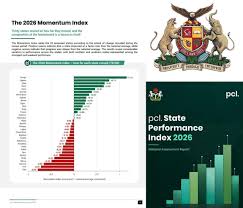
Abia State has climbed to second place in Nigeria’s 2026 State Performance Index, recording the biggest improvement in ranking across the three editions of the assessment by Phillips Consulting.
The revised report gave Abia a score of 0.55, placing it behind Jigawa State, which retained the top position, while Enugu State ranked third nationally. Abia also emerged as the highest-ranked state in the South-East.
The state Commissioner for Information, Prince Okey Kanu, announced the result in a statement on Monday, highlighting the scale of Abia’s movement over the three editions.
According to the statement, Abia ranked 36th in 2024, moved to 10th in 2025, and then rose to second in 2026, representing a gain of 34 positions from the previous edition.
Phillips Consulting initially released its 2026 National Assessment Report on July 23, 2026, using a single Momentum Index to rank states.
The firm subsequently reviewed its methodology, corrected identified errors and recalculated the results.
One of the major changes was the separation of current state performance from momentum, allowing the assessment to distinguish between where a state currently stands and how its position has changed over time.
Under the revised methodology, momentum is measured through changes in state rankings across the three editions rather than by comparing scores calculated using different scales.
This distinction is important because a state’s current position and its rate of improvement represent two different aspects of performance.
Beyond its overall ranking, the report identified citizen satisfaction as Abia’s strongest performance area.
The state recorded an absolute citizen satisfaction score of 3.92, which Phillips Consulting classified as “Good”, based on responses from 770 residents.
Residents gave the highest rating to government support for businesses, which scored 4.45.
Roads followed closely with a score of 4.42, while publicity of government policies recorded 4.33.
These figures suggest that residents surveyed by the assessment viewed some aspects of government support, infrastructure and communication more positively than other areas measured.
The assessment also revealed areas where residents expressed comparatively lower satisfaction.
Finding employment scored 3.12, making it one of the weaker areas in the citizen satisfaction assessment, while access to clean water scored 3.22.
Law-enforcement conduct received a score of 3.56.
The figures show that despite the state’s overall improvement in the ranking, citizen experience remains uneven across different aspects of public services and economic opportunity.
Employment, in particular, remains an important measure because improvements in government performance do not automatically translate into jobs or higher incomes for residents.
Phillips Consulting also examined Abia’s fiscal position, including revenue generation, debt and government spending.
The report put the state’s revenue self-reliance at 27 per cent, while internally generated revenue per capita stood at approximately N13,100.
Debt per capita was estimated at about N31,300, with the state’s debt-to-revenue ratio standing at 36 per cent.
Capital expenditure accounted for 70 per cent of the state’s spending in the assessment.
These indicators form part of the broader attempt to assess how states generate resources, manage their obligations and allocate funds towards development.
The 2026 revision also changed the way Phillips Consulting measures fiscal transparency.
The new approach considers whether states publish their audited accounts within the statutory deadline.
Under the revised methodology, states without qualifying audited accounts receive no score, rather than being assigned an automatic zero.
For Abia, Kanu said the revised assessment used the state’s 2025 audited accounts to calculate a transparency score of 0.38.
The initial report had instead relied on figures from the state’s 2024 accounts.
Phillips Consulting also changed its approach to measuring debt sustainability.
Rather than relying on a single indicator, the revised methodology considers both debt per capita and debt relative to revenue.
This provides a broader view of the pressure that public debt may place on a state’s finances, particularly when revenue-generating capacity varies significantly between states.
For Abia, the report’s fiscal indicators therefore form part of the wider assessment rather than serving as a standalone measure of governance performance.
The revised 2026 assessment produced a strong showing for the South-East.
Abia ranked second nationally, while neighbouring Enugu State came third.
Jigawa retained the number-one position in the overall performance ranking.
The result places two South-East states among the top three nationally in the revised assessment, although the ranking measures several dimensions of state performance rather than representing a single measure of development.
Phillips Consulting’s assessment is designed to provide a broader picture of state performance by bringing together several indicators.
These include citizen satisfaction, revenue performance, fiscal sustainability and transparency, while the separate momentum measure tracks changes in state rankings over the three editions.
This means the ranking should not be interpreted simply as a measurement of infrastructure or economic growth.
A state’s position reflects a combination of how residents rate government performance, how the state manages its finances and how its ranking has changed over time.
Abia’s movement from 36th in 2024 to 10th in 2025 and second in 2026 is the most significant ranking improvement recorded across the three editions, according to the revised assessment.
The change also illustrates why separating current performance from momentum can provide additional context.
A state may rank highly because of its present performance, while another may attract attention because of how quickly its position has changed.
For Abia, both elements are notable: the state now occupies second place in the current ranking while also recording the largest cumulative improvement across the three editions.
However, the lower scores recorded in areas such as employment and access to clean water indicate that a strong overall ranking does not mean every aspect of residents’ experience has improved equally.
Ultimately, the significance of the ranking will depend on whether improvements reflected in the assessment are sustained and whether they translate into better public services, stronger economic opportunities and improved living conditions for residents.