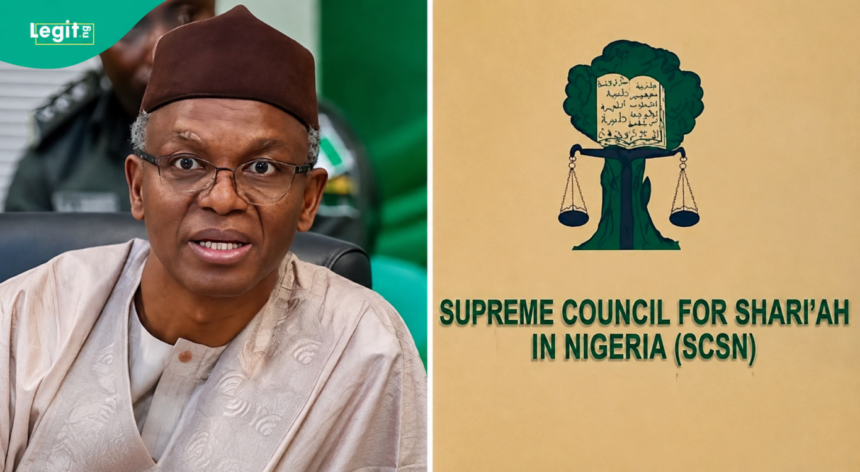
The Supreme Council for Shariah in Nigeria (SCSN) has called on relevant authorities to uphold the rule of law in the continued detention of former Kaduna State Governor, Nasir El-Rufai, amid his ongoing legal battles.
In a statement issued on Monday by its Secretary-General, Nafiu Baba Ahmad, the council expressed concern over the circumstances surrounding El-Rufai’s continued detention and reported difficulties in meeting the conditions attached to his bail.
The SCSN said such circumstances could raise concerns about compliance with established legal procedures and constitutional safeguards.
According to the council, El-Rufai, like every Nigerian citizen, is entitled to his fundamental rights and remains presumed innocent until proven guilty by a competent court.
The organisation stressed that Nigeria’s status as a constitutional democracy requires authorities to uphold due process, fair hearing and lawful detention, regardless of an individual’s political affiliation, status or disposition.
The council clarified that its intervention should not be interpreted as an endorsement of any alleged wrongdoing attributed to the former governor.
“The Council does not, under any circumstances, support or condone criminality in any form by anyone. However, the pursuit of justice must itself be just,” it said.
The SCSN warned that actions perceived as arbitrary or politically motivated could erode public confidence in government institutions and weaken democratic governance.
It therefore urged the relevant authorities to ensure that all stages of the legal proceedings comply with the Nigerian Constitution and other applicable laws.
The council also appealed to authorities to avoid actions that could be interpreted as political persecution, urging them instead to demonstrate fairness, transparency and commitment to the rule of law.
El-Rufai is currently facing legal proceedings over allegations connected to his administration as governor of Kaduna State.
The former governor is standing trial on a nine-count amended charge filed by the Independent Corrupt Practices and Other Related Offences Commission (ICPC). The allegations include abuse of office, fraud, irregular award and execution of public contracts, money laundering, conferring undue advantage and unlawful handling of public funds during his tenure.
Separately, El-Rufai is facing a five-count amended charge filed by the Department of State Services (DSS) concerning allegations of unlawful tapping of telephone conversations linked to the National Security Adviser, Nuhu Ribadu.
The legal proceedings have continued to attract political and public attention, with debates centred on the allegations against the former governor, his detention and the conditions attached to his bail.
The Sharia Council’s intervention adds to calls for the authorities to balance the prosecution of alleged offences with constitutional protections and the rights of an accused person.