
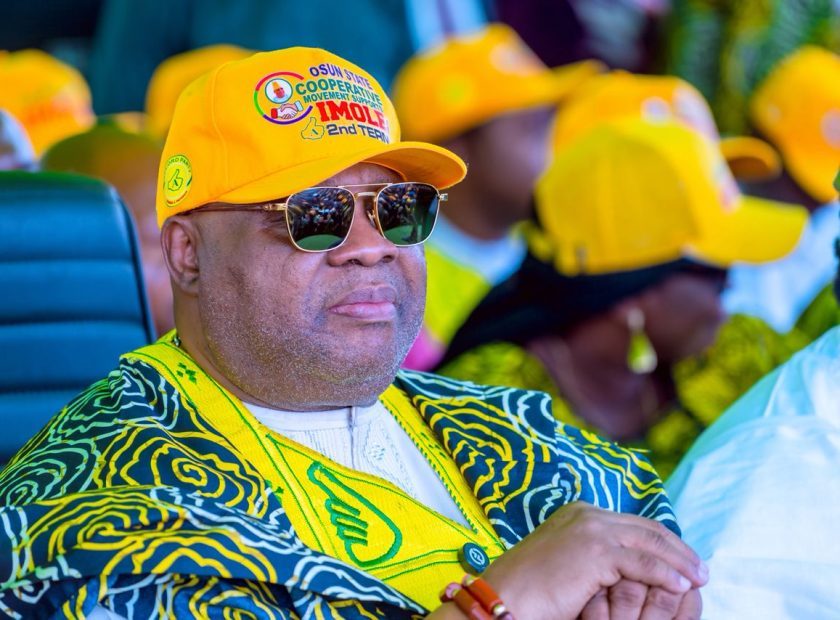
The 2026 Osun State governorship election has provided another important case study for understanding Nigeria’s evolving electoral politics. Beyond the victory of Governor Ademola Adeleke, the election offers important lessons about incumbency, voter behaviour, political organisation, electoral technology, vote-buying, opposition politics and the prospects for the 2027 general elections.
Governor Ademola Adeleke of the Accord Party was declared winner of the August 15 election after securing 511,067 votes, defeating the All Progressives Congress (APC) candidate, Bola Oyebamiji, who polled 444,815 votes. African Democratic Congress (ADC) candidate Najeem Salaam finished a distant third with 17,180 votes. Adeleke won 19 of Osun State’s 30 local government areas.
From a political science perspective, however, the significance of the election goes beyond the final figures. It provides useful evidence about how Nigerian voters, political parties and electoral institutions are behaving as the country approaches another major electoral cycle.
Incumbency Is an Advantage, But Not a Guarantee
One of the clearest lessons from Osun is the continuing importance of incumbency in Nigerian politics.
A sitting governor has access to political visibility, an established administrative record, a network of political actors and an existing grassroots structure. Adeleke was able to convert those advantages into a second-term victory.
However, incumbency should not be interpreted as an automatic guarantee of electoral success. Nigerian politics has repeatedly demonstrated that incumbents can lose when voters become dissatisfied with their performance, when opposition parties build effective structures or when internal divisions weaken the ruling party.
The Osun election therefore reinforces the argument that incumbency provides political capital, but the incumbent must still convert that capital into electoral legitimacy.
Governance Performance Matters
Another important lesson is the relationship between governance and electoral behaviour.
Adeleke’s campaign benefited from the ability to present his administration’s activities to voters as evidence of performance. His victory can therefore be examined through the concept of retrospective voting, in which voters assess an incumbent based on their experience of the administration before deciding whether to retain or replace it.
This has an important implication for Nigerian politicians.
Governments cannot depend entirely on campaign promises. Roads, education, healthcare, employment, infrastructure, social programmes and other tangible outcomes increasingly form part of the political conversation.
The election therefore reinforces a simple principle: performance must be communicated effectively if it is expected to generate electoral rewards.
Political Structures Remain More Important Than Social Media Popularity
The Osun election also demonstrates that political visibility is not the same as electoral strength.
The ADC entered the election amid significant national political attention surrounding the party and the broader opposition coalition. Yet its candidate, Najeem Salaam, secured only 17,180 votes and finished third.
This should be carefully studied by emerging political parties.
A party may dominate conversations on social media, attract prominent politicians and generate national excitement, but elections are ultimately fought at polling units, wards and local government areas.
Political parties therefore need functioning grassroots structures, credible agents, voter mobilisation networks and effective election-day logistics.
In political science terms, organisational capacity remains a critical determinant of electoral competitiveness.
The Osun Election Is a Lesson for the ADC
The performance of the ADC deserves particular attention because of the party’s growing relevance in Nigeria’s opposition politics.
Osun demonstrates that national political visibility must eventually be translated into local electoral organisation.
The party’s performance should not necessarily be interpreted as evidence that it has no future. Rather, it provides a useful diagnostic test.
The ADC now has to ask difficult questions: Does it have sufficient structures across the wards? Can it recruit and train polling-unit agents? Can it mobilise voters outside major urban centres? Can it develop strong candidates with deep local political networks?
If the party intends to challenge the established parties in 2027, Osun provides a clear lesson: coalition politics must be accompanied by grassroots organisation.
Vote-Buying Remains a Major Threat
Perhaps the most disturbing lesson from the election is that electoral technology has not eliminated vote-buying.
Election observers reported incidents of vote-buying and voter inducement during the poll. Yiaga Africa said the official results were consistent with its independent verification of ballots counted at polling units, but also raised concerns about widespread reports of vote-buying.
The Centre for Democracy and Development similarly described the election as largely peaceful while reporting vote-buying, technical challenges and isolated incidents of violence.
This presents a fundamental problem for democratic consolidation.
An election can have accurate result transmission and still suffer from compromised voter choice.
The challenge is therefore no longer simply how to prevent manipulation of ballot papers. Nigeria must also address the political economy that encourages citizens to exchange votes for money, food, gifts or other material benefits.
Technology Can Strengthen Elections, But It Is Not a Magic Solution
The Osun election also provides another important lesson about the role of technology in Nigerian elections.
The deployment of BVAS and the electronic transmission of results have increased the capacity to verify voters and improve transparency. Yiaga Africa said its independent verification showed that the official results corresponded with ballots counted at polling units.
However, observers also reported BVAS-related challenges. Dataphyte reported technical difficulties alongside largely peaceful voting, while the KDI reported BVAS failures in some polling locations.
The lesson is therefore not that technology has failed.
Rather, technology must be supported by institutional capacity.
INEC requires adequate technical preparation, trained personnel, reliable power and communication systems, contingency arrangements and rapid technical support at polling units.
Technology can reduce electoral malpractice, but it cannot compensate for weak institutions.
Voter Behaviour Cannot Be Taken for Granted
The Osun election also reminds political parties that voters are not permanently owned by any political party.
Electoral preferences can change according to performance, candidate popularity, local political calculations, party organisation and prevailing public sentiment.
This is why parties should be cautious about assuming that historical voting patterns automatically determine future elections.
Osun demonstrates the importance of treating every election as competitive and every voter as persuadable.
Opposition Parties Need a Stronger Strategy
For the APC, the election provides a particularly important lesson.
The party was able to secure 444,815 votes, demonstrating significant electoral strength, but it could not overcome Adeleke’s advantage.
The implication is that opposition politics requires more than criticism of an incumbent.
A successful opposition campaign must answer three questions clearly:
What is wrong with the current government?
What would we do differently?
Why should voters trust us to do it?
Without convincing answers to these questions, opposition parties may struggle to convert dissatisfaction into votes.
Peaceful Elections Are Possible, But Security Remains Critical
The Osun election was generally described by observers as largely peaceful, although there were reports of isolated incidents of violence, thuggery and disruption.
This is significant because Nigeria’s electoral history includes serious concerns about political violence.
The relative peacefulness of the Osun election demonstrates that competitive elections do not necessarily have to result in widespread violence.
However, the reported incidents show that security agencies must remain politically neutral, professional and sufficiently prepared.
The objective should not merely be to prevent violence. Security agencies must also create an environment where voters can make choices without intimidation.
Concession Is Also Part of Democratic Culture
Another positive development was the concession by ADC candidate Najeem Salaam, who congratulated Adeleke after the results were announced.
In a democracy, losing an election is not necessarily a political death sentence. Candidates and parties can challenge questionable processes through legitimate legal channels, but peaceful acceptance of credible results is essential to democratic stability.
Concession, where appropriate, helps prevent unnecessary tension and reinforces the principle that political office is temporary.
Osun Is a Warning Ahead of 2027
Perhaps the most important lesson from Osun is that the 2027 election will not be won through national popularity alone.
Political parties that want to perform strongly in 2027 must begin building their structures now.
They need effective ward-level organisations, polling-unit agents, voter education programmes, youth mobilisation strategies, women-focused outreach, credible candidates, strong communication teams and reliable election-day logistics.
The Osun experience demonstrates that elections are ultimately fought where voters are—not simply where political debates are trending online.
What Does Osun Tell Us About 2027?
The election should be viewed as an important political laboratory ahead of 2027.
It provides evidence that incumbency remains powerful, but performance matters. It shows that opposition coalitions can generate attention, but attention must be converted into votes. It demonstrates that technology can improve electoral transparency, but technological problems remain. It also shows that vote-buying continues to threaten the quality of democratic choice.
Most importantly, Osun demonstrates that Nigerian democracy is gradually becoming more institutionally competitive, but it remains vulnerable to the influence of money, political structures and electoral malpractice.
For political parties, the message is clear: build structures early.
For INEC, the message is equally clear: strengthen technology and logistics.
For security agencies: protect the voter rather than the political interest.
For civil society: continue monitoring the process and documenting violations.
And for voters: the power of the ballot is meaningful only when that ballot represents an independent political choice.
The Osun election therefore offers a broader lesson about Nigerian democracy: elections are not won by technology alone, money alone, incumbency alone or social-media popularity alone. They are won through the interaction of governance performance, political organisation, candidate credibility, voter mobilisation and the integrity of the electoral process.
As Nigeria moves towards 2027, Osun should therefore be studied not merely as another off-cycle election, but as an important indicator of the political forces, institutional challenges and voter dynamics that could shape the next national electoral contest.