
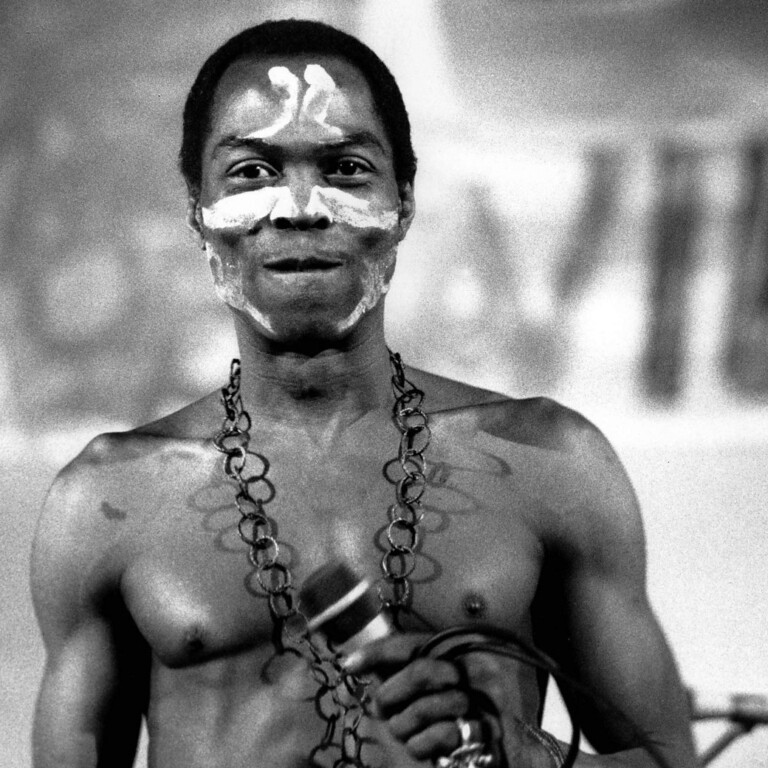
There are musicians who entertain, musicians who inspire, and musicians who challenge the world around them.
Fela Anikulapo Kuti did all three.
The Nigerian musician, composer, bandleader and activist created Afrobeat and turned it into much more than a musical genre. He used it to challenge corruption, military rule, police brutality and social injustice.
For decades, Fela stood at the centre of Nigeria’s cultural and political battles. His music filled dance floors, but his lyrics also forced listeners to confront uncomfortable realities.
He did not simply sing about Nigeria.
He confronted Nigeria.
The Family That Shaped Fela
Fela was born Olufela Olusegun Oludotun Ransome Kuti on October 15, 1938, in Abeokuta, Nigeria.
He grew up in one of Nigeria’s most prominent families.
His father, Reverend Israel Oludotun Ransome Kuti, worked as an educator and clergyman. His mother, Funmilayo Ransome Kuti, became a powerful anti-colonial activist and women’s rights campaigner.
Funmilayo’s activism deeply influenced her son.
She challenged colonial authorities and fought for the rights of Nigerian women. Fela watched her confront powerful institutions and eventually developed his own uncompromising approach to authority.
That rebellious spirit would later define his music.
Fela Chooses Music Over Medicine
In 1958, Fela travelled to London with plans to study medicine.
Instead, he chose music.
He enrolled at Trinity College of Music, where he studied trumpet and piano. He soon formed Koola Lobitos, a band that blended jazz with West African highlife.
The young musician had begun experimenting with different sounds.
However, he had not yet created Afrobeat.
That transformation would come through years of experimentation and a life-changing experience in the United States.
America Changes Fela
In 1969, Fela travelled to the United States with his band.
The trip exposed him to the Black Power movement and a new generation of political thinkers and activists.
He encountered ideas about African identity, racism, colonialism and political resistance that changed his worldview.
Fela returned to Nigeria with a different understanding of music.
He no longer viewed music simply as entertainment.
He saw it as a tool.
He could use it to educate people, expose injustice and challenge those in power.
From that point, his music became increasingly political.
The Birth of Afrobeat
Fela developed Afrobeat by combining different musical traditions.
He brought together Yoruba percussion, highlife, jazz, funk and soul. His powerful horn sections, heavy percussion, bass lines and extended performances created a sound unlike anything else in Nigerian popular music at the time.
His songs often lasted for several minutes, allowing the band to build tension through long instrumental passages.
Then Fela would deliver his message.
He often sang in Nigerian Pidgin English, which helped ordinary Nigerians connect with his lyrics.
People could dance to Afrobeat.
They could also hear themselves in it.
That combination helped Fela build a huge following.
When Music Became Protest
Fela’s music became increasingly confrontational as Nigeria experienced years of military rule.
He attacked corruption.
He criticized politicians.
He challenged the police and military.
He questioned the treatment of ordinary Nigerians.
One of his most famous songs, “Zombie,” directly mocked Nigerian soldiers.
Fela compared them to zombies who followed commands without questioning them.
The song became a huge hit.
It also intensified the government’s hostility towards him.
Fela had crossed a line.
He had turned popular music into political opposition.
The Rise of Kalakuta Republic
Fela eventually created the Kalakuta Republic in Lagos.
The compound became his home, recording space and communal centre.
It also became a symbol of his resistance to government authority.
Fela recorded music there, lived with members of his community and hosted musicians and supporters.
His band, Afrika ’70, became one of the most important groups in Afrobeat history.
Later, Fela formed Egypt 80.
As his popularity grew, so did the government’s pressure.
Authorities raided his properties, arrested him and disrupted his activities.
But Fela refused to stop.
The Attack That Changed His Life
In 1977, soldiers attacked Kalakuta Republic.
The assault devastated Fela and his community.
His mother, Funmilayo Ransome Kuti, suffered serious injuries after soldiers threw her from a window.
She later died from complications linked to those injuries.
Her death deeply affected Fela.
He responded with one of his most powerful protest songs, “Coffin for Head of State.”
He also turned his mother’s coffin into a political statement.
Fela and his supporters carried the coffin to Dodan Barracks, then the seat of Nigeria’s military government.
The gesture sent a clear message.
The government could attack him, but it could not silence him.
Fela Pays the Price for His Defiance
Fela faced arrests, harassment, raids and imprisonment throughout his career.
In 1984, the military government under General Muhammadu Buhari arrested him on charges involving currency offences.
The court sentenced him to prison, and he spent about 20 months behind bars.
Even prison could not stop his activism.
After his release, Fela continued recording music and criticizing the government.
His songs remained political.
His performances remained provocative.
And his audience continued to grow.
Fela Rejects His Colonial Name
Fela also challenged colonial influence through his identity.
He dropped “Ransome” from his name and adopted “Anikulapo.”
The Yoruba name carries the idea of a person who holds death in a pouch.
The change reflected Fela’s rejection of colonial identity and his stronger embrace of African culture.
His identity became part of his message.
His clothes, language, performances and music all reflected his vision of African independence.
The Complicated Man Behind the Legend
Fela’s legacy does not come without controversy.
His political courage remains widely admired, but his personal life continues to attract debate.
He married 27 women in a single ceremony in 1978.
His views about relationships and women have also drawn criticism, especially from modern audiences.
These contradictions make Fela difficult to reduce to a simple hero narrative.
He could inspire people and provoke them at the same time.
He could fight oppression while holding personal views that many people now challenge.
Understanding Fela therefore requires us to examine the whole person, not just the legend.
Fela Turned Music Into Journalism
One of Fela’s greatest contributions came from the way he documented Nigerian society through music.
His songs often responded directly to events around him.
He sang about corruption.
He sang about police brutality.
He sang about military oppression.
He sang about poverty.
He sang about political hypocrisy.
In many ways, Fela turned his music into a form of journalism.
His songs captured the mood of a country struggling with political instability and authoritarian rule.
Decades later, those songs still provide a window into the Nigeria of his time.
Fela’s Pan African Vision
Fela’s activism eventually moved beyond Nigeria.
He embraced Pan Africanism and criticized colonialism and foreign influence across Africa.
He wanted Africans to take greater control of their political, economic and cultural destiny.
His music therefore carried messages that reached beyond Nigerian borders.
People across Africa connected with his ideas.
Eventually, musicians and activists around the world discovered his work.
Afrobeat began its journey from Lagos to the global stage.
The Death of a Legend
Fela died in Lagos on August 2, 1997, at the age of 58.
His death shocked Nigeria and the international music community.
Thousands of people gathered to mourn him, while reports at the time placed the funeral crowd at more than a million people.
But Fela’s death did not end his influence.
Instead, his music reached new generations.
His sons, Femi Kuti and Seun Kuti, continued the Afrobeat tradition and built their own international careers.
At the same time, musicians around the world began drawing from Fela’s rhythms, political songwriting and performance style.
From Lagos to the World
Fela’s influence now stretches far beyond Nigeria.
His music has inspired artists across Africa, Europe and the United States.
His story has reached international audiences through documentaries, books, exhibitions and the Broadway musical “FELA!”
His records have also received major recognition decades after his death.
In 2025, “Zombie” entered the GRAMMY Hall of Fame, cementing its place in music history.
Then, in 2026, the Recording Academy honoured Fela with a GRAMMY Lifetime Achievement Award.
The Rock & Roll Hall of Fame also inducted him in 2026, recognizing his influence on global music.
Those honours highlight something Fela understood long before the world fully recognized it.
African music could stand on the biggest stages without abandoning its identity.
Why Fela Still Matters
Fela died almost three decades ago, but his questions remain relevant.
Who holds leaders accountable?
What happens when governments abuse power?
What happens when ordinary citizens lose their voices?
Can music challenge injustice?
Fela answered those questions through his life and work.
He showed that an artist could become a political voice.
He showed that African rhythms could carry global influence.
He showed that entertainment could also challenge society.
Most importantly, he refused to separate his art from his beliefs.
The Legacy of Fela Kuti
Fela Anikulapo Kuti did not simply create Afrobeat.
He created a movement around it.
His music carried the rhythms of Yoruba culture, the energy of jazz and funk, the spirit of African independence and the anger of a man who refused to remain silent.
He challenged governments.
He confronted soldiers.
He mourned his mother through music.
He went to prison.
He rebuilt.
And he kept singing.
Today, Afrobeat continues to evolve, but Fela’s influence remains at its core.
His music still fills clubs.
His songs still provoke conversations.
His story still inspires musicians.
And his name still represents the power of an artist who refused to look away from the problems around him.
Fela Kuti spent his life turning music into a weapon.
Decades after his death, that weapon still speaks.