
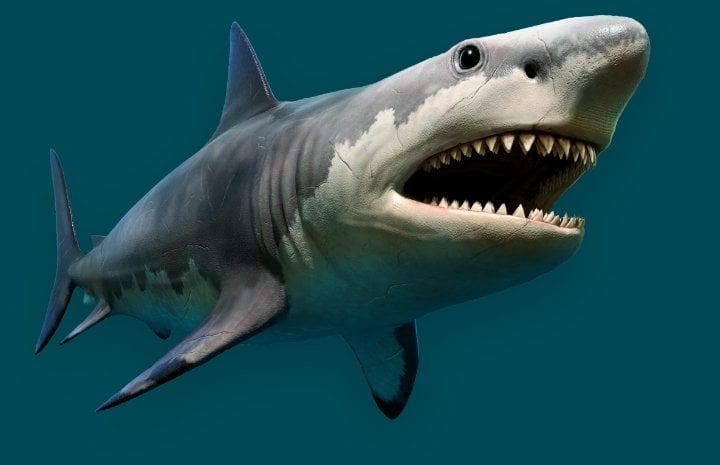
Long before humans entered the oceans, a massive predator dominated the seas, its teeth were larger than a human hand, its jaws could open several feet wide and its body may have stretched nearly 80 feet.
This was the megalodon, scientifically known as Otodus megalodon.
The name means “big tooth,” a fitting description for the largest shark known to have lived, the prehistoric predator inhabited warm oceans around the world for millions of years before disappearing roughly 3.6 million years ago.
Today, only its enormous fossilized teeth and a few vertebrae remain. Yet those remains reveal just how terrifyingly powerful this ancient shark was.
A Shark Bigger Than Any Living Species
Scientists estimate that adult megalodons commonly reached about 50 to 60 feet in length. However, recent fossil analysis has pushed estimates even higher, suggesting that some individuals may have exceeded 79 feet.
That size dwarfs the modern great white shark.
The megalodon also had a heavily built body rather than simply looking like an oversized great white. It belonged to the extinct shark family Otodontidae and developed physical features suited to hunting enormous marine animals.
Its teeth provide some of the clearest evidence of its size.
The shark had more than 200 large, serrated teeth arranged in several rows. Some measured about seven inches long. When one tooth broke or fell out, another could move forward to replace it.
That constant supply of teeth gave the predator an effective weapon for tearing through thick flesh.
A Bite Built for Giants
Size alone did not make the megalodon a formidable predator.
Its jaws delivered enormous force.
Estimates of its bite strength vary, but some studies place its maximum bite force at more than 40,000 pounds of force. That would have allowed it to attack prey far larger than the animals targeted by most modern sharks.
Its enormous mouth also helped it consume large pieces of prey.
Scientists have estimated that its jaws could open to around 10 feet. At that size, a megalodon could take a huge bite from a whale rather than relying on repeated small attacks.
The shark therefore had the combination that every apex predator needs: size, power and an efficient hunting strategy.
What Did the Megalodon Eat?
The megalodon did not survive on small fish.
Instead, it targeted large marine mammals, including prehistoric whales, dolphins, seals and sea cows.
As whale populations expanded during the period when megalodons lived, the enormous mammals provided an abundant source of food.
The shark likely attacked from below, using surprise and its powerful jaws to injure prey before delivering another attack.
Its hunting style may also have involved targeting vulnerable parts of large animals. Scientists have found fossil evidence of whale bones bearing tooth marks that match the size and shape expected from megalodon attacks.
With such a huge body, however, the predator needed enormous amounts of food to survive. Some estimates suggest that a large megalodon could have required thousands of pounds of food.
It Was More Than a Giant Shark
For years, popular illustrations portrayed the megalodon as a gigantic version of today’s great white shark.
Scientists now know that picture was too simple.
Megalodon belonged to a different evolutionary lineage. Its body was likely more robust and heavily built than the streamlined shape often shown in movies and documentaries.
Researchers continue to study its fossil remains to understand exactly how the animal looked and moved.
Because sharks have skeletons made largely from cartilage, their bodies rarely fossilize. That creates a major challenge for scientists.
Most of what researchers know about megalodon comes from its teeth.
Its teeth were made of hard enamel and fossilized far more easily than its cartilage-based skeleton. Fossilized megalodon teeth have appeared in marine deposits across the world, providing evidence of its enormous geographical range.
Where Did Megalodon Live?
The giant predator inhabited warm waters around the world.
It likely preferred coastal and shallow marine environments where large marine mammals were plentiful. Scientists have also identified evidence suggesting that megalodons used warm coastal areas as nursery grounds.
These environments would have provided young sharks with protection and access to food while they developed.
The discovery of possible nursery sites shows that megalodons did not simply roam the open ocean throughout their lives. Their survival also depended on suitable environments for reproduction and the development of young sharks.
Why Did the Megalodon Disappear?
For more than 20 million years, megalodon remained one of the dominant predators in the world’s oceans.
Then, its reign ended.
Scientists generally link its extinction to several environmental and ecological changes rather than one single event.
Global temperatures began to fall. Ocean ecosystems changed. Many marine animals shifted their ranges, while some large prey species became less available.
At the same time, competition increased.
Other marine predators emerged and expanded their ranges, including early relatives of today’s great white sharks and killer whales. These animals competed for some of the same food sources.
Young megalodons may have faced particular pressure because smaller sharks depended heavily on warm coastal environments that were changing.
Together, these pressures may have made survival increasingly difficult for the giant predator.
Could Megalodon Still Be Alive?
The idea of a living megalodon continues to fascinate people.
Movies, social media posts and viral videos have fueled claims that the enormous shark could still exist somewhere in the deep ocean.
Scientists, however, have found no credible evidence that megalodon survived.
The animal disappeared from the fossil record millions of years ago. Researchers would also expect to find fresh teeth, carcasses, bite marks or other evidence if a population still existed.
The deep ocean cannot simply hide an animal of this scale indefinitely.
A living population would need a huge and reliable supply of food. It would also leave biological evidence behind.
There is currently no scientific evidence of such a population.
The Legacy of the Megalodon
Although the megalodon vanished millions of years ago, its reputation has only grown.
Its enormous teeth continue to turn up in fossil beds, museums and private collections. Each discovery gives scientists another opportunity to understand one of the most extraordinary predators in Earth’s history.
The shark’s story also shows how powerful animals can disappear when environmental conditions change.
For millions of years, megalodon sat at the top of the marine food chain. Nothing living today comes close to matching its combination of size and predatory power.
Yet even this ocean giant could not survive forever.
The megalodon is gone. Its teeth remain as reminders of a time when a nearly 80-foot predator hunted the world’s ancient seas.