
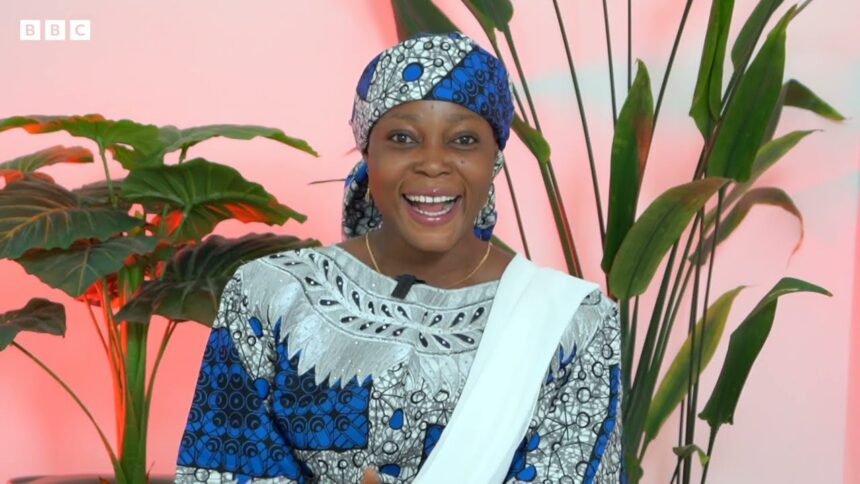
Veteran Hausa dubbing actress Hauwa Musa Abdullahi, popularly known as Mufi or Moofy, has disclosed that she once provided the voices for as many as 20 different female characters in a single Indian film, with many viewers never realizing that one person voiced all the characters.
Speaking in an exclusive interview with RFI Hausa, the celebrated voice actress opened up about her journey into the Hausa dubbing industry, the challenges facing the profession, her departure from Algaita, and the lessons she has learned from years in the entertainment industry.
A Gift She Says Came From God
Mufi attributed her extraordinary vocal range to a natural talent bestowed upon her by God, explaining that she can effortlessly switch between multiple character types.
According to her, she can convincingly portray the voices of an elderly woman, a young lady, a female thug, loud and chaotic personalities, and highly energetic, talkative characters.
During the interview, she demonstrated how she manipulates her voice, including holding her throat in a particular way to produce the convincing voice of a very old woman.
The veteran actress revealed that her versatility often allowed her to perform numerous characters in a single production without audiences noticing they were listening to the same person.
“I once voiced about 20 female characters in one Indian movie, and many people never knew it was me,” she said.
From Medical Records to Entertainment
Away from the entertainment scene, Mufi has an academic background in healthcare.
She earned both a National Diploma (ND) and Higher National Diploma (HND) in Medical Health Record and Information Management from the Malam Aminu Kano Teaching Hospital.
She completed her National Youth Service Corps (NYSC) programme in Duguri before serving at General Hospital Dutse in Jigawa State.
She also trained as a flight attendant at the Lagos Aviation Academy, highlighting a career path that extended well beyond entertainment.
She Didn’t Join Algaita as a Dubber
Contrary to popular belief, Mufi said she did not initially join Algaita to become a voice-over artist.
According to her, she was introduced into the organisation as a singer through her father figure, MSK, alongside Buzu Dan Filani.
Her breakthrough into dubbing came unexpectedly during voice auditions for the film 300 Spartans, where her vocal ability impressed producers and opened the door to a successful career in voice acting.
She explained that her natural speaking voice became associated with youthful female characters, making her one of the industry’s most recognizable voices.
“So many people recognise my voice in markets or even inside tricycles (keke),” she said.
Dubbers Don’t Choose the Movies
Responding to claims that dubbing companies determine which Indian films reach Hausa audiences, Mufi clarified that the process works differently.
She explained that clients are responsible for selecting the movies they want translated, while Algaita simply provides dubbing services before returning the completed master copy.
“We don’t choose the films. Clients bring them to us, we dub them and hand back the master copy,” she explained.
Why She Left Algaita
Mufi also addressed long-standing speculation that her departure from Algaita followed disagreements with management.
She firmly dismissed those claims, insisting there was no conflict between her and the company’s founder, Buzu Dan Filani.
According to her, she left only because she found another opportunity she considered more rewarding.
“Wallahi, nothing bad happened between me and Buzu. I found something better than voice-over, that’s why I left. He is my boss, and I will forever be grateful to him,” she said.
Industry Facing Decline
Reflecting on the current state of Hausa dubbing, Mufi expressed concern that the profession has lost much of its value.
She blamed the decline on poor financial rewards and the growing number of inexperienced individuals flooding the market with low-quality productions.
According to her, some newcomers release between 10 and 11 dubbed films every week, making it difficult to maintain professional standards.
She lamented that despite the hard work required to produce quality dubbing, financial returns remain disappointingly low.
On Claims Dubbers Hurt Kannywood
The veteran actress also responded to allegations that Hausa dubbing contributed to the decline of Kannywood films.
She rejected the accusation, arguing that dubbing merely introduced audiences to a new style of entertainment.
According to her, viewers became fascinated by the seamless combination of Hausa dialogue with Indian actors’ performances, temporarily shifting attention away from locally produced films.
“It wasn’t our fault. People simply loved the new experience of hearing Hausa voices perfectly synchronized with Indian actors,” she explained.
Lessons from Stardom
Looking back on her journey, Mufi admitted that one of her greatest regrets was ignoring her father’s advice that fame would not last forever.
She also spoke emotionally about being betrayed by someone she described as her best friend, saying the individual created problems between her and her father.
Rather than dwell on the experience, she said she has left the matter to God.
Today, Mufi says her priorities have changed.
She now encourages young people, particularly girls, to pursue education alongside their talents and hopes to live a peaceful family life dedicated to raising children with both Islamic and western education.
Her story reflects the evolution of one of the most recognizable voices in Hausa dubbing—a performer whose talent entertained millions, even when audiences never realized how many characters they were hearing came from a single voice.